Too often, laundry areas are given little thought in the design of a house. The washer, dryer, and sink, if there is one, are just lined up against the wall of a mudroom or even relegated to the basement because the homeowners don’t want to lose precious floor space upstairs. But considering how often it gets used, a poorly thought-out laundry area usually proves inadequate. That’s why, in my work as a kitchen and bath designer, I am often asked by homeowners to incorporate the laundry into a remodeling project. Most requests are simple: provide counter space for sorting and folding clothes, a hanging rod for clothes to drip dry, a small storage area for detergents, good lighting, and a small wastebasket for cleaning the dryer vent. Some clients expand on these requests to include amenities like a pull-out spray faucet, a built-in ironing board, a laundry chute and dirty clothes hamper, and recycling-type bins for sorting the laundry.
Design Considerations
There are no established guidelines to follow like there are in designing a kitchen, but here are some tips for laying out an efficient laundry room.
Appliance specs.
Always check with the homeowners to make sure that you have the exact brand and model numbers of the washer and dryer so you can verify the dimensions, clearance, and hookup requirements. Remember that the dryer will most likely need to be vented to the outside, which may affect exterior aesthetics. Also, try to keep the duct as short and straight as possible, to remove moisture effectively and maximize dryer efficiency. Watch the dryer door.
Remember that the dryer door may be left open while clothes are being folded. Try to avoid conflict with passage doors and leave enough floor space for the user to walk around the open door. Top-loading machines should also be checked for clearance: Measure the door in its highest open position, then add at least 6 inches for hand room. Wet zone.
It’s a good idea to place the sink next to the washer so that all the plumbing and water sources are contained in one wet zone. You may even want to discuss the possibility of incorporating a floor drain in this area of the room in case of an accidental overflow — especially important for upper floor laundry areas with living spaces below. Installation of a floor drain can be handled just like a custom tile shower base (see “Mortar Bed Shower Floors,” 4/98), though instead of an expensive waterproofing membrane you could use a 60-minute felt paper under the finish floor. For best results, the floor should be slightly sloped toward the drain. Another option is to place the washer in a plastic shower base or plastic tray that is plumbed to a drain. The limitation of this approach is that the shower base may only catch overflow from the washer itself. In a case I recently heard of, the washer hose broke at the hookup, spraying water out of the laundry closet and resulting in $20,000 damage to the home — even though the washer was sitting in a shower pan with a plumbed drain. If a hanging bar for dripping clothes is requested, this should also be contained in the wet zone. A small bar hanging directly over the sink will generally suffice, or the area can be expanded with a countertop drain board.
Cabinets
Even the smallest design should include wall cabinets or open shelving over the washer and dryer, and a base cabinet for the sink. From there, you can build to meet the homeowner’s desires. Some of the available units allow for a more built-in look, like the stacking units enclosed with end panels in Figure 3. Higher-end washers and dryers, such as the Asko brand, fit under a countertop — which saves space by providing the counter area above for sorting and folding. There are a host of built-in fold-down or pull-out ironing boards available. When placing the ironing board, make sure that there is enough floor space to walk around both sides and the end of the board when it’s open. Another option is to provide a tall cabinet to store a freestanding board. Extra base cabinets are always welcomed because they can house a pull-out wastebasket for cleaning the dryer vent trap and disposing of dryer sheets, a hamper for storing dirty clothes, or bins for sorting loads of laundry. Additionally, these base cabinets will increase counter area, which is always welcome in a laundry.
Lighting
Finally, good lighting is critical to a successful laundry room design. General lighting should be supplemented with task lighting in at least two areas: at the sink, to help the client treat soiled clothes, and at the folding area, so that dark socks can be matched correctly.
The Small Plan
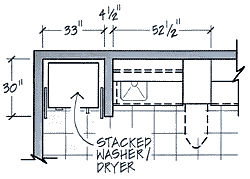
A workable laundry area doesn’t necessarily require a lot of floor space. The laundry in Figure 1 incorporates the washer and dryer, a sink, some counter space, an ironing board, and several shelves and cabinets — all in less than 20 square feet.
Figure 1. This small laundry center occupies less than 20 square feet, but contains all the elements: Washer, dryer, sink, ironing board, clothes rod, and storage. | |
This design can easily be incorporated into one end of a kitchen. Using a stacked washer/dryer in its own closet allows the unit to be hidden behind doors when it’s not in use. A 36-inch-wide base cabinet includes a sink for hand washables, while the 12-inch-high cabinet above leaves space to hang a laundry pole. The 15-inch-wide by 24-inch-deep cabinet at right opens to reveal a fold-down ironing board and storage.
The Medium-Size Laundry
The laundry area in Figure 2 works well when you have a little more space at your disposal.
Figure 2. The author has used this design to convert a walk-through mudroom into an organized laundry. The sink, drip-dry rod, folding area, and storage are on one side; the washer/dryer and shelving line the opposite wall. | |
This plan, which takes up 36 square feet, might be used to replace a walk-through mudroom. The utility sink is set in the center of three 24-inch-wide base cabinets, while two 18-inch-wide upper cabinets anchor two laundry poles. The washer, dryer, and shelves are on the opposite wall.
A Large Laundry
The laundry in Figure 3 occupies 55 square feet.
Figure 3. This laundry design includes lots of storage in its 55 square feet of floor space. The base cabinet to the left of the washer/dryer contains a pull-out ironing board. | |
At the left end are 12-inch-wide curved base and wall cabinets, followed by 18-inch-wide cabinets. Three Plexiglas bins on the counter hold detergents; the base unit holds a pull-out ironing board in its drawer. Next, the stacked washer/dryer fits snugly between two full-height end panels, with a 12-inch-high wall cabinet on top. To the right, base storage includes a 12-inch-wide cabinet, a 36-inch corner sink cabinet, and a 36-inch cabinet. Above, the laundry pole hangs between the washer/dryer and the 24-inch-wide upper cabinet, which also has an 18-inch-high working door.