By Georgie Kajer, AIA, and Scott Uriu, AIA
Thanks to Southern California’s mild, dry climate, outdoor living and entertaining have always been popular here. In the past, those sorts of activities often took place on a simple backyard patio. But in recent years, there’s been a trend toward more elaborate, better-designed outdoor living spaces.
In part, this may stem from a corresponding trend toward smaller building lots. Homeowners want their houses to “live larger” than they are, and one way to achieve that is to replace underused, undifferentiated yard space with areas that have been specifically designed for sitting, eating, and socializing. Depending on the situation, this can involve anything from tweaking an existing patio by providing shade and improved access to the house to using reinforced concrete to create a multilevel terrace on a steep slope. But the same basic design considerations apply to all outdoor living spaces, no matter how simple or elaborate they may be.
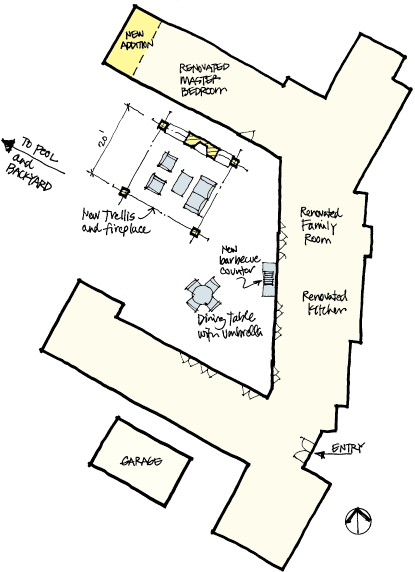
A plan view of the trellis project shows the relationship between the outdoor space and the renovated interior rooms. The small addition at upper left contains an indoor bathroom for the master suite and a smaller outdoor bathroom that’s conveniently near the pool and sitting area.
Developing a Master Plan
We find that many of our outdoor living space design projects are spinoffs of an indoor project of some sort. As part of the design process that goes into developing a new kitchen or master suite, we encourage clients to take a step back and consider the bigger picture of easing the connection between indoors and out. The response is almost always enthusiastic, even if it hasn’t been a specific goal of the work.
In many cases, there’s no way to stretch the project budget enough to do the outdoor work right away. But that’s why this sort of master planning is such a good idea: It allows you to do preliminary work that will save the customer a lot of time and money later on.
For example, even if there’s no money to install that set of French doors leading to the future patio, it may make sense to frame the door opening, document its location with a photograph, and run the wall finish over it. The plumbing, gas, and electrical connections to an outdoor barbecue area can be roughed into the outside wall so they’ll be there when needed.
A trellis “ceiling” over this outdoor sitting space gives the area around the outdoor fireplace the feel of an open-air room. The trellis was assembled from unpainted steel tubing to eliminate the need for intermediate supports; corner supports are reinforced concrete block faced with stucco.
Access and Traffic Flow
Usually, the connection between the house and the outdoor living space should take place through a semi-public area. This can be a challenge in a home from the 1920s or ’30s, in which the door to the backyard is ordinarily reached through the utility room. Today’s homeowners don’t want to escort their cocktail party guests past the washer and dryer. More contemporary homes generally have some orientation toward the outdoors to begin with, which may make it possible to work around an existing patio door from the living or dining room.
If there are children in the house, it’s best to avoid routing traffic through a formal living room. Locating the door in the family room is a good compromise. Like a family room, most outdoor living areas are fairly relaxed, informal spaces, so the two flow naturally into one another.
On this steep site, the floor of the upper terrace and porch also serves as the roof of the new basement-level family roomgame room below. The floor system consists of I-joists covered with plywood, a waterproof membrane, and brick in thinset cement. The curved lower stairs lead to the family room, while the straight stairs lead to the backyard and driveway.
A Sense of Enclosure
It’s convenient to think of outdoor living spaces as outdoor rooms or series of rooms. And like all rooms, they have walls, ceilings, and floors.
The exterior wall of the house often forms one wall of an outdoor living space. To create a comfortable sense of enclosure, consider adding one or more walls of wood, masonry, or even ornamental plantings. In general, wall heights should be kept fairly low to avoid blocking sight lines. From a practical standpoint, outdoor walls can also serve to block the wind, screen traffic noise, and provide shade.
Ceilings. Outdoor living spaces are often left open to the sky, but spaces that face west or south may call for a solid roof, or at least a partial one, for protection from the sun. If the orientation of the space makes a solid roof unnecessary, some sort of trellis roof can help provide a cozy feel. A trellis roof and its supports also make it easier to provide overhead lighting.
Floors. Just as indoor flooring doesn’t have to be the same throughout a house, patio surfacing can be varied to create the feel of different outdoor “rooms.” Stone, brick, and concrete are all popular patio surfaces. We like poured concrete with score lines and a water-wash finish because it’s inexpensive (about $7 per square foot in our area) and can be tinted almost any color.
We’ve also had great results with “poor man’s stone” — recycled slabs of concrete sidewalk, which are available from the city free for the hauling. They’re a consistent 3 1/2 to 4 inches thick, making them easy to work with, and when they’re closely fitted and laid like stone, they look great. Another option is washed gravel, placed over landscape fabric to prevent weeds from taking root.
The addition of a new bedroom wing to this two-story Mediterranean created a sheltered angle that was ideal for an outdoor living space. The roofed portion nearest the house provides a refuge from the afternoon sun. A new wall separates the driveway from the living area, but a gate provides easy access between the two.
Outdoor Conveniences
All outdoor living spaces have to provide at least one comfortable seating area. If space permits, it’s best to distinguish casual conversation areas from dining areas. Dining tables are typically tied to the location of the barbecue and kitchen.
Cooking. Outdoor barbecue areas can be plain or elaborate. With a simple barbecue counter, easy access to the kitchen is important. A barbecue area that includes sink, refrigerator, and other conveniences may become almost a kitchen in its own right and can be farther away. The barbecue should be convenient to use, but avoid making it part of the view from the living room.
Keeping warm. A growing trend here, completely in the spirit of outdoor gathering spaces in this climate, is the outdoor wood- or gas-fired fireplace. The gentle heat it provides makes it possible to linger outside for several hours longer than would otherwise be possible, and it is unmatched as a conversational focal point.
Georgie Kajer and Scott Uriu are architects in Pasadena, Calif.