Perhaps because they’re small, entry foyers are often designed with little thought. That’s a mistake, because a foyer has an important effect on how a visitor or homeowner feels about the rest of the house. Instead of seeing it simply as a small space for greeting guests and storing coats and boots, try thinking of the foyer as the introductory chapter of a good book — a well-thought-out space that sets the stage for what lies ahead, without giving away the story.
Sight Lines and Light
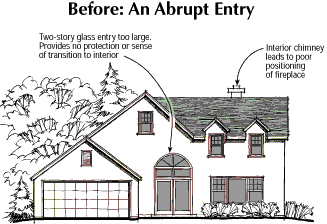
A set of plans that we recently revised for one of our clients provides a good case in point. The original plans featured a two-story glass entry (see Figure 1). It’s a common feature among recently built homes — especially where the homeowner’s real entry is the door leading from the garage to the kitchen — but the result can be cold and uninviting.
Figure 1. In the original plan, the exaggerated scale of the entry and the absence of any outdoor transition space leads to an “abrupt” feel that is not at all welcoming (top). Inside, the two-story foyer had additional problems (above), including uncomfortably exposed second-floor bedrooms, a poorly defined living room, and a direct sight line to the dirty dishes in the kitchen sink. Pajamas on parade. The original design also made the classic mistake of mixing the home’s private spaces with its more public ones. As drawn, the main stairs led up to a second-floor hallway, separated from the foyer below by only an open railing. Every trip between one of the upstairs bedrooms and the bathroom down the hall would have taken place in full view of anyone standing in the foyer. On the lower level, there was no clear boundary between foyer and living room, so neither space appeared to have a clearly defined purpose. Rather than emphasizing the fireplace — which should have been a natural focal point — the sight line from foyer to living room led to a window at its far end, which offered a view of the blank sidewall of the neighbor’s house.
A Made-Over Foyer
Our first step was to replace the original grand entry with a modest porch, so a visitor waiting for an answer to the doorbell wouldn’t have to stand out in the rain (Figure 2). That also cut down on the amount of daylight reaching the foyer itself, to good effect: Because people are instinctively attracted to light, the subdued lighting gave the well-lit spaces beyond a more welcoming feel. That would have been impossible to achieve in a foyer already awash with direct sun.
Figure 2. The author replaced the oversized glass entry with a simple porch, providing a sheltered place to ring the doorbell or fumble with house keys (top). The human-scale entry is more inviting and doesn’t flood the foyer with too much daylight. On the inside, the redesigned one-story foyer has a more comfortable feel, improved sight lines, and makes more efficient use of space (above). To visually separate the living room from the foyer, we added a set of French doors flanked by a pair of closets. Moving the fireplace from its original location between the living room and dining room to the far end of the living room was helpful in two respects. First, it made for a more balanced front elevation, by using the mass of the exterior chimney to offset the garage at the other end of the house. Second, it shifted the fireplace to the far end of the living room, where it provided a strong visual anchor to the view from the foyer. (An exterior chimney is admittedly more expensive and less energy-efficient than one located inside the building envelope, but visual gains in this case made the trade-off seem worthwhile.) Varying ceilings heights. We enclosed the redesigned foyer with an 8-foot ceiling to make the upstairs into a purely private space. Dropping the ceiling to 7 feet in the passage from foyer to kitchen — and casing the far end of the opening — gave each area a separate feel, without restricting movement between them. Lowering a ceiling in a transition space also has the effect of making the space beyond seem more spacious than it otherwise would. Alan Freysinger is an architectural designer and co-owner of Design Group Three in Milwaukee, Wisc.