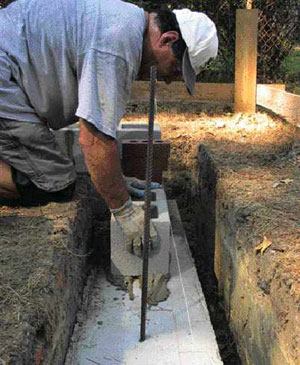
Placing a nice new home on top of a bare block foundation is like getting all dressed up for the prom and then wearing a pair of construction boots. So I like to build my foundations out of a combination of brick and block, a common method here in North Carolina.
Blocks — or CMUs (concrete masonry units) — are economical, come in different sizes, and lay up quickly, so they’re used below grade. Bricks are more expensive and take longer to install, so they’re saved for above-grade work, where they’ll show.
While most GCs will never lay the foundation for an entire house, brick- and block-laying skills can come in handy on small jobs when it’s tough to enlist a masonry contractor. In this article, I’ll use a small workshop foundation that I built to illustrate some of the techniques you need to confidently lay concrete block and brick. Except for the size of the units, there’s not a lot of difference between working with brick and with block.
Cutting Masonry UnitsOne way to cut masonry is with a brick hammer and chisel, but it’s an inaccurate and wasteful method that I use only for very rough work. Large, stationary masonry saws do a terrific job, but they’re expensive and a hassle to move and set up. Most of the time, I use two relatively inexpensive tools that are light and portable, yet produce excellent cuts. The first is my Elmer’s Midget Helper (about $400; E&R Mfg. Co., 765/279-8826, www.ermanufacturing.com), a portable brick-splitter I’ve owned for more than 25 years. Pulling down on its handle compresses the brick between two hardened blades; the tool works great for cutting bricks to length and for making the angled cuts needed for window sills (see photo, below). To cleanly and accurately cut — rather than break — brick and block, I use a dry-cutting diamond blade attached to my 4 1/2-inch grinder (blades are available to fit circular saws as well). This technique creates a lot of dust, so I use a high-quality dust mask. The 4 1/2-inch blade cuts only about an inch deep. With brick, though, I can usually finish the cut by making another pass on the opposite side of the brick. With block, I can usually break the block cleanly along the cut by tapping it with a hammer. This portable mechanical cutter — which weighs only 35 pounds — can be used to accurately break brick, stone, and concrete products. |
Lay Out to Avoid Cutting
Bricks and blocks are hard to cut, so it pays to think in terms of unit sizes when laying out masonry work. Since the 1930s, masonry units have been manufactured in sizes that fit into a modular scheme based on 4 inches. So while a standard block is 7 5/8 inches high by 15 5/8 inches long, adding a horizontal joint below (the bed joint) and a vertical joint on one end (the head joint) brings the unit to an even 8 inches by 16 inches.
A standard modular brick measures 2 1/4 inches high by 7 5/8 inches long. Three courses of brick with three bed joints add up to 8 inches in height, while a single brick with a head joint is 8 inches long.
Because they can be adjusted in size slightly, mortar joints provide some layout flexibility. While the ideal mortar joint is 3/8 inch wide, masons routinely shrink joints to as small as 1/4 inch or stretch them to as large as 1/2 inch. Joints that fall outside this range are unsightly and, with a few small exceptions, prohibited by most building codes.
Masonry units can be cut to length when necessary to fit around windows and doors or to build a foundation to precise dimensions (see “Cutting Masonry Units,” left). But cutting them along their length — what carpenters would call ripping — is another matter altogether. To avoid this aggravating job, masons usually begin course layout from the top, establishing a finish elevation and then measuring and marking down, in full courses, from that point.
In the small shop building shown here, for example, the reference point for the foundation was the projected top of the slab, which my client wanted a few inches above grade. Using batter boards, I set a string at this elevation for reference, then dug and poured the reinforced footing so that the top surface of the concrete would end up two full block courses and two full brick courses down from the string.
Block Dimensions Guide the Footing Layout
Choosing the Right Mortar
Probably nothing is more confusing to the lay mason than mortar mixes. And it’s not hard to see why: There are three different kinds of mortar available for brick- and block-work: cement-lime mortar, masonry cement mortar, and the awkwardly named mortar cement mortar.
Although they look pretty much the same, these are distinctly different products. Each can be made into four types of mortar, designated by the letters M, S, N, and O (taken from the word “masonry”). The letters indicate each type’s tested compressive strength, which is achieved by adding or reducing the percentage of portland cement in the mix. Type M mortar, for example, has the highest percentage of portland cement and the highest compressive strength, but for many applications it’s not the best choice.
Masonry cement mortar is the best overall choice for beginner masons. It’s inexpensive, easy to use, and the first choice for most residential masonry contractors. While cement-lime mortar and mortar cement mortar are frequently specified for large commercial projects, they are rarely necessary for residential work.
Generally speaking, Types M and S are used for foundations, for work under and in contact with the ground, and for flat work. Type N is a general-purpose mortar that can be used for loadbearing walls and exterior surfaces. It is usually recommended for vertical work above grade, such as brick veneer and chimneys. Type O is usually reserved for nonbearing walls not subjected to freezing temperatures. Because of local differences in climates, soils, and so forth, local codes concerning mortar requirements differ.
For the foundation shown here, I used Type S masonry cement mortar for both the block and the brick. This kind of mortar is required in my area for foundations and any work below grade.
Estimating Masonry MaterialsI begin each project by carefully estimating the square footage that will be built and adding in a factor of about 12 percent for cuts and waste. Next, I calculate the number of units needed based on the padded square-footage calculation, then determine the amount of mortar needed based on the number of units. Finally, I calculate the amount of sand I need based on the number of bags of mortar. I use the following formulas for my calculations. Units• 1.125 8×16 concrete blocks are needed for each square foot of wall area • 6.75 standard modular bricks are needed for each square foot of wall area Mortar• One 80-pound bag of masonry cement, mixed 1-3 with mason’s sand, lays 35 8×16 blocks • One 80-pound bag of masonry cement, mixed 1-3 with mason’s sand, lays 135 standard modular bricks Sand• 3 cubic feet of sand are needed for each bag of masonry cement • 1 cubic yard of sand is needed for every nine bags of masonry cement • 4.5 5-gallon buckets of sand = 3 cubic feet, the amount needed for each bag of masonry cement |
Mixing Mortar
Because premixed mortars are expensive, somewhat hard to work with, and sometimes of suspect quality, I recommend buying mason’s sand and mixing it with masonry cement on site, even for very small jobs. You can get mason’s sand at just about any masonry supply house and most building supply stores. It’s usually sold in very small quantities; my supplier sells it by the shovelful, the 5-gallon bucket, and the cubic yard (see “Estimating Masonry Materials,” left).
While some masonry crews mix mortar by the bag (a common recipe is to add 18 shovelfuls of sand for each 80-pound bag of masonry cement), I think that this method is inexact and makes too much mortar. A better way of mixing perfect mortar in manageable batches is to measure the sand and the masonry cement in buckets.
The recommended proportions are 1 part masonry cement to 2 1/2 to 3 parts sand. To make a fairly large batch of Type S mortar, therefore, I just fill up one 5-gallon bucket with Type S masonry cement and three equal-sized buckets with sand. I mix these together and add water until the proper consistency is reached to make correctly proportioned mortar that remains consistent from batch to batch.
To make a midsized batch, I fill up two 1-gallon buckets with masonry cement and one 5-gallon bucket plus one 1-gallon bucket with sand. To make a small batch, I fill up one 1-gallon bucket with masonry cement and three 1-gallon buckets with sand. This basic 1-to-3 ratio of sand to cementitious materials (the combination of portland cement, lime, and other additives that are used to make the various mortars) is the same for most mortars.