Working as a carpenter, my medium is generally wood, but like many builders, I often find myself cutting things like threaded rod, metal roofing, steel studs, and rebar. While I typically use a reciprocating saw or a circular saw with an abrasive blade for such materials, the resulting cuts are slow and usually a bit ragged. In search of a better method, I recently tested DeWalt’s DW934 Cordless Metal Cutting Circular Saw (DeWalt, 800/433-9258, www.dewalt.com) on a collection of steel tubing, angle iron, rebar, and sheet metal.
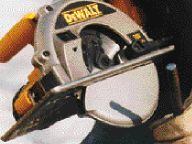
The DW934 metal-cutting saw looks a lot like an ordinary cordless saw, except for a larger all-metal guard. The substantial guard prevents metal slivers from becoming airborne and prevents hang-ups on thin material. Unfortunately, it also hampers visibility, and two little windows meant to make the cut line easier to see don’t help enough.
Features and Operation
Flying metal particles can be hot and dangerous, so the DW934 has a heavy, all-metal blade guard that’s noticeably wider than the guards on wood-cutting cordless saws. The guard keeps most of the flying metal chips under control, but it also reduces visibility of the cut line. To improve visibility, DeWalt has included two small windows in the guard, one on the front and another on the side.
The saw’s shoe adjusts easily for depth, and because it’s made of non-magnetic stainless steel, metal chips don’t stick to it. But it doesn’t tilt, so if you need to make beveled or compound cuts, keep that in mind.
An arbor lock helps with blade changes, and the blade wrench is stored on the saw housing. Aside from spinning a little slower (3,100 vs. 3,700 rpm), the saw is similar in appearance and operation to DeWalt’s 18-volt wood-cutting saw (model DW939).
Cutting Sheet Metal
Although I try to keep an open mind regarding new tools, I was a little concerned about cutting heavy-gauge steel with a carbide-tipped blade, so my first test was intentionally easy. I used the saw to cut 24-gauge sheet metal. It does an excellent job cutting straight lines, but like any circular saw, cutting a slight curve with even the thinnest material causes kickbacks, so I wouldn’t recommend it. If you need to make circular or curved cuts, this isn’t the right tool.
After cutting the 24-gauge sheet metal, I cut some 26-gauge spiral ductwork for a dust-collection system in my shop. It produced nice clean cuts and worked faster than my previous method, using a pneumatic cutoff tool with an abrasive wheel.
Six-inch spiral ductwork is tough to cut by hand, but by working his way around the duct, the author was able to make smooth cuts in under 30 seconds. Plunge cuts for a wye branch weren’t a problem, either.
Cutting Real Steel
After the initial testing on sheet metal and easily plowing through some 1/2-inch rebar, I was confident that the saw was up to cutting even heavier materials, so I set out to find its limit. When it was unfazed by my next material, 1/8-inch angle iron and bar stock, I tried high-strength, 3/16-inch-thick, 2-inch-square tubing. Although the saw is listed as having a 2 3/8-inch capacity, it lacked the power to cut all the way through this in one pass. I managed to get through it by cutting halfway through from one side and finishing with a second pass from the other side. While the saw produced a smooth cut, it was pretty slow, proving that it’s not a substitute for a metal-cutting chop saw.
The Verdict
Seeing your cut line with this tool is a challenge. The viewing window in front of the blade guard is almost completely useless, and the side window isn’t much better. Instead, I relied on the shoe’s guide slot for directing cuts. While the slot is effective for 3-inch or longer cuts, it doesn’t help with narrow pieces like bar stock and threaded rod. Trying to make it easier to see my cut lines, I used a number of different markers and crayons. Yellow marking crayons show up best in the viewing window, and a lot of light helps, too. This is one tool that would truly benefit from on-board lighting.
Visibility issues aside, the saw is an efficient, well-designed tool for light to medium metal-cutting applications. It cuts faster than an abrasive blade and is easier to handle than a recip saw, especially with the light-gauge steel and aluminum that I typically cut. While it’s not a replacement for a metal cutoff saw, it can cut steel angle and pipe pretty well, and it works great for long straight cuts in sheet metal.
I’m still on the fence about buying one. Even though it came in handy more than I thought it would, I don’t think I’d use it enough to justify the cost. However, I’m sure the DW934 would be great for hvac installers, electricians, plumbers, and anyone else who cuts metal regularly.
The DeWalt 934 sells for about $370 and comes with two 18-volt XR NiCad batteries, a 40-tooth carbide-tipped blade, and a blow-molded case.
Gary Godbersen is a carpenter and woodworker in northern Vermont.