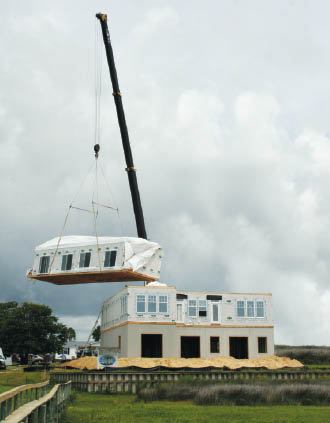
In a cost-competitive construction market, modular technology offers small-volume custom builders the efficiencies of factory-based mass production. The typical modular shell drops onto the foundation in less than a day — and includes plumbing, wiring, insulation, windows, and doors.
So what about the “custom” part? The public perception of modular homes is that they’re basic, boxy, and not very stylish. But the truth is it’s possible for a modular house to look every bit as sharp and unique as any fine stick-built home, as many architects and some modular manufacturers are demonstrating. Not only that, but they’re doing it along the East Coast on sites subject to high wind loads — proving that besides looking good, these factory houses can perform as well as engineered custom homes.
Adding Style
Architect Douglas Cutler designs modular homes for the high-end suburbs of New York City, including areas along Long Island Sound. It’s a market where style matters and, as Cutler points out, where the hand of a design professional can make a big difference in what a modular home looks like. From the choice of windows to the rooflines and massing of the structure, the modular-home designer has an almost free hand in combining traditional styling with custom expression.
“That’s where the architect shines,” says Cutler, “in the site-installed appliquƒ© that gives the home its character. I call it the fashion design.” Cutler readily admits that working within a palette limited by module box size imposes real constraints, but he insists that “99 percent of the homes out there could be done as modular homes.”
Open spaces. Modular homes arrive at the site in pieces, on the back of a truck, so the loads have to conform to state and federal shipping rules. Individual modules can be 16 feet wide at most and must be low enough to fit under a highway overpass. This limits ceiling heights to 9 feet in most cases, and means that large open rooms must be built from two modules. The trick is to divide the space with a double LVL ceiling beam. The two open boxes, each containing half of the beam, are mated together when the house is set to create one large room.
“With modular there’s what’s called shared space or double-wide space,” explains Cutler, “meaning the room is not limited to the width of a module. You can put a series of modules together and create a room that’s as long as you want. The cross-sectional span is limited to maybe 18 to 20 feet, but you could have a room that’s, say, 60 feet long by 20 feet wide, probably bigger than you’d need. You can certainly have rooms in a modular house that are just as large as rooms in a stick-built house.”
Structural Redundancy
Modular homes ship as a series of boxes, each of which must be stable enough to be lifted into place with a crane; this means that most packages contain structural redundancies. “For example,” says Cutler, “in a two-story package there is a ceiling on the first-floor module and a separate floor system in the second-floor module. And there are ‘marriage walls,’ where two walls meet face-to-face to make a single partition.” The redundant framing is there mainly to stiffen the individual boxes for shipping and setting, Cutler says, but he maintains that the method adds strength to the final product as well. And, he notes, many modular manufacturers use foam adhesive as well as screws to bond gypsum wallboard to studs, and may even glue and nail their plywood sheathing on exterior walls. “All these things cumulatively add up to a stronger building,” he says.
Trim makes the difference. Cutler has also learned to adapt that structural redundancy to his design purposes. On a recent project, he was able to selectively remove some of the ceiling joists in a first-story room to create a recessed coffered ceiling nearly 10 feet tall. He left the main girder intact to support the floor joists and marriage wall above, disguising it as one of the beams in the coffered ceiling; the other beams are fake.
Such trim details are a hallmark of Cutler’s style and help illustrate how a modular frame becomes a custom home. “The factories have limitations on how finely they can do interior detailing,” Cutler says. “They can do a decent door casing and a decent base mold, and even a crown mold. This can yield a very elegant room. But anything more involved than that — detailed rooms with built-in shelving and raised paneling — you’ll have to do on site, because it will slow their line down.”
Beachfront Modular
If Douglas Cutler has proved that modular homes can compete on style in the high-end market along the waterfront east of New York City, further south, on the coast of the mid-Atlantic states, modular builders face the challenge of building on sites where design wind speeds range from 120 to 140 mph.
Len Fairfield is a modular builder in North Carolina’s Onslow, Carteret, and Pamlico Counties. After owning his own business for years and setting houses from other manufacturers, he now works exclusively for HandCrafted Homes, a modular company in Henderson, N.C. Fairfield provides the customer with a turnkey product, from sales and design to move-in. In a typical year he sets 20 or more houses.
Engineering. According to Fairfield, the sales process involves a series of “sketches,” in which the prospective client’s basic wish list is worked out. Next, the design is turned over to the factory, where HandCrafted’s director of engineering, Jane Yates, and her staff review the plans in light of the region’s 130-mph design wind speed. They analyze the proposed structure to determine how it can handle the overturning, uplift, and shear loads that might be imposed by hurricane winds, then send the plans out for review by a licensed consulting engineer. Structural redundancy notwithstanding, Yates knows the standard modular kit isn’t always stiff enough to meet the extreme wind loads in the mid-Atlantic states the company serves, and she always assumes that some custom design engineering may be necessary.
“Thus far,” says Yates, “we haven’t had any problem with shear loads such that a floor plan would need to be changed. We do sometimes have to create an interior shear wall by reinforcing an existing partition, or we have to reinforce exterior walls, or strengthen a floor system to create a diaphragm.”
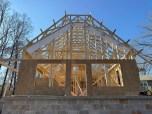
Case in point. A recent project illustrates the point (see photos on this page and facing page). Called Twin Gables, the design is the work of William E. Poole Designs, a stock plan company based in Wilmington, N.C., that recently created a portfolio of designs licensed to HandCrafted. A licensed builder himself, William Poole has sometimes been less than satisfied with the work of stick builders who have used his designs, but he is impressed with the quality coming out of modular factories. He visited and interviewed many modular manufacturers before choosing HandCrafted to build his designs, and says that most of them were “doing a superb job.”
The Twin Gables model was created with a beach location in mind, Poole says. Almost every room has an ocean view. The main living level includes large open spaces typical of beachfront vacation homes. “The great room in this house is 20 feet by 20 feet,” he says.
The first Twin Gables model was recently erected on a beach in North Carolina; Jane Yates supervised structural design, and Len Fairfield, the construction. To meet wind loads, says Yates, “we had to take two interior walls and make them shear-worthy. They were constructed as if they were exterior walls, with 7/16-inch OSB and nails, as opposed to standard gypsum board and screws.” All the exterior walls on the model are detailed as shearwalls, she says: “Most have standard 6-inch-on-center nailing, but a couple are nailed at 2 inches on center. I don’t think we had to double up any 7/16 sheathing — say, putting one layer on the inside and one on the outside to meet the requirements for shear. But that is something we could do if we had to.”
Like Douglas Cutler, Poole assigns a high priority to trim detailing and finish carpentry. Even his stock plans intended for stick construction include detailed drawings of every piece of trim, every built-in, and every cabinet. And he’s designed his own collection of millwork and trim profiles for synthetic molding maker Fypon. As for the Twin Gables house, carpenters spent weeks on site completing the exterior trim, decks, and porches, according to Fairfield.
Tying Down
Of course, no house gets built in a high-wind zone without due consideration to hold-downs. For a large house like the Twin Gables model, says Yates, wind uplift is a relatively minor concern. “Very big houses don’t tend to get picked up by wind,” she explains. “They tend to sit quite sturdy on their foundation, so we didn’t have to do anything horrible on the strapping. That house is strapped to the foundation at corners and around doors that are over 4 feet wide.”
In other cases, she notes, hold-downs have been a bigger deal: “Some time ago we did a three-story-high structure that was 15 feet wide by 40 feet long. Because of its tallness and narrowness, it required some pretty intense connections to the foundation. The likelihood of that tall narrow structure being toppled by the wind was far greater than most structures we do — which are typically nearly twice that wide and not so tall.”
Hold-down details also vary depending on the foundation type. For the Twin Gables project shown here, Len Fairfield was permitted to raise the grade at the site using engineered fill and an armored seawall bulkhead, so that the entire foundation could sit above the base flood elevation for that location. He then used a prefabricated concrete Superior Wall foundation to create a fully enclosed ground level, which gained an extra floor’s worth of living and storage space. The modular units shipped with Simpson Strong-Tie MSTA12 straps that were nailed to the double sill bolted to the top of the concrete perimeter wall. In addition to the straps, notes Yates, “we also toenail through the perimeter bands into the sill all the way around the house, at 4 inches on-center. Then we overlay that with a layer of OSB.” When the units are shipped, she explains, 18-inch-wide bands on the exterior wall are left unsheathed at the base and between stories so that site-applied lapping strips of sheathing can join the wall frame to the sill and the first story to the second story.
Pile foundations are prepared differently. The tops of the pilings are notched out to receive large girders, says Fairfield. “We run a double 2×12 band around, which is through-bolted to the pilings with a metal plate. The house sits down on top of that 2×12, and it all gets nailed together, the metal connectors get attached, and then the OSB goes down and also attaches to the band.”
Quality Checks
William Poole seems sold on the advantages of modular construction. Management makes the difference, he argues: “They have independent code inspectors who come through the plant frequently. And there is full-time supervision — the workmen have someone around all the time, seeing if they are doing it right. It would be impossible to do that in the field. So you are assured of a better-built house.”
Douglas Cutler agrees, and says that customers benefit further from the layers of professional oversight, which — like the redundant framing in the modular units themselves — provide added assurance of structural integrity. On a recent house, he says, “We had the design architect. We had the third-party engineer that the factory employs. We had another consulting engineer for the foundation — and the building official for that house was also an engineer. When you have that many professionals reviewing the design and the engineering, you’re going to have a good product. Is there a cost involved? Of course. But it is still relatively negligible, and look at what you get in terms of better performance and peace of mind.”
Ted Cushman writes about construction from his home in Great Barrington, Mass.