- Q. Why does mildew grow in the closet?
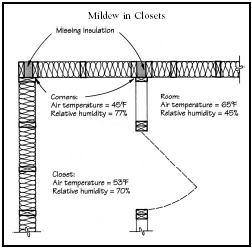
A.Marc Rosenbaum responds: To control mildew growth, we must first look at the relationship between air, water vapor, and relative humidity (RH). Water vapor is water in its gas form, and is present in air. The warmer the air, the more water vapor it can hold; the colder the air, the less water vapor it can hold. RH is a measure of how much water vapor is in the air compared to the maximum amount of water vapor the air can hold at that temperature. As air cools, without changing its water vapor content, its RH goes up. As the air continues to cool, it reaches the point where the water vapor it contains is all that it can hold — this is 100% RH. Cooling the air any further will result in condensation as some of the water vapor changes to liquid.
Mildew can only grow on surfaces where the RH exceeds 70%. Closet surfaces tend to be colder than adjacent rooms, because of poor air circulation from the heated room to the closet, and because, relative to their size, they often have more exterior surface area for heat to escape. A corner or cold wall section lacking proper insulation is particularly vulnerable. Since these areas are colder, but have just as much moisture in the air as adjacent rooms, they have higher RH and are prone to mold and mildew.
To control the mildew, we have to lower the RH of the closet below 70%. To do this, we either have to raise the closet temperature or lower the amount of water vapor present in the air.
When troubleshooting a closet mold problem, measure temperature and RH in the adjacent room with a sling psychrometer. If the room RH is 30%, then it will be difficult (and hard on the occupants’ respiratory systems) to reduce RH much, so look for ways to raise the closet temperature. Either increase heat flow into the closet (in some cases, louvered doors may permit enough heated room air to circulate; in other cases, you may have to put in some heat directly), or cut heat loss from the closet (add insulation, seal air leaks).
If the room RH is 50% or greater, look for ways to reduce the amount of moisture in the air. First, control the moisture at its source. Is it coming from a hot tub, lots of plants, or a gross of gerbils? Is it coming from the six cords of firewood drying in the basement? Next, if the problem occurs in the heating season, increase ventilation levels to replace humid house air with cold outdoor air holding little moisture. As a last resort, use mechanical dehumidification.
Closet mildew problems often occur with other moisture problems that the homeowner is not aware of, so a comprehensive “footing to ridge” assessment may be in order.
— Marc Rosenbaum, P.E., of Energysmiths, in Meriden, N.H., designs and engineers everything from hvac systems to solar, low-energy use homes.
Q&A: Mildew In Closets
Answers to the questions asked most often in the field
3 MIN READ