Designers sometimes use the phrase “prospect and refuge” to describe a pleasing environment that offers a good view of its surroundings while still providing a comforting sense of shelter. Our attraction to this type of setting runs deep: For most of human history, survival depended on scanning the horizon for saber-tooth tigers or raiders from an enemy tribe while staying within easy reach of a good defensive position or hiding place. The countless generations of distant ancestors who survived by doing that have passed that genetic trait down to the present day.
Or at least that’s one explanation. Whatever the reason, the prospect-and-refuge model seems to strike a chord with most people. Saber-tooth tigers or not, it’s a human trait that designers and builders need to respect.
How Not to Build
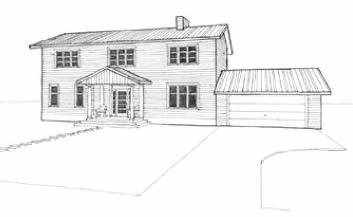
With that in mind, consider a typical new house on rural acreage. A two-story, center-hall colonial with an attached garage floating on an acre of bluegrass lawn offers no refuge other than inside the house itself. Garage door openers allow the homeowners to drive directly into the house, and once inside, they seldom venture outside again. Why should they? They’re exposed on all sides.
In this setting, a front porch usually doesn’t work very well. Where houses are close together — in an urban neighborhood or inner suburb — a porch can be an appealing place to spend time with friends and family, and wave to or chat with passing neighbors.
But when a house is isolated from any neighbors, there’s no one to socialize with. Rather than sit out front and feel that they’re being stared at by those driving by, the owners are likely to retreat to the house, leaving the porch an unused ornament.
Adding a back deck or porch may not be much of an improvement. The back of the house may offer more privacy, but the feeling of openness and exposure remains. The result, once again, is that the owners stay inside. And what’s the point of living in the country if you never go outside?
The Farmstead Model
One solution is to extend the house into the landscape to create smaller, more human-scale spaces. Traditional farmsteads offer designers and builders a perfect model for how to create a comforting sense of shelter on wide-open land. A farmstead is always composed of many different buildings. Humans feel sheltered, protected, and psychologically comfortable in the smaller spaces created between house and barn, machine shed, granary, and other outbuildings.
In new construction, the easiest way to extend the house into the landscape and define some smaller, more human-scale outdoor spaces is by separating the house from the garage. Other possibilities include turning a detached garage at a right angle to the main house, breaking the larger house into wings, or building outbuildings like storage sheds, pole barns, pool houses, gazebos, or freestanding screen porches.
In the slightly modified design, for example, the driveway now leads into a comfortable courtyard rather than shooting straight into the garage. The result is a sheltered, hard-surface space where small children can ride bikes and teenagers can play basketball. This simple space between two buildings provides a feeling of shelter and a sense of safety. A hedge helps define the space and accentuates the feeling of shelter.
Changing Orientation
An easy way to enhance the farmstead effect is to orient the front entrance of the new home porch toward the courtyard rather than the road. Adults can comfortably lounge on the front porch, watch their children play in the courtyard, and keep an eye on who’s driving by, all without feeling too exposed.
The tower included in this design cartoons the idea of prospect and refuge, creating a small space up high with a wonderful view out across the landscape. People love towers — from the Queen Anne designs of the last decades of the 1800s to more contemporary versions like this one — and the sense of safety they provide is probably why.
Turning the entry away from the road may seem radical, but it acknowledges the fact that formal front doors are rarely used today. That was also true of traditional farmsteads, where day-to-day activities centered around a side door facing the barns and outbuildings. A front entry, while usually present, was traditionally reserved for ceremonial occasions.
Using Landscape Elements
Elements like fences, rows of trees, and stone walls, and simple structures like a trellis or pergola can also be used to define a more protected outdoor space. A homeowner or guest sitting in this backyard is going to feel comfortably sheltered and protected on three sides.
Even more important, when you step out of this house, you always step into a protected transition space. The front door leads to a front porch, the kitchen steps out onto a patio beneath a trellis, and the master suite steps out onto a covered porch. Again, the homeowners will feel sheltered and protected, not exposed and vulnerable.
There’s often little money left for landscaping by the time the house is built, so a landscape like this one may take years to complete. Still, I believe that it’s important to offer the homeowners a long-term vision. Planning ahead makes it possible to site the most permanent elements — the house and garage — in the right place to begin with, rather than trying to develop a plan around them later.