Americans love their cars — along with any excuse for extra living space. So it’s no wonder that most new houses include garages containing additional space for a bedroom, an entertainment room, or a home office.
Unlike an attached garage, which can inflate the overall appearance of a house and block desirable light or views, a freestanding garage can be placed to shape a yard, create privacy for guests, or simply distance car activity from the main living space.
Considering how popular detached garages are, it’s well worth determining what makes one successful. From a design standpoint, several general factors come into play, including the number of cars to be accommodated, the nature of the second-level living space, and, of course, the context of the property.
The following examples offer solutions to a variety of garage requirements. Each design uses building orientation, massing, door types, and finishes to shape a structure that relates well to the human scale.
One-Car Garage
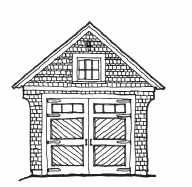
Placing the gable end toward the street is a natural choice for a one-car garage. Unlike two- and three-car garages, the single-stall building doesn’t have to struggle with scale issues. In fact, a small garage presents an opportunity to explore and refine a handful of elements in detail. Each component — roof, enclosing walls, windows, doors, and exterior finish — can be individually considered and shaped in concert with the others.
A few details on the elevation set this garage apart. The curved shingle brackets under the eaves play up the wide, sheltering roof. The oversized carriage doors with heavy hinges and diagonal planking establish a barnlike aesthetic that’s echoed by the central gable window. The trim band beneath the upper gable pediment signals a switch from regular 5-inch shingle coursing to alternating 21/2-inch and 5-inch coursing. The change in shingle texture clearly differentiates the more elaborate pediment from the base.
An oblique view of the shingle brackets reveals their function further; they receive the ends of a double track carrying sliding barn-style doors, which are glazed rather than opaque. When fully open, the doors hang in front of the large double-hung window. They allow the garage to be quickly transformed into an outdoor entertaining room overlooking a side yard or garden.
This view also reveals the exposed rafter tails, which — like the shuttered gable-end window accessed from a small storage loft — evoke a cottage look. Inside, the loft doubles as a nap shelf for the outdoor living space.
One-and-One-Half-Car Garage
If your garage customers are interested in more storage space for yard gear plus a second-level living space, but they can do without housing a second car, a one-and-one-half-car garage might fit the bill. Accommodating several uses under one roof requires some finessing, however, to reduce the building’s apparent overall mass.
The first scale-reducing move is to use a single overhead garage door designed to look like two traditional carriage doors. Here, these doors are offset by a covered opening that shelters a glazed entrance door to the interior stair — leading to the second-level bedroom — and an ancillary access door. The paired double-hung windows above echo the implied double doors below.
Because this building is longer than it is wide, it makes sense to orient the gable to the front, as in the one-car-garage example. In this case, though, the gable form has been tweaked. To keep the gable face from towering over the doors, a shed roof has been introduced off the front to push the gable face back. The pergola on the side recalls the front shed-roof slope and depth while creating a semi-sheltered passageway to the main house; both shed elements ease the transition from roof to ground.
Setting the shed-roof dormers back from both the gable end and the side walls reduces their massing and nests them comfortably within the roof. The pan, cut into the primary roof to accommodate the sills of the double-hung windows along the side, helps to further carve out mass.
Two-Car Garage With Shed and Gable-End Stalls
This outbuilding looks more like a rural barn than a suburban two-car garage — which largely explains its appeal. The gable structure most likely started out as a stand-alone one-and-one-half-car stall with a small second-level space above. As such, it probably appeared tall, though the knee-wall-height eaves are certainly better than full-height ones. The addition of the second, smaller lean-to stall helps modulate the structure’s height by bringing one of the eaves closer to the ground.
The charm of this building lies mostly in its seemingly ad hoc form. If constructed from scratch today as a two-car garage, it could be reconceived as a saltbox. An adjusted continuous slope from the ridge down to the lower eaves would allow the second stall to be full height while slightly increasing the headroom in the second-level space. Accessed from an ell-shaped interior stair terminating near the ridge, the upper floor could function as overflow storage, a small office, or play space.
If side-hinged carriage doors aren’t practical, overhead doors like those shown in the one-and-one-half-car example could be used. The result would be a familiar vernacular form reinterpreted for today’s needs.
Two-Car Garage With Side-Facing Gable
The front-facing saltbox discussed above is rotated here so that the garage doors occupy the side with the lowest eaves, which keeps the front wall from seeming too tall. This two-story building is dug into a hillside, allowing the slope of the primary front roof to echo that of the hill.
Several of the mass-reducing strategies employed in the one-and-one-half-car garage are used here as well. The structure’s front corners are recessed below the roof to reduce the breadth of the front wall and shelter the auxiliary entrance and the trash enclosure. A fully nested shed dormer and roof pan expand second-level living space while lessening the roof’s bulk. Overhead doors designed to resemble carriage doors visually scale down the large openings.
To maximize interior space, access to the second-level guest bedroom is on the exterior. A stone stair climbs the hill alongside a planter; a rear deck with more stairs continues the run to the second level. On the opposite gable-end wall, another set of deck stairs provides a second means of egress.
Katie Hutchison is an architect and the owner of Earthlight Design in Salem, Mass.