Maine Passive House, Part 1: Framing Meets Air-Sealing~
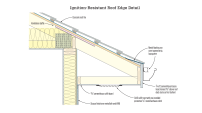
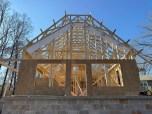
Work continued in July and August on builder Chris Corson’s passive house in Knox, Maine, under construction for Belfast couple Matt and Heather Diko. Adverse weather, a detour to finish up an unrelated basement remodel, and the crew’s unfamiliarity with the house’s advanced framing details slowed progress in the early going. But by last week, Corson and his EcoCor Design/Build crew were framing the roof. Said Corson, “The idea is to build this house using methods that any typical builder in America would be able to learn, and that a typical home-buyer could afford.” Above, Corson and his crew set a header for a large window on the home’s west wall. The load-bearing inner frame’s window openings are packed out with engineered rim-joist material to allow the European-made high-performance windows to be set at mid-wall (see drawing below). But this departure from standard framing required the crew to slow down and think twice about rough opening dimensions. “We couldn’t just follow our old habits,” said Corson — one window opening had to be re-framed after a layout mistake. Here’s a closer look at the wall framing and air-sealing in progress. The building’s airtight envelope concept is based on attaching and air-sealing an OSB skin over the inner, load-bearing 2×4 wall frame, before the outer insulated shell of foot-deep vertical wood I-joists is attached. This inner airtight layer is simply typical OSB sheathing — except for the tape seals applied at all joints and penetrations, and the fact that the OSB layer is buried deep inside the 16-inch-thick wall assembly. The outer sheathing for the I-joist second skin, when that layer finally goes on, will be a more vapor-permeable fiberboard product. Corson calls this assembly, passed to him by Passive House Institute US director Katrin Klingenberg, a “hybrid wall.” He argues that the system achieves the advantages of a full double-stud-wall frame, but with simpler construction and air-sealing detailing — and, arguably, with better thermal breaks. Air-sealing the OSB layer for the inner wall assembly on site is simple enough: The plan is just to apply flexible, tenacious 3M All Weather Flashing sealing tape over all OSB joints, and also over nail penetrations where the sheathing is nailed to intermediate studs between joints (as shown in the next story below). Corson demonstrated the 3M tape’s flexibility for Coastal Connection on site, stretching a short piece by hand by a full inch or more. This, he said, gives him confidence that the material will readily accommodate the moisture-related movement of the wood frame in service through many seasons, maintaining the long-term performance of the air barrier. As for the tape seal over the nailed sheathing connections in the field, where the OSB is attached to intermediate studs between joists, Corson admits that the tape won’t make much difference when the house is new (nail holes in OSB don’t leak much air anyway). But if those joints and the nails move and loosen over time, he says, the tape will serve as a backstop in future years. “You could actually kick the sheathing right of the stud at those places, and the tape would still keep it air-tight,” he says. “It gives me confidence in the long-term durability of the air barrier.”