Full- and Partial-Height Columns
The terms “column” and “post” are often used interchangeably, but it helps to differentiate between the two. For the sake of this piece, we’ll define a column as a vertical support, usually circular (but occasionally square) in plan, inspired by classical architecture, with a base, shaft, and capital. And we’ll define a post as a timberlike vertical support that is generally square or rectangular in plan.
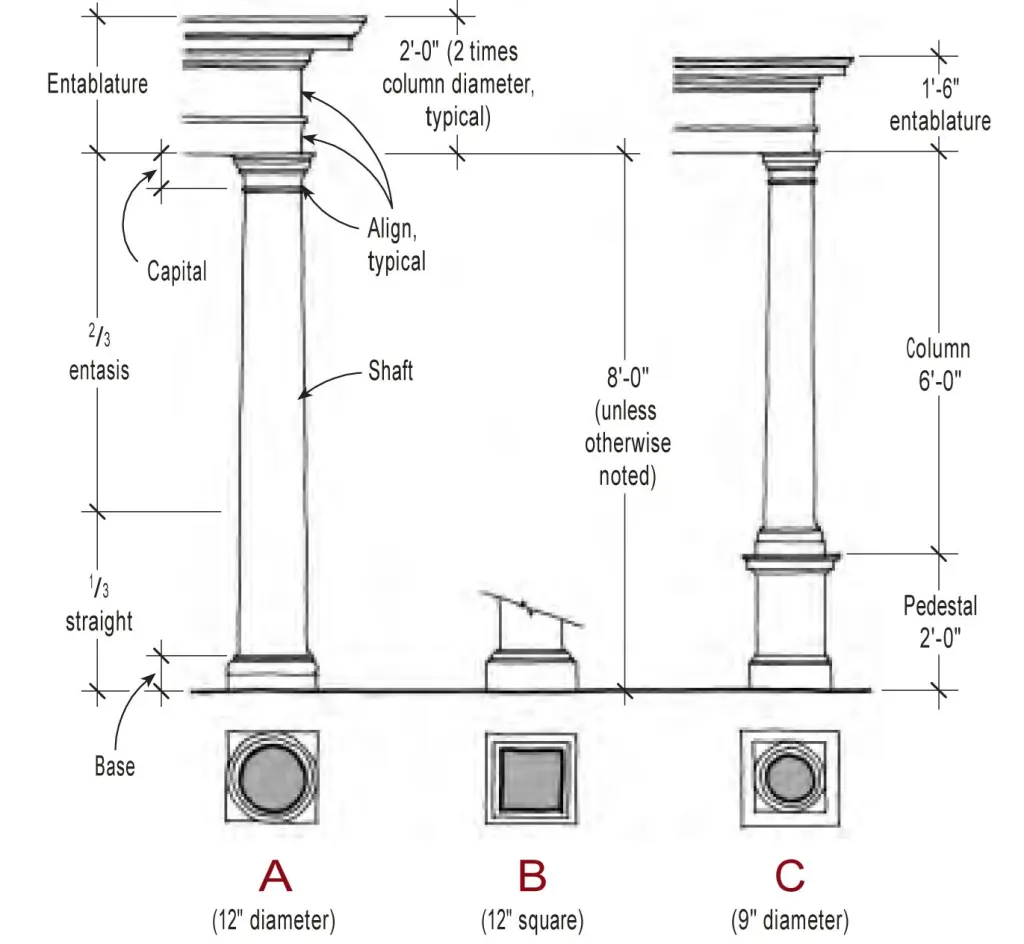
Column examples A, B, and C are roughly based on the Doric classical order. They are more formal and traditional than post examples D, E, and F.
A is fairly massive and supports an appropriately massive entablature. A column of this scale and detail is most appropriate on a large-scale, authentic classical reproduction; it would likely look overinflated and silly on most anything else.
As is typical of classical columns, the bottom third of the shaft extends straight up from the base diameter and the upper two-thirds of the shaft tapers, with a convex profile. This tapering is called entasis.
Column B is a square-plan version of Column A. It’s a tad less formal but equally robust.
Column C is of a more moderate scale. Sitting the 9-inch-diameter column atop a pedestal allows it to occupy the same overall height as full-height columns A and B without the girth. The entablature at is scaled down to accommodate the smaller column.
Full-Height Posts
Posts D, E, and F suit a wide variety of more eclectic homes.
Posts D and E are somewhat chunky and recall Arts and Crafts detailing. Post D is the dressier of the two; it’s trimmed with modest base and crown moldings that are pared-down reminders of classical elements. It also features chamfered corners located to recall the division of classical columns into one-third and two-thirds portions.
Post E discards the base and trim moldings and instead uses the start and stop points of the chamfer to suggest a base and cap. The entablatures on both D and E have been downsized in proportion to the post dimensions, and simplified in relation to the post types.
F is the slenderest and thus has been made shorter. If it were any taller, the 6×6 might appear overly skinny. Its entablature is scaled back accordingly. Simple crown and necking trim highlight the cap with minimal fanfare.
Piers
A pier differs from a column or a post in that it is usually more substantial and wall-like. Example G is a shingled pier featuring a flared shingle base with a bed molding. This pier supports a horizontal band of two full shingle courses, frieze trim, and a cornice, which together equal a quarter of the pier height. Pier G is comfortably proportioned for a generous porch or veranda.
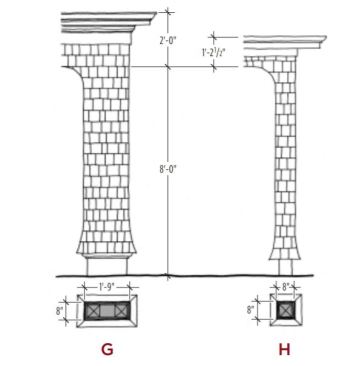
Example H, however, is an unconvincing pier. Its slender dimension is more postlike. The narrow horizontal band of two partial shingle courses, frieze trim, and cornice is undersized. In general, H is too anemic for a pier.
Paired Partial-Height Columns and Posts
On a porch that includes a typical 3-foot-tall guardrail, pairing posts atop a 3-foot pedestal creates a lighter look than a hefty full-height pier or massive full-height column would. The paired traditional columns in example I sit on a fittingly formal paneled pedestal.
The more informal smaller-scale posts in example J are better suited to the simple shingled guardrail and shingled pier-style pedestal. The porch with the J posts is decidedly more casual than the one with the I columns.
Modest Partial-Height Posts
If the slender full-height post F is too thin for your taste, it may make sense to trim out the lower third, as seen in example K. This simple treatment dresses up the post slightly while evoking the one-third-point dimensional shift of a classical column.
Example L, on the other hand, just doesn’t work. The shingled lower section isn’t chunky enough to pull off a pier-style shingle pedestal treatment. Also, the 3-foot height of the shingled section feels too tall for a single post with this overall support height; the post appears to be clad in a gawky tube sock.
For a partial shingle treatment to work, it needs to be scaled more like the shingled, pier-style pedestal in example
Katie Hutchison is an architect and the owner of Earthlight Design in Salem, Mass.