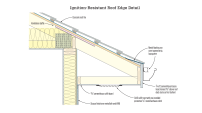
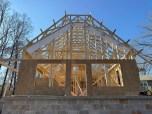
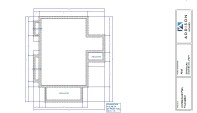
Jo-Anne Peck has the historic preservation contractor’s dream job. Together with husband, Craig DeRoin, a renovator with 25 years experience in restoration, Peck, who holds a bachelor’s degree in Building Science from Rensselaer Polytechnic Institute (RPI) and a Master of Fine Arts in Historic Preservation from the Savannah College of Art and Design, runs Preservation Resource, Inc., based in Brooksville, Florida, near Tampa. In the past decade, the pair has jacked up, moved, and restored dozens buildings in three Tampa historic districts to protect the area’s architectural heritage from destruction by a Federal and state highway project. “They were extending Interstate 4 through Ybor City, which is a National Historic Landmark District,” Peck explains. A consultant on the project hired Peck and DeRoin as sub-consultants, she says, “and we ended up moving — well, first we did 33 buildings, and then did all the rehab work for them, and then we did another 29 buildings, and did all the rehab work for those. And that one project has provided the bulk of our jobs for ten or eleven years now.” For more on the I-4 project, see Peck’s blog posting here (“ I-4 Mitigation Project Wins Planning Commission Award ”). Moving and rehabilitating historic structures in the path of a single highway project near Tampa, Florida, has been Preservation Resource’s stock in trade for ten years. Here the team transports the largest building in the set to a new location. But all good things come to an end. The highway project is nearing completion, Peck says, and the team has only about five houses left to move. That leaves Peck and DeRoin looking for a new way to occupy their time. “We don’t see more government work coming along,” says Peck. “And you know, that was kind of like my dream job. When you can impact a community by rehabbing 35 buildings within 25 blocks, and help to restore a neighborhood that was really sketchy — you know, we’ve done all the things that we wanted to do with a preservation job. After that, I felt like most other jobs would probably feel like a letdown.” Before they took on the highway project, says Peck, the couple did a lot of remodeling work for homeowners. But they don’t find that work as creative or satisfying. So they hit on another idea: supplying outbuildings for historic homes. That’s how the couple’s new company, Historic Shed, came into being. And so far, Peck says, it has been more fun than she expected. “In Florida, if you’re in a historic district, you can’t just go out and buy a big metal shed,” Peck explains. “They just won’t approve it.” But few suppliers have the knowledge or experience to make an outbuilding match a historic home. Peck and DeRoin had built a prototype for their own home office. “This thing was tricked out,” she says: “Hardwood floor, vaulted ceiling, French doors…” After winning an award for their office outbuilding, she says, “we realized that there was probably a market for something like this.” One recent project involved a particularly close tie to Florida’s history: the shed would not only have to match a vintage 1880s house, but it would also have to house a treasure trove of historic letters and artifacts. “The woman who owns the house, her grandparents built it,” says Peck, “and she has all of their letters, their furniture — everything.” History professors and graduate students come to the property to study one of the few remaining traces of history left in the area. “The worst sprawl you can think of is everywhere around her,” says Peck. “It’s strip shopping mall after strip shopping mall. And you go by and you think, ‘Oh I wonder why they didn’t develop that lot?’ And then you drive down this driveway, and it’s like going through a time tunnel.” The tiny wooded patch in the center of square miles of suburbs is all that remains of the wild Florida documented in the letters of Julia Daniels Mosely, the grandmother of the current owner. Selected letters are now out in the form of a book (“ Come to My Sunland: Letters of Julia Daniels Moseley from the Florida Frontier, 1882-1886 ,” edited by Betty Powers Crislip), one of a “Florida History and Culture Series” published by the University Press of Florida. This “historic shed”mimics the architectural details of the original home (top). The air-conditioned and lighted interior (middle) will serve as an archive and study area for historic artifacts and letters. The company frames and assembles all of its sheds indoors (bottom) before disassembling the package and re-erecting it on site. In Florida, even outbuildings, if they exceed a minimum size, require wind-resistant structural details based on the local design wind speed and the associated lateral loads. “When you tell a customer that they don’t have to pull a permit if their shed is under 150 square feet, they typically say, ‘Okay, let’s do a 12-by-12 shed.’ Then we avoid the engineering review,” says Peck. But the archive shed needed more space than that, so the company hired an engineer to specify structural details, which included 20-inch-wide foundation piers, tie-down straps, and steel framing connectors. The archive shed also had spray foam insulation — R30 in the walls and R50 in the roof — and a mini-split air conditioner. “It’s the king of all sheds,” says Peck. Wind-resistant structural details are required even for outbuildings in Florida’s high design-wind speed zones — if only to stop the sheds from turning into airborne missiles aimed at the neighbors. “We use the same engineered details on our other sheds, even when we don’t need a permit,” says Peck. But some requirements for a house — such as impact-resistant windows — don’t apply to sheds. Peck’s and DeRoin’s massive building relocation jobs relied on outside structural engineers — although Peck says that building departments usually didn’t require updated structural details. “We could stick to the code that was in force when the building was originally built, not the most recent code,” she says. For the sheds, though, Peck has started to do her own design engineering. She’s taken Florida’s contractor certification course , and passed the test that qualifies her to specify her own structural solutions, working mostly from a cookbook set of approved details. Peck explains, “If you’re a licensed contractor in Florida, then you can take this residential wind-load design class, and then pass a test, and then you can basically do all the calculations yourself, within certain parameters. You have to stick to their charts and stuff — it’s basically a bunch of pre-engineered things — and you can’t get too crazy with your designs. But obviously, with a shed, it’s not much of a problem. I use the Wood Frame Construction Manual from the American Wood Council. But there are several other books that also work as well.” Right now, Peck is working on the design for a historic reproduction two-car garage with cypress siding; plywood on the inside walls will provide the wind-resistant bracing elements. It’s satisfying to be able to do the heavy lifting herself, she says, but it’s hard work: “It’s a little more complicated in real life than it seemed in the class,” she says.
Crafting the Historic Outbuilding In Hurricane Country
Crafting the Historic Outbuilding In Hurricane Country ~
6 MIN READ