Download PDF version (1848.9k) Log In or Register to view the full article as a PDF document.

Launch Slideshow

Rebuilding on the Gulf Coast

Rebuilding on the Gulf Coast

  • http://www.jlconline.com/Images/377007851_1010_JLC_Rebuild%20on%20Gulf_00a_tcm96-1160581.jpg

    600

  • http://www.jlconline.com/Images/1440281388_1010_JLC_Rebuild%20on%20Gulf_00b_tcm96-1160593.jpg

    600

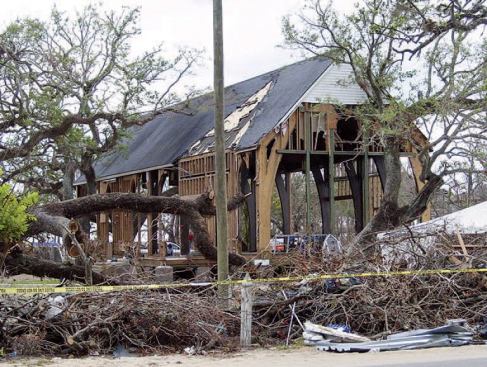
    The Trinity Episcopal Church in Pass Christian, Miss., once stood on piers about 4 feet above grade and 14 feet above sea level. In August 2005, Hurricane Katrina's 26-foot storm surge washed away the walls but left the church's laminated-arch frame virtually intact. During reconstruction the church was raised another 10 feet to assure it would withstand future storms.

  • http://www.jlconline.com/Images/430946357_1010_JLC_Rebuild%20on%20Gulf_01a_tcm96-1160604.jpg

    600

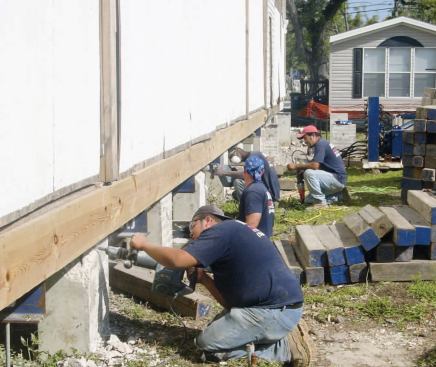
    The shoring crew first disconnected the floor framing from the foundation by cutting the steel bolts embedded in the short concrete piers.

  • http://www.jlconline.com/Images/72651646_1010_JLC_Rebuild%20on%20Gulf_01b_tcm96-1160613.jpg

    600

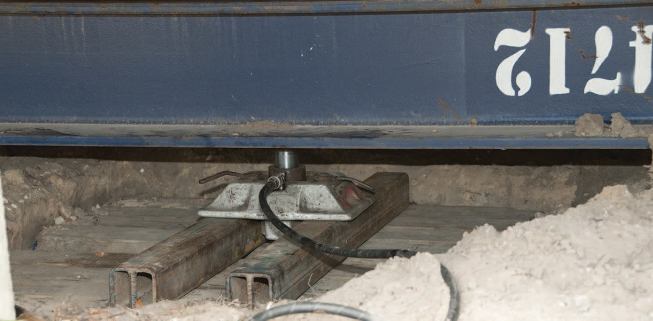
    The crew installed cribbing and hydraulic jacks for lifting the building.

  • http://www.jlconline.com/Images/297613109_1010_JLC_Rebuild%20on%20Gulf_01c_tcm96-1160621.jpg

    600

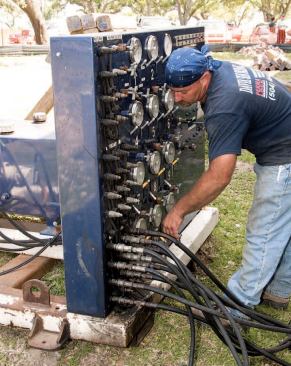
    Each jack was connected to a hydraulic manifold powered by a diesel engine.

  • http://www.jlconline.com/Images/1129002363_1010_JLC_Rebuild%20on%20Gulf_01d_tcm96-1160629.jpg

    600

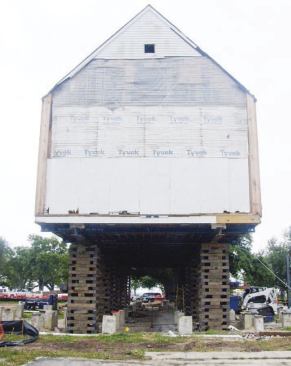
    The jacks were able to lift the 3,000-square-foot structure more than 10 feet with less than 3/8-inch difference in elevation between any of the 10 lifting points.

  • http://www.jlconline.com/Images/1960391617_1010_JLC_Rebuild%20on%20Gulf_02a_tcm96-1160637.jpg

    600

    The rebar for new grade beams and pier extensions was epoxied to the original piers.

  • http://www.jlconline.com/Images/1182940869_1010_JLC_Rebuild%20on%20Gulf_02b_tcm96-1160645.jpg

    600

    Formwork for the pier extensions stopped a foot shy of the raised building to allow for setting the anchor bolt-studded cap plates and pumping the concrete.

  • http://www.jlconline.com/Images/1782445840_1010_JLC_Rebuild%20on%20Gulf_02c_tcm96-1160653.jpg

    600

    Diagonal steel rods provide lateral bracing for the exposed portions of the piers; note the cold joint at the base of each pier between the old pier and the pier extensions.

  • http://www.jlconline.com/Images/1124482700_1010_JLC_Rebuild%20on%20Gulf_02d_tcm96-1160661.jpg

    600

    Steel brackets welded to the cap plates anchor the transept framing to the foundation.

  • http://www.jlconline.com/Images/1962962887_1010_JLC_Rebuild%20on%20Gulf_03a_tcm96-1160669.jpg

    600

  • http://www.jlconline.com/Images/534471819_1010_JLC_Rebuild%20on%20Gulf_03b_tcm96-1160677.jpg

    600

    Cantilevered steel plates (left) welded to the cap plates and existing steel framing brackets in the original floor system provide support for the glulam rim joists (right) that support the new SIP walls.

  • http://www.jlconline.com/Images/1904504718_1010_JLC_Rebuild%20on%20Gulf_03c_tcm96-1160685.jpg

    600

    With the glulam rims secured to the original structure and the new transept floor framing completed, the building is ready for wall A and roof panels.

  • http://www.jlconline.com/Images/813203675_1010_JLC_Rebuild%20on%20Gulf_04a_tcm96-1160691.jpg

    600

    The floor was 14 feet above grade, so man lifts were essential for safe handling of the large panels.

  • http://www.jlconline.com/Images/1105949284_1010_JLC_Rebuild%20on%20Gulf_04b_tcm96-1160701.jpg

    600

    The wall panels are lifted into place with man lifts.

  • http://www.jlconline.com/Images/560382819_1010_JLC_Rebuild%20on%20Gulf_04c_tcm96-1160709.jpg

    600

    Panel edges were relieved at the bottom to fit over the glulam rim joist, and at the sides and top for the 2-by connecting splines.

  • http://www.jlconline.com/Images/583890662_1010_JLC_Rebuild%20on%20Gulf_04d_tcm96-1160717.jpg

    600

    The wall panels were first glued and nailed to the glulam band and splines, then fastened to each other and to existing framing with structural screws.

  • http://www.jlconline.com/Images/106276456_1010_JLC_Rebuild%20on%20Gulf_05a_tcm96-1160725.jpg

    600

    The stiffeners were bolted to the glulam and recessed into the wall panels.

  • http://www.jlconline.com/Images/1087583981_1010_JLC_Rebuild%20on%20Gulf_05b_tcm96-1160733.jpg

    600

    To prevent wind deflection, the tall window walls were reinforced with full-length flitch beam stiffeners.

  • http://www.jlconline.com/Images/1829916290_1010_JLC_Rebuild%20on%20Gulf_06a_tcm96-1160741.jpg

    600

    Preinstalled 2-by walk boards reinforced the connection between the lifting hooks and the OSB skins of the roof panels.

  • http://www.jlconline.com/Images/2047786820_1010_JLC_Rebuild%20on%20Gulf_06b_tcm96-1160749.jpg

    600

    View of roof panel emplacement.

  • http://www.jlconline.com/Images/949562957_1010_JLC_Rebuild%20on%20Gulf_06c_tcm96-1160757.jpg

    600

    Placing the hooks slightly off-center eliminated camber in the panel, making it easier to slide the edge over the spline of the previous panel.

  • http://www.jlconline.com/Images/898195721_1010_JLC_Rebuild%20on%20Gulf_07a_tcm96-1160765.jpg

    600

    The second-story floor system in the transept addition hangs between the top of the first-floor wall panels.

  • http://www.jlconline.com/Images/1647618963_1010_JLC_Rebuild%20on%20Gulf_07b_tcm96-1160773.jpg

    600

    The second-floor structure of the transcept addition is supported by 6x16 glulam beams that span the openings of the arches of the original church frame.

  • http://www.jlconline.com/Images/1132483161_1010_JLC_Rebuild%20on%20Gulf_07c_tcm96-1160781.jpg

    600

    The 32-foot-long structural ridge beam fit into reinforced pockets in the gable SIPs.

  • http://www.jlconline.com/Images/617347359_1010_JLC_Rebuild%20on%20Gulf_08a_tcm96-1160789.jpg

    600

    The nonstructural skirt wall and lowered entry deck make the church appear lower to the ground than it actually is.

  • http://www.jlconline.com/Images/1008475890_1010_JLC_Rebuild%20on%20Gulf_08b_tcm96-1160797.jpg

    600

    There's elevator access from the finished slab underneath the building.

  • http://www.jlconline.com/Images/650349292_1010_JLC_Rebuild%20on%20Gulf_08c_tcm96-1160805.jpg

    600

    With the arches and finish ceiling intact — and the original stained-glass window back in place — the interior looks almost unchanged.

New Piers

While the lift was quick, we had to wait two months for the foundation contractor to complete the iron and concrete work needed to build the new pier foundation. Needless to say, I was anxious to get the building bolted down before the next storm season started. The shoring company reinforced the existing piers with grade beams and extended them with new rebar dowelled and epoxied into the old concrete (see slideshow). The crew also built new concrete piers for the two transept additions to the main building.

Steel work. To anchor the building to the piers, workers embedded 1/2-inch-thick steel plates into the concrete at the top of each pier during the pour. Each plate had four 3/4-inch by 12-inch J-bolts welded to it to strengthen the connection between the concrete and the steel.

We also bored holes through the forms and inserted short lengths of conduit so that later we could through-bolt steel brackets to the piers. These brackets accommodate 1-1/8-inch-diameter diagonal steel rods and steel tubing that reinforce the tall piers (see drawing "Pier Connection Details" on page 4 of the PDF).

Around the perimeter of the building, ironsmith Craig Campbell welded 1/2-inch-thick steel plates to the steel framing brackets that the shoring company had cut loose from the old piers. These new plates extend out over the tops of the piers 5 inches from the original wall plane, and help support the 5-inch by 15-inch glulams that hold up the SIP walls.

A few days after the pour, we measured the strength of the new concrete. It registered at over 3,000 psi, which meant the building could finally be lowered onto the piers. Campbell then spent a couple more days welding all of the metal plates together, using shims as necessary. He also cut bolt holes in the plates, and we sprayed the steelwork with Rust-Oleum’s Cold Galvanizing Compound (800/323-3584, rusto leum.com) to protect against corrosion.

Then we bolted the big perimeter glulams to the steel plates with 1-inch all-thread rod and to the framework of the church with 3/4-inch bolts 16 inches on-center. To account for the thickness of the panels’ inner OSB skins, we shimmed the glulams out from the framing with 5/8-inch plywood shims.