Before getting a license to practice medicine, a new doctor has to swear to uphold the Hippocratic oath to “do no harm” to any patient. If there were a similar oath for remodelers (the Palladian oath?), builders would have to swear not to leave a remodeled house looking uglier than it was before. That’s not difficult if you’re starting with a charming old farmhouse or some other character-rich design, but when you’re remodeling a house that didn’t have any style to begin with, it can be a real challenge.
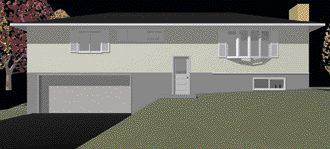
That challenge is a common one nowadays, when the number of style-deficient post-WW II houses in need of major remodeling is at an all-time high. My architectural practice here in Minnesota is dominated by remodeled designs of such newer house types as split levels, ranches, and the ever popular “raised ranch” shown here.
The front facade of this 60s-vintage raised ranch is dominated by the huge tuck-under garage door, making the actual main entrance look like an afterthought. The fenestration or window pattern is a jumbled mess with no balance, rhythm, or character. The only design quality to build on is a strong emphasis on horizontal lines.
Thoughtful use of color is a quick and inexpensive way to add character. Here we’ve painted the siding a barn red and specified a quiet, light-gray shingle that connects back to the exposed concrete-block base. The barn red makes the house stand out in the neighborhood of beige houses, but more important it makes the white trim pop out, emphasizing what little detail the house has. Residing the house with a thinner horizontal siding adds visual texture and strengthens its existing horizontal lines, as does the addition of horizontal 2×2 battens to the existing garage door.
The biggest functional problem with the existing house was a front entry that dumped visitors onto a tiny stair landing. A new front entry provides much-needed transition space and adds a strong vertical element that emphasizes the horizontal through contrast.
Just as important as changes to the house itself are design moves to extend the house into the landscape. A new front walk extends toward the street, and a low fence draws your eye to the front door. A row of bushes along the new walk also draws attention to the front door, deemphasizing the garage door. Peeking around the side is a new deck and screen porch, each with strongly horizontal detailing.
Many of these designs evolved during the sixties and seventies, when builders could sell pretty much anything. Houses were stripped of ornamentation, with no attention paid to such design basics as contrast, proportion, scale, balance, and rhythm. Despite their stylistic shortcomings, many of these houses are built on lots with mature trees in desirable neighborhoods. Such amenities can’t be replicated in today’s greenfield developments, so there’s strong demand for these homes and lots of incentive to update their appearance.
Here are a few basic design ideas that I’ve found useful for injecting some style into houses that desperately need it:
* Build on what you’ve already got. In a typical raised ranch, the only identifiable design motif is an emphasis on horizontality. Take advantage of it by working with design elements that reinforce that focus.
* Use color to create character. Most speculative houses are beige and bland. Infuse a dose of color by repainting and reroofing.
* Extend the house into the landscape. Create outdoor rooms and spaces with lots of detail to compensate for the lack of detail in the original house.
* Finally, don’t load a house with more style than it can support. You can’t turn a humble raised ranch into Tara from Gone With the Wind, and you shouldn’t try. Don’t forget your remodeler’s oath.
Robert Gerloff is a residential architect in Minneapolis, Minn.