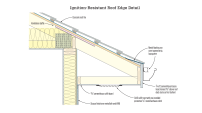
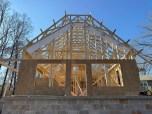
When it comes to green and energy-efficient construction, builders have a lot of standards and programs to choose from. LEED for Homes, Energy Star, the NAHB Green Building Guideline — each offers something, and along most dimensions the programs overlap. In the South, Atlanta-based Earthcraft is a strong contender for people’s choice. And for a 2009 project in a near-ideal location, Earthcraft Earthcraft was the choice of Virginia Beach builder Craig Reed. Reed’s customer came to him after seeing his crew at work on a nearby new home. When Reed got a look at the home site, he was eager to start. At the end of the road on a narrow spit, the home site had 180-degree view of the water. At the tip of Buccaneer Road in Virginia Beach, on the edge of an intertidal creek near the zone where the Chesapeake Bay meets the Atlantic Ocean, the lot is sheltered from the Bay and the ocean by just 1, 000 feet of land. When the house was finished, Reed says, “Every room had water views. Even if you’re right on the ocean, most houses, the rooms on the street side of the house aren’t facing the water.” Building an Earthcraft house was Reed’s idea, not his customer’s. “I was committed to raising the standard of our construction and giving me a competitive marketing edge. And I put up the Earthcraft sign right next to my construction signs. I had one sign facing the water so that all the boaters could see it, and I had another construction sign facing the road. And within a year of doing that, I saw three other builders doing Earthcraft homes going up within that same area. And I know those other builders were doing that to compete with me. But I still have bragging rights I built the first Earthcraft house in Virginia Beach, and I still have the only Earthcraft house that is on the water, and the only one that’s built on a pile foundation.” The house has a full range of green, energy-efficient options, Reed says, starting with high-performance windows and insulated exterior doors. Walls and cathedral roofs are insulated with a half inch of closed-cell spray polyurethane foam against the sheathing, and the rest of the cavity packed with cellulose. Lights and appliances are Energy Star-labeled products. Toilets, taps, and shower heads are low-flow. Second floor ceilings are air-sealed and insulated with dense cellulose; hvac ducts run in chases within the insulated space, and the roof sheathing is radiant-barrier foil-faced plywood. ZIP System ’s rain-barrier sheathing system backs up the weather envelope. And for heating and cooling, the house has a closed-loop geothermal system from Florida Heat Pump. At the end of a slender spit of land in sheltered intertidal waters, the home site was an ideal waterfront location. Energy details for the engineered floor system, built on a driven pile foundation, were a tricky problem to solve. But a well-insulated, airtight envelope paired well with the geothermal heating and cooling system, ideal for a mixed-humid climate with moderate heating and cooling loads. Perhaps the most difficult detail was the floor system, installed over an open crawl space. With the floor framed on an open piling foundation, says Reed, good insulation and air sealing was problematic. Reed decided on two inches of closed cell spray-applied polyurethane. “We really couldn’t come up with anything else that was acceptable,” he says, given the mixed-humid climate and the risk of flood. While Reed’s client was well-funded, “he wasn’t that good of a client in terms of being ready to jump on board with all the green stuff. He’s almost 70 years old, and he’s old school. But in the end, he was tickled pink. I still get emails from him now and then telling me how low his utility bills are.” But for the future, Reed’s looking beyond Earthcraft. “Earthcraft is a regional player,” he observes. “They got started in Atlanta, and then some people here got together — I know some of those guys that brought it here to this state. And it’s actually the most successful green building program in the state of Virginia — they have the most houses, quantity-wise. But I decided to hitch my wagon to NAHB’s National Green Building Program , , because it’s an ANSI-certified standard, and it’s a national program. And I feel like that’s where the whole industry’s gotta go, sooner or later.” Also, Reed says, he likes the way NAHBGreen is set up for builders to do all their project submittals and documentation on line.
But regardless of the program, Reed says, he may never top the experience of building his Earthcraft home, simply because of the location: “I could go the rest of my career and never get another lot like that.”