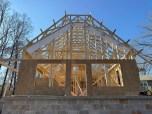
Maine was one of the last states in the nation to adopt a statewide energy code for homes, and there are plenty of Mainers who still don’t like the idea. But Maine also has its share of energy-efficient builders, including some who are leading the nation with exemplary cold-climate high-performance homes. Case in point: Dan Kolbert and Portland-based Kolbert Building. new house with a double-wall frame and dense-packed cellulose insulation, hit ultra-low air leakage numbers and earned a LEED Platinum rating (see “ Building a Tight House ,” by Dan Kolbert, JLC 6/09). Kolbert’s current project, however, is if anything more challenging: he’s working on a complete gut/rehab of a 1970’s post and beam house, aiming for zero net energy consumption. “I don’t know if we’ll get there,” he says, “but we’ll get close.” There’s more to any gut-rehab than just energy, of course. It’s a dirty job — literally. Right off the bat, says Kolbert, the team realized that the slope the house was built on included unstable fill: “We had to build a whole concrete retaining wall there.” And because the original house was built with reclaimed timbers from an old barn that had never been thoroughly cleaned, Kolbert hired a local firm to come in and soda-blast the grime off the old timbers in place. But the energy package is the core mission: “That’s the whole point of the project,” says Kolbert. “And that’s pretty much what we do. We’re a small company — we do maybe one big job a year, and frankly, if it’s not shooting for pretty ambitious energy goals, we’re not particularly interested. We have a limited amount of time, and we don’t want to spend it on jobs where people don’t agree with those goals.” Sticking to that niche has worked for Kolbert, he says: “So far, we’ve been very lucky. We’ve stayed as busy as ever during this down time. Part of that is just that we’re really tiny, which helps. But part of it is that we do have a reputation for knowing this kind of work, and we’ve been doing it long enough that it’s pretty clear that we’re not greenwashing.”
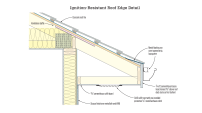
For this 1970s-era timber frame, shooting for net zero started with the envelope. Kolbert tore out most of the old infill 2×6 stud framing. He says, “Originally we were going to leave the exterior walls alone and just skin the place with foam from the outside. But we found some really serious rodent infestations, and we saw some structural problems that we needed to address. So in the end we ended up tearing out all the drywall, all the fiberglass insulation, and a lot of the infill framing too, which had not been done very well. And that’s one of the lessons of this kind of deep energy retrofit — you’ve gotta be prepared for all sorts of surprises.” After re-framing, Kolbert skinned the whole building with ZIP System System coated plywood and sealant tape. “We wanted to get our air barrier right there,” he explains. “We needed to re-sheathe it for structure anyway, so we used ZIP Wall so we could get a good air seal.” Over the ZIP sheathing, the crew tacked up a layer of 2-inch polyiso rigid insulation board using cap nails, and then installed another 2.5-inch layer of high-R nailbase suitable for shingle siding, fastened through to the studs with 6.5-inch SIP fasteners (all components supplied by Hunter Panels). For the infill cavities, Kolbert hired Manchester, Maine-based energy contractors “ The Breathable Home ” to install dense-pack cellulose behind netting. When Coastal Connection talked with Kolbert last week, the insulators were on site, installing the final component in the building’s insulated envelope. “Our blower door numbers were pretty good back when we installed the ZIP sheathng,” he said. “Now that the foam is on the outside and the dense-pack is going in, I’m hoping they’ll be even better.” Of course, there’s more to a net-zero house than a high-performance envelope. In later phases, the project plan calls for photovoltaic rooftop panels, a solar water heater, air-to-air heat exchangers, and “lots of LED and low-voltage lighting,” Kolbert says. We’ll update the story for you when the project is complete and test results are in.