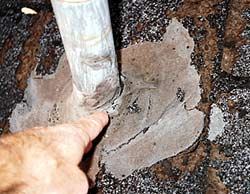
As an architect who has worked with the roofing industry since 1977, I often inspect leaking roofs. I have found that poor flashing details – at penetrations, at roof edges, or where a roof changes planes – are much more likely to be the cause of a leak than the roofing itself. Similarly, many leaks are caused by the use of insufficient or inadequate fasteners for sheathing, flashing, or roofing, and by the attempt to substitute caulk or roofing cement for flashing. The cost of installing the roof on a new building usually amounts to less than 5% of the total construction cost. Yet some lawyers estimate that 60% to 80% of construction lawsuits involve roof failures. Often, it’s a small leak that quickly grows into a big, expensive problem. The following problems are among the most common I encounter. In every case, the leak could have been avoided had the installer used and paid more attention to detail.
Fasteners
Problem: No support at sheathing edges. The plywood sheathing on this flat roof was installed without blocking under the edges. If someone walks on the roof, the roofing may crack when the sheathing flexes at the plywood joints.
Solution:
Use H-clips or solid blocking
at plywood edges, or use tongue-and-groove plywood roof sheathing.
Problem:
Smooth-shank nails don’t hold.
Smooth-shank common nails used to fasten roof sheathing can work themselves loose over the years, especially if a roof deck is walked on. Rising nail heads can eventually poke through the roofing.
Solution:
Use ring-shank nails for roof sheathing.
Problem:
Flashing is incorrectly fastened.
There are three problems with the coping flashing on this parapet wall: •
The flashing has been fastened on the horizontal face
, instead of the vertical. •
The flashing has been nailed
instead of screwed. •
No allowance has been made for expansion and contraction
of the metal flashing, nor for differential movement between the metal flashing and the wood nailer, which expand at different rates. An exposed fastener on the horizontal surface of the flashing is a potential leakage point. If flashing is attached with nails instead of screws, the last hammer blow can leave a concave dimple in the flashing, encouraging ponding around the nail hole. If long runs of flashing are installed without allowing for expansion and contraction, the moving flashing can work nails back and forth until they loosen. Solution: Attach flashing on a vertical surface rather than a horizontal surface.
Use hex-head screws with neoprene washers rather than nails if it is necessary to use exposed fasteners.
Install fasteners in slotted holes, which allow the flashing to move with changes in temperature.