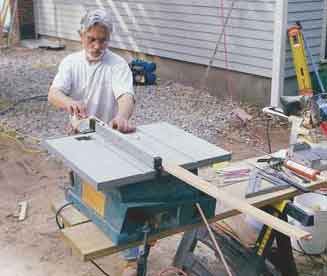
In my early years as a carpenter, table saws were a luxury on many job sites. Back then, saws were expensive, had cast-iron tops, and weighed upwards of 225 pounds. There was simply no such thing as a lightweight professional-grade portable. But that changed in the mid-’80s when Makita introduced its model 2708 8 1/4-inch table saw. It was light, powerful, and at about twice the price of a circular saw, very affordable. The next big change took place in the late ’90s when DeWalt introduced its model DW744. Like full-size cast-iron contractor saws, this tool had a 10-inch blade and the ability to make a 24-inch rip. But unlike those machines, the DW744 was compact and light enough to be carried by one person. In addition, that saw had a very sophisticated fence mechanism.
In the last few years, a number of manufacturers have introduced portable table saws with 10-inch blades and the rip capacity of full-size contractor models. For this article, I tested 10-inch saws from Bosch, Craftsman, DeWalt, Hitachi, Makita, Porter-Cable, and Ridgid.
Power
How much power you need depends on the kind of work you do. For example, most of these saws can make 24-inch rips, which is what you need to cut sheet goods such as plywood. Every one of these saws has more than enough power to cut 3/4-inch plywood and MDF.
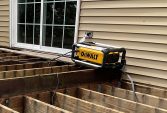
The saws showed up while I was building a deck, so I put them through a sterner test, ripping pressure-treated framing lumber. None of the saws had any trouble ripping 1 1/2-inch stock, so to get a better sense of their power, I resawed some dry hemlock 2x4s. Normally, you’d cut halfway in from each side, but I did this with the blades all the way up. It was not a scientific test, but the results were consistent with how the saws felt cutting thinner material. Makita’s model had the easiest time resawing 2x4s and was the only saw with enough depth of cut to make it all the way through in a single pass. The Bosch, Craftsman, Hitachi, and Porter-Cable felt about the same, a little less powerful than the Makita. The DeWalt and Ridgid had the most trouble ripping 3 1/2-inch material with the blade all the way up. That said, every one of these saws had the power to perform standard carpentry tasks.
Motors
The saws all have direct-drive universal motors. And they all draw 15 amps, except for the DeWalt, which draws 13 amps. The Makita, Hitachi, and Porter-Cable saws are equipped with automatic brakes. This safety feature is especially useful if you set the fence by measuring off the blade.
Rip Capacity
In the old days, rip capacity was related to the size of the table. The broader the table, the wider the rip. But table size became less important in the late ’90s when DeWalt introduced a saw with telescoping rails. Except for the Hitachi and the Makita, all of the saws I tested have telescoping rails and can make rips over 24 inches wide. The saws with fixed rails make narrower cuts. The maximum rip on the Hitachi is 15 inches to the right and 16 inches to the left. The Makita can rip 12 1/4 inches to the right.
Fence System
On most saws, you lock the rails into position by activating a lever below the table. Ridgid’s lever is accessed from above. The Bosch, Craftsman, and Ridgid saws have split tables, so a 6-inch section of table extends outward with the rails. The extended section supports the right edge of the stock during wide rips. DeWalt and Porter-Cable use single-piece tops. DeWalt relies on a narrow pivoting shelf to support thin stock during wide rips. Porter-Cable uses a support that clips to the side of the fence.
DeWalt uses a pivot-mounted shelf to support thin stock that extends beyond the right edge of the table. Other manufacturers split the table or add a clip-on shelf.
DeWalt’s rails are connected to a slick rack-and-pinion mechanism that you can move by hand or by turning a fine-adjustment knob. The other telescoping rails are moved entirely by hand. The rails on the Bosch and Porter-Cable saws slide easily. The rails on the Craftsman and Ridgid are harder to push in and out.
Scale
A good scale increases productivity by allowing you to set rips without a tape. The graduations should be easy to read, and the pointer or indicator line should be thin and close to the scale.
Porter-Cable puts a magnifier over the indicator on its scale. The fence can be recalibrated by loosening the screws and moving the indicator.
The scales on the Bosch, DeWalt, and Porter-Cable saws are particularly easy to read. The Craftsman, Hitachi, and Ridgid scales are a step down, mostly because the scale or the pointer is harder to read. The scale on the Makita is okay for rough rips, but if you want accuracy, it’s easier to set the fence with a tape.
The rear scale on Bosch’s saw is especially easy to read because the graduations vary in length and the indicator is right down on the numbers.
Ideally, the rip scale would be as accurate for bevels as it is for 90-degree cuts. But on some saws (see the specs for individual tools), tilting the arbor shifts the cutting line to the left. If that happens, you’ll have to make test cuts, because the scale won’t work for beveled rips.
Portability
A cast-iron-top table saw is fine if you always work in the same place. But a carpenter may work on multiple sites or need to set up at different locations on the same job, so it’s a big plus if a saw is easy to move and store. Most of these machines weigh around 60 pounds, about the same as a 12-inch sliding miter saw. At 44 pounds, Makita’s saw is exceptionally light and easy to carry. The Craftsman and Ridgid saws come on wheeled, bolt-on stands. The wheels make it easier to move the saws, which is good because the stands add a lot of weight.
Size matters, too. The bigger the footprint, the harder it is to store and transport a saw. The Makita has a smaller footprint than the other models. The Hitachi has the largest footprint if you don’t include the stand. If you include the stand, the Ridgid has the largest footprint, though you can reduce it by storing the saw on end.
Stands
Whatever saw you get, it’s a good idea to buy some kind of stand, because otherwise you’ll have to kneel to use the machine. Some carpenters use sawhorses, but they’re rarely as portable or as stable as a manufactured stand. Most saws come with or are available with detachable scissor-action stands that fold flat for storage.
Ridgid’s stand is very stable, and the wheels make it easy to move around. The downside of the bolt-on stand is that it adds weight and bulk to the tool.
Makita sells optional bolt-on legs, but they make it harder to transport the tool because they don’t fold. The Bosch, DeWalt, Hitachi, and Porter-Cable saws are available with scissor-action stands that are stable and solidly made.
Craftsman’s stand has wheels, but they work only when the legs are folded. The wheels make it easier to move the saw around, but they’re so close together that the saw lacks stability when you roll it on uneven surfaces. Ridgid’s wheels are widely spaced, so the stand is more stable when rolled. And the wheels are always on the ground, so you can move the saw without breaking it down. I like using this stand, but it makes the saw so large and heavy that it’s hard to consider it portable.
When you’re pricing saws, be sure to account for the stand. Some machines come with them, but they’re an $80 to $100 option on others.
Height and Bevel Control
Every saw has a crank to raise and lower the blade. There’s nothing unusual about any of them except that the action is particularly smooth on the Bosch, DeWalt, and Porter-Cable machines.
Most of the saws have quick-action bevel locks that can be activated with a single 90-degree turn of a lever. Craftsman and Hitachi use old-fashioned captured-nut mechanisms that require multiple turns. Ridgid uses a quick-action cam.
All but two of the saws (Bosch and DeWalt) include a rack-and-pinion mechanism to adjust the tilt of the blade. The rack is on the housing, and the pinion is on the handwheel. These gizmos make it somewhat easier to fine-adjust bevels, but I wouldn’t go out of my way to get one.
The lever-activated arbor lock on the Bosch saw makes it easy to change blades. Craftsman’s saw is equipped with a similar mechanism.
Other Features
Most saws have a variety of small added features. They might include onboard storage for blades, wrenches, and miter gauges or a cord wrap or a better guard. None of these items is that important, but they do make saws more convenient to use.
Cord wrap. This feature is a no-brainer. Of course there should be a way to safely store the cord when you transport the machine. No one wants to trash the cord or trip on it when carrying the saw. The Hitachi, Bosch, and Ridgid tools have manual wraps, and the Craftsman has a spring-loaded reel. I like the mechanism on the Craftsman because it automatically retracts the cord, but I have some doubts about how long that will last under daily use. Bosch has the best traditional wrap because it’s big and the plug ties off by clipping on to the cord.
Manufacturers continue to add features, such as the cord wrap on this Ridgid saw. Bosch, Craftsman, and Hitachi also provide places to store the cord.
Guard. More carpenters would use guards if they were better designed. I don’t mind using one if for no other reason than I’m less likely to catch a face full of chips. The problem is you can’t cut dados or rabbets without removing the guard. Most manufacturers make no effort to make guards easy to remove and, more important, easy to reinstall. That task frequently requires the use of tools and the manipulation of small, easy-to-lose parts. No wonder it’s rare for carpenters to actually use the things.
But two of these saws come with guards that are easy to remove and reinstall. Ridgid’s guard attaches to the back of the saw with a small, permanently connected handwheel. Porter-Cable’s guard installs by clicking it into a slot behind the blade. To remove, just pull the lock spring and lift.
Favorites
For a basic no-frills saw, look no further than the Makita 2703. Its fence is clunky and its rip capacity is small, but it has a powerful motor and a simple, solid design that should withstand years of hard use.
If you want to make 24-inch rips, consider a Bosch or Porter-Cable machine. The Bosch is powerful and extremely quiet for a table saw. The Porter-Cable is equally powerful and has a solid, accurate fence.
Noise OutputMost carpenters have a general sense of which tools are louder than others, but the introduction of inexpensive decibel (dB) meters has made quantification possible. I used a digital meter to measure the noise output of these saws. There are many ways to measure sound, so the numbers I came up with are less important than the relative rankings of the machines. Even so, Porter-Cable lists a dB rating in its specs, and it’s the same as the number I got. The meter confirmed what I already believed: that some saws are louder than others and that they’re loudest when you first turn them on. I tested the tools in the center of a 20×20-foot garage. The meter was on a tripod 24 inches above the table, pretty much where your head is when you’re ripping. I measured the maximum sound output at startup and at idle. It helps to put the numbers into perspective. Sound intensity is measured in decibels and is a measure of fluctuations in air pressure caused by sound waves. The dB scale is logarithmic, which means that an increase of 10 dB represents a tenfold increase in sound intensity. Increase a noise by 3 dB, and you’ve doubled its intensity. Human physiology is such that we perceive a tenfold increase in intensity as a mere tripling of loudness. The important point is that aside from being more annoying, a tool that puts out 100 dB is significantly more likely to damage your hearing than one that puts out 90 dB. Normal conversation is usually between 45 and 60 dB. A car horn is over 90 dB, loud enough to cause hearing damage; 110 dB is considered deafening, the equivalent of standing next to a cannon; 130 dB is loud enough to cause immediate hearing damage. — D.F.
| |||||||||||||||||||||||||||