by David Frane
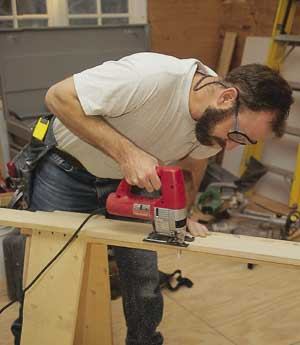
A jigsaw isn’t the first, or even the second, power tool most carpenters buy. But if you’re going to do trim work or install cabinets, it’s one you can’t afford to be without. Over the years, I’ve owned and used a lot of different power tools, but few of them have changed as much as jigsaws. With features like dust blowers, orbital cutting action, and toolless blade and bevel clamps, today’s saws are much easier to use than earlier models.
Applications
Jigsaws have the ability to make curved and irregular cuts with great speed and accuracy. You can make similar cuts with a band or coping saw, but coping saws are slow and bandsaws aren’t portable. Circular saws will cut broad arcing curves, but not the tight radii that jigsaws can. When a carpenter needs to cut a scribe line on a cabinet, countertop, or piece of baseboard, odds are he’ll do it with a jigsaw. The same goes for fitting siding around curved windows and doors or for making decorative trim items like shelf supports and exposed rafter tails. Some carpenters will put a scrolling blade in their jigsaw and use it to cope the ends of crown and other molded trim. Stopped cuts. Carpenters frequently use jigsaws to make stopped cuts. You can use a circular saw or miter saw to notch items like deck boards, window stools, and door sills, but circular blades make arc-shaped cuts, so unless you’re willing to cut beyond inside corners, you’ll need to finish with a jigsaw. Cabinet installers use jigsaws to do sink cutouts and make openings for items like electrical boxes, plumbing pipes, and ventilating ducts. Utility cutting. A jigsaw is also a good substitute for a hacksaw. With the right kind of blades, you can cut aluminum thresholds, threaded rod, angle iron, and most kinds of plastic and metal pipe. Hand-held grinders are better, but in a pinch you can use a jigsaw to cut fiberglass, cement board, and ceramic tile.
Getting a Grip
There are two kinds of jigsaws, ones that have handles and ones that don’t. Saws without handles are known as barrel-grips because you hold them by their barrel-shaped motor housing. Top- handle models are just what they sound like, jigsaws with handles on top. Also known as overhand-grip or D-grip jigsaws, these tools are often barrel-grip models that have been modified by adding a handle and trigger switch. Many tool companies offer the same saw in either configuration. The type of saw you choose is purely a matter of personal preference. In the U.S., top-handle models outsell barrel-grips by a factor of about ten to one. The opposite is true in Europe, where barrel-grips are much more popular. No one knows why this is; it’s just one of those regional preferences like East Coast carpenters using sidewinders and West Coast carpenters using worm-drives. Personally, I like barrel-grip saws because I think they’re easier to control, especially on intricate cuts. Your hand is closer to the work and the tool feels more like an extension of your arm. Barrel-grip models aren’t very tall, and that makes them easier to maneuver in tight spaces, like inside cabinets. But there are good reasons why you might prefer a top-handle saw. For example, they’re simple to turn on and off in a hurry because the trigger switch is right there in your hand. And I think it’s easier to plunge cut when there’s a handle to grab onto.
Switches
When tradespeople talk about why they like a particular power tool, you rarely hear them mention the switch. I’ve heard carpenters get all excited about being able to replace brushes, even though it’s the kind of thing they might do once every five years. But if you ask me, the switch is one of the most important parts of any power tool, because it’s something you use every single time the tool comes out of the case. Jigsaws are made with two different types of switches. Barrel-grip models rely on a slide switch mounted somewhere on the motor housing. Overhand-grip saws use a trigger switch mounted right up on the handle. Slide switches. Slide switches are simple on/off mechanisms, so speed is always controlled by turning a separate thumb wheel. Simply put, the only way to change the speed during a cut with a barrel-grip saw is to have both hands on the saw. One hand operates the trigger, and the other turns the thumb wheel. I’d rather control the saw with one hand and have the other free to steady the workpiece. The biggest issue with a slide switch is where it’s located. Usually, it’s on the top or left side of the motor housing. Being left-handed, I prefer a top-mounted switch because I can get at it with either thumb. A side-mounted switch is impossible to use when it’s under the palm of your hand. That said, if you’re exclusively right-handed, a side-mounted switch might be preferable because it’s closer to where your thumb lies when you use the tool. DeWalt provides a third option and puts the switch on the bottom of the saw. This allows you to activate the switch with the fingers of either hand without having to shift your grip. There are a couple of different kinds of slide switches. The older style slides straight forward for on and straight back for off. No harm’s done if you occasionally fumble to turn a saw on, but in an emergency you’ve got to be able to turn it off quickly. About half of the barrel-grip models have a newer type of switch that slides forward for on, but rocks back for off. It’s easier to turn the tool off because all you have to do is tap the rear end of the switch and it pops backward. Trigger switches. Nothing is easier to use than a trigger switch. Squeeze the trigger and the saw turns on, release it and the saw turns off. It’s even better if the switch is true variable-speed, because then you can control speed by finger pressure alone. About half the top-handle saws I tested have this feature. The rest have a type of trigger switch that only turns the saw on or off. Like a slide-switch on a barrel-grip saw, speed is controlled by turning a separate thumb wheel somewhere on the handle or motor housing. Personally, if I were going to buy a top-handle saw, I couldn’t imagine settling for one without a true variable-speed switch. Otherwise, you have to put both hands on the saw if you want to change speed in the middle of a cut. Another thing to consider when buying an overhand-grip saw is the location of the trigger lock. Some manufacturers put it on the left side of the handle, which is fine as long as you use the tool right-handed. But if you’re left-handed, this can be a dangerous location because it’s easy to accidentally activate the lock with the palm of your hand. Many tool companies have recognized this and put the lock where you can’t accidentally trip it.
Blade Clamps
In recent years, toolless blade clamps have become popular features on jigsaws. They’re mostly a matter of convenience, because they don’t hold blades any better than old style clamps. And some of them aren’t even any faster to use than an Allen key. But most toolless clamps make it less annoying to change blades because you never have to search for lost wrenches. About two-thirds of the saws I tested had toolless blade clamps. The mechanisms vary quite a bit in terms of design and ease of use. Most are activated by turning a knob or pulling a lever on the gear housing. The rest rely on mechanisms that are attached to the end of the blade spindle. Bosch, Makita, and DeWalt have clamps that are activated by rotating a knob or lever on top of the saw. The Bosch mechanism is a little slower to use because you have to rotate the blade so that the teeth face forward after you place it in the clamp. It’s no great hardship but is not the sort of thing you want to do when the blade is hot. The Makita and DeWalt mechanisms are slightly easier to operate, but neither one is significantly faster than using an Allen key. Milwaukee’s toolless blade clamp is one of the best I’ve ever used. To install a blade, you pull back a lever on the nose of the saw, insert the blade, and then release the lever. To remove blades, just reverse the process. This is about as fast and easy as it gets. In addition, if you pull back on the lever and shake the tool, you can frequently get the blade to fall right out of the machine. It beats the heck out of burning your fingers on a hot piece of metal.
Bevel Mechanism
Most jigsaws still require Allen wrenches to adjust the angle of the base. But three companies now make saws with toolless bevel clamps. DeWalt and Makita saws have lever-activated mechanisms that are much faster to use than Allen wrenches. Porter-Cable also makes a toolless bevel clamp, but it’s not as fast as a lever because it rotates rather than pivots. As far as I’m concerned, any toolless bevel lock is preferable to using an Allen wrench. All but one of the tools I tested had bases that tilt 45 degrees left or right for bevel cuts. Usually, some kind of detent slot is milled into the base at common angles such as 0, 15, 30, and 45 degrees. More settings aren’t necessarily better, because carpenters normally change angles only when they need to back-cut scribed pieces, so the exact angle hardly matters.
Baseplates
It used to be that most jigsaws had stamped-steel baseplates. The problem with steel plates was that they were likely to bend if you dropped the tool. These days, it’s much more common to see a cast-metal plate with a steel or plastic insert. A number of saws come with plastic covers that fit in or over the base to prevent it from scratching delicate surfaces. I appreciate the added rigidity of a cast base but wouldn’t go out of my way to get a plastic cover or insert because it’s easy to protect delicate surfaces by covering the bottom of the saw with masking tape.
Blade Action
Orbital cutting action used to be an exotic feature on jigsaws. But nowadays, it’s nearly impossible to find a professional grade tool without it. If your current saw doesn’t orbit, that’s reason enough to replace it. Orbital cutting. Jigsaws cut a whole lot faster with orbital action because the blade swings forward and back as it goes up and down. This aggressive motion is great for cutting wood, provided you don’t mind increased splintering and rougher cuts. A lever on the gear housing controls the amount of orbit. If you need to make cleaner cuts, set the lever to straight-line cutting. You should always do this when you cut metal because the orbiting action will ruin the blade. Blade guides. Orbital action is transferred to the blade by a small cam-activated roller behind the spindle. The roller is usually grooved to house the back of the blade, which prevents it from bowing from side to side as it cuts. Porter-Cable and Festo use smooth wheels to push the blade and slotted guide rods to stabilize it. The guides help but won’t absolutely prevent blades from wandering, especially in thick stock. Speed. All things being equal, cutting speed is a function of blade speed, which is measured in strokes per minute (spm). As far as I’m concerned, the faster the saw, the better. Most corded models have a top speed in the range of 3,000 spm. The fastest cordless model topped out at 2,000 spm, significantly slower than the corded saws. Vibration. One thing to consider when you evaluate power tools is how much they vibrate. I think it’s reasonable to conclude that a tool that runs smoothly is of better quality than one that shakes and clatters. It’s not just a matter of how long the tool will last; it’s also relevant to safety. When tools vibrate, your natural response is to grasp them more tightly. This contributes to fatigue and, over time, to injuries like carpal tunnel syndrome. The spec table below contains my opinion about how much or how little each jigsaw vibrates.
Dust Blowers and Other Features
Most of the saws I tested were equipped with dust blowers, which is a fancy way of saying that some of the cooling air exhausts through the front of the tool. It’s hard not to appreciate this feature when you’ve spent as many years as I have using lung power to blow dust off cut lines. Some of these tools have an on/off switch for the blower, and the rest are on all the time, which is fine by me because I can’t imagine ever wanting to turn it off. Some of the saws come with dust collection ports, and a few more can be equipped with them. In most cases, this option for dust collection has become available because similar models are being sold in Europe, where there are very strict safety standards concerning dust control. The clear plastic shield on the front of the saw is there to aid dust collection. But if the saw isn’t connected to a vacuum hose, the shield gets coated with sawdust, which makes it hard to see where you’re cutting. Luckily, the shields pop right off. Cord length. The saws I tested had cords that were anywhere from 7 to 14 feet long. It’s not a make-or-break issue, but other things being equal, I’d rather have a long cord than a short one. Having an extra couple of feet sometimes makes the difference between finishing a job quickly or wandering around the job site trying to locate an extension cord. Cordless models. A number of companies, including Makita and Metabo, have tried selling cordless jigsaws in the past. These tools didn’t catch on, however, because the batteries of the day weren’t up to the task. But recent advances in technology have made it possible to build a greater variety of cordless tools. Two of the more interesting saws I tried for this article were a 12-volt barrel-grip model from Milwaukee and an 18-volt top-handle from DeWalt. The first thing you notice about these saws is how much slower they cut than corded tools. Milwaukee’s saw has a single speed of 1,700 spm. DeWalt’s saw is variable-speed and tops out at 2,000 spm. Also, these saws differ a lot in weight. Milwaukee’s saw weighs 5.8 pounds, so it feels like you’re using a regular jigsaw. DeWalt’s tool weighs 8 pounds, so it’s noticeably heavier than any jigsaw I’ve ever used. Weight and extra cost aside, I’d be a lot more interested in buying a cordless saw if someone made one that cut as fast as a corded model.
David Frane, a former finish carpenter, is a contributing editor to The Journal of Light Construction.
| Sources of Supply | |
Bosch Power Tools 877/267-2499 DeWalt Industrial Tool 800/433-9258 Fein Power Tools 800/441-9878 Festo ToolGuide Corporation 888/337-8600 Freud U.S.A. 800/472-7307 | Hitachi Power Tools 800/829-4752 www.hitachi.com/powertoolsMakita U.S.A. 800/462-5482 Metabo 800/638-2264 Milwaukee Electric Tools 800/729-3878 Porter-Cable 800/321-9443 |
See page two of article for jigsaw descriptions and specs.