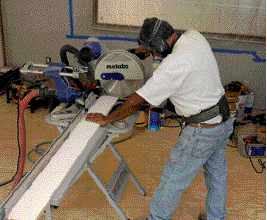
Metabo KGS 305 Specs
Blade: 12-inch-by-1-inch bore
No-load speed: 3,800 rpm
Cutting depth, 90-45 degrees: 45/8 inches to 31/4 inches
Cutting width, 90-45 degrees: 121/2 inches to 91/4 inches
Bevel cuts: 0 to 47 degrees left/right
Miter cuts: 0 to 50 degrees left; 0 to 60 degrees right
Bevel stops: 0, 22.5, 33.9, 45 degrees
Miter stops: 0, 15, 22.5, 31.6, 45, 60 degrees
Motor: 15 amps
Weight without stand: 68 pounds
Street price: saw $649; stand $100; extension tables $200 each; dust-extraction adapter $40
Metabo Corp.
800/638-2264
As a finish carpenter and remodeler, I use a miter saw almost every day. I prefer the compound sliding models because they can cut everything from 2x4s and small pieces of trim to wide baseboards and crown moldings. A few months back, JLC asked me to try out the KGS 305, Metabo’s new 12-inch dual-bevel sliding compound miter saw. The tool showed up while I was trimming out one end of a house, so I was able to give it a good workout over a period of months.
Accuracy
Miter saws are designed to make accurate cuts; sliding models simply do so in wider stock. With so many moving parts and a large 12-inch blade, there is always the chance the cut will wander. I found the KGS 305 to be very accurate; there’s no slop in the mechanism and the blade cuts smoothly with no runout.
Capacity
Like most other 12-inch sliding saws, the Metabo has a 15-amp motor. It easily cuts through poplar, oak, and maple — nothing seems to slow it down. It can cut 12 1/2-inch-wide material in a single pass. Other than Ridgid’s MS1290LZ, which cuts stock of up to 13 1/2 inches wide, most saws in this category are limited to 12-inch cuts.
However, while it’s hard to argue with added cross-cutting capacity, I’m not sure it would greatly affect my buying decision. Most of the material I cut is well under 12 inches wide.
Controls
A miter saw’s controls — particularly the miter lock, bevel lock, and angle stops — get handled more than any other part of the tool except for the trigger, so it’s important that they work well. On this tool, the major controls do work well, but there are some small details that I felt could be improved.
Bevel. With most saws, I have to walk to the side of the machine to reach the knob that locks and unlocks the bevel mechanism. The KGS 305 has a lever-style lock that faces forward, making it easy to reach from the front of the saw. Pull the lever, and the lock loosens its grip; push it back and the bevel is set.
Since the KGS 305 is a dual-bevel saw, the blade tilts both ways, with bevel stops at 0, 22.5, and 45 degrees. There are also stops at 33.9 degrees, the bevel you use to cut crown on the flat.
A red spring-loaded pin on the front side of the rear housing engages the bevel presets. I like everything about the bevel mechanism except the indicator on the bevel scale. Although the scale itself is easy to read, the “hairline” on the bevel indicator is wider than it needs to be.
Miter. The table pivots smoothly and swings to the left up to 50 degrees and to the right up to 60 degrees.
The miter detents engage automatically, but you can override them by using your thumb to depress the red lever just to the left of the table-lock knob. This saw has the usual miter stops at 0, 15, 22.5, 45, and 60 degrees, plus stops at 31.6 degrees (right only), the miter setting used to cut crown on the flat.
The miter scale is easy to read, but the angle indicator is not, due to unhelpful magnification and three different “hairlines,” all of which are too wide. Dust exacerbates the problem. Metabo needs to redesign this part of the saw — which should be easy, since it’s just a piece of plastic. If I were to buy a KGS 305, the first thing I’d do is make a new indicator for the miter scale.
According to the manual, another of the saw’s features — a red lever that sticks out from under the table — can be used to set a custom stop position for miters. This is a nice idea, but the instructions were confusing and neither I nor a finish-carpenter friend of mine could figure out how to make it work.
Depth stop. The tool has a handy adjustable depth stop that allows you to cut dadoes and rabbets by making multiple passes. The stop is on a pivot, so you can go back to making through-cuts by flipping it out of the way.
Returning to the original shallow setting is simple; you just flip it back into place.
Setting Up on Site
Thanks to the KGS 305’s broad and stable base, it doesn’t tend to tip. I tested it with an optional metal stand that sells for $100. The stand — which is very solid — folds flat for transport, much like a folding chair. A hex key that stores on the saw can be used to tighten the four hex bolts that hold the saw to the stand.
Weight. My partner and I had no trouble moving the saw around the site — but there were two of us to handle the weight. Even without the stand, this saw is very heavy. At 68 pounds, it’s 10 to 15 pounds heavier than comparable models from Bosch, DeWalt, Hitachi, and Makita.
Since I set up for long periods of time on the same site and always work with a partner, the weight is not an issue for me. But a carpenter who moves around a lot or needs to set up on his own would probably be happier with a lighter saw.
Table extensions. This saw has the usual telescoping stock supports built into both sides of the table. For about $200, you can buy 41-inch table extensions for either side of the saw.
The saw I tested had a left side extension, which clamped to the table with a lever-operated cam; the right side extension works the same way. A single folding leg supports the opposite end of the table. The extension has a high-quality aluminum fence, an adjustable cutting stop that flips out of the way, and a second stop that extends from the end of the fence.
It’s a handy setup for making multiple cuts, but despite the sturdiness of the extension itself, the single postlike leg means the table isn’t very stable front to back.
Dust Extractor
For about $40, you can buy an optional dust-extraction adapter that plugs into the back of the saw.
This device has two inlet ports and one outlet port. The outlet can be connected to a standard dust-vac hose or to collector fittings of up to 4 inches in size. One inlet collects dust from under the table, and the other connects to the blade housing with a 1 1/2-inch hose.
The system is more effective than most I’ve used, but it still picked up only about 75 percent of the dust.
Verdict
The KGS 305 works very well, but to get the most out of it, you really need to buy expensive accessories like the stand and extension tables. In short, although it’s a great machine for the shop, its weight and the need to haul around bulky accessories make it less suitable for the site.
Roberto Ramirezis a remodeler in Moraga, Calif.

A Cord With Teeth. You’re about to make a cut or drill a hole, but you need just a little more slack, so you give the cord a tug and — you know what happens next. The Push Lock cord from Coleman Cable has a locking female end that the maker claims won’t let go unless you want it to. Sold in 45- and 90-foot lengths, the cord boasts a lighted outlet that shows whether it’s energized and insulation that allegedly remains flexible at minus 40°F. A 12-gauge 45-footer costs about $25. Coleman Cable, 800/323-9355, www.colemancable.com

Pro-Grade Power Strip. Most job sites have plenty of electric tools but comparatively few outlets. The Power Sentry Model 100588 Power Center adds to your supply four conventionally spaced GFCI-protected outlets and, for devices with DC adapters, four wide-spaced GFCI-protected outlets. A built-in cord-winder keeps the 14-gauge, 15-foot cord under control during storage and transport; protective covers keep receptacles free of dirt and sawdust. The power center carries a lifetime warranty and sells for about $40. Power Sentry, 800/852-4312, www.powersentry.com

Locking Plug End. This is one of those devices I can’t believe somebody didn’t think of sooner. The Qwik-Lok Plug replaces the conventional female end of your extension cord with a locking receptacle that operates the same way as quick-connect fittings on airhoses. According to the manufacturer, it works with “virtually any” male plug with holes in the prongs. Perhaps the best testimonial to this product is a photo on the manufacturer’s Web site that shows a wheelbarrow-style air compressor suspended from the Qwik-Lok. The plug sells for about $20. Qwik-Lok, 866/794-5565, www.qwiklok.com
Finish Carpentry

Tight Miters. Every finish-carpentry guru has his own unique bag of tricks for producing high-quality interiors. There is one method, however, that all of the best finish carpenters have in common: preassembly. They preassemble door and window casings, crown for coffers, and components for frame and panel wall treatments — tasks made easier with Miter Clamps from Collins Tool. These sturdy wire clamps — designed to hold miters together while the glue sets — grip corners effortlessly and leave smaller holes than competing products. Special pliers make the clamps easy to open and place. A Miter Clamp 12-pack costs $30; the pliers, $15. Collins Tool, 888/838-8988, www.collinstool.com


No-Slip Grip. Clamping odd-angled surfaces for gluing and fastening can be an agonizing process — but you can minimize the pain with Bessey’s ES Irregular Angle Clamp Set. The ball-and-socket adapter mounts on the pressure plate of standard TGK-series bar clamps, making them suitable for work angled from 15 to 180 degrees. The clamping blocks’ nonmarring pads protect finished surfaces and maximize grip. The ES set — two blocks and two caps; no bar clamp — lists at $35. The ES31/6 kit — two blocks, two caps, two 6-inch bar clamps, and a 31-inch bar clamp — lists at $95. Bessey, 800/828-1004, www.besseyclamps.com
Get Jiggy With It.
Not all the carpenters I’ve talked to are on board with Hitachi’s new hip-hop styling, but most agree that the company’s recently introduced string of tools offers good performance at reasonable prices. One of the newest additions is the CJ110MV Variable Speed Jigsaw. At just under 5 pounds, this saw features electronic variable speed, four-position orbital cutting, and toolless blade changes. The soft rubber compound on the housing does more than make the tool eye-catching: It reduces vibration and improves grip, says Hitachi. The jigsaw sells for $100. Hitachi Power Tools, 800/829-4752, www.hitachipowertools.com