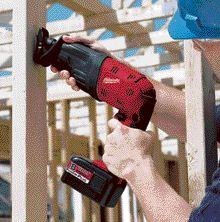
Given the worldwide popularity of the Sawzall, one might expect Milwaukee to rest on its laurels and simply refine its existing models. But about a year ago, Milwaukee introduced the Hatchet. The innovation caught my attention, and I recently had an opportunity to check out this latest addition to the popular Sawzall family. Generally speaking, I found the tool worthy of its heritage.
Figure 1.A distinctive folding handle and small housing allow the Hatchet to get into places other recip saws can’t.
Innovation
Not only is the Hatchet completely different from the first generation of Sawzalls, it also differs from every other cordless recip saw presently on the market. Besides being the only cordless reciprocating saw to include an orbital sawing action, the Hatchet sports a far more innovative feature — a folding handle. Given the kinds of spaces where a recip saw typically finds itself, the benefit is obvious. Measuring 20 inches when fully extended, the Hatchet folds to a sleek 12 inches with its six-position handle at 90 degrees, allowing it to fit easily into standard stud and joist cavities (see Figure 1). The tool’s compactness is not based solely on the handle; the saw housing has been pared to a minimum, too. It’s about one third smaller than a typical cordless reciprocating saw. This diminutive configuration reduces the number of awkward and uncomfortable positions you find yourself in when using a recip saw. Further adding to the saw’s tight-space versatility, the battery can be rotated on the housing, keeping the overhanging battery from getting in your way (Figure 2).
Figure 2.The Hatchet’s battery can be spun around to keep its ample size out of your way. The 2.4-amp-hour pack charges in a little under an hour and powers the tool for about 15 minutes of continuous, heavy-duty cutting.
One-Handed Operation
In addition to the benefit of reduced size, the folding handle and smaller body of the Hatchet result in another valuable feature — one-handed operation. Though probably not recommended by the manufacturer, and certainly not the safest practice, sometimes it’s simply impossible to keep both hands on the saw (when cutting a loose-hanging pipe, for example). When completely folded, the Hatchet’s grip position becomes similar to that of an oversized cordless drill, making it easier and more comfortable to cut with one hand.
Tool Specs
The Hatchet’s blade runs at 2,700 strokes per minute and features a 3/4-inch orbital action. A variable-speed trigger helps start cuts on slippery surfaces, and the orbital setting can be turned off for metal cutting. The pivoting shoe adjusts in and out from the housing, helping to prevent bent or shattered blades when the tip contacts a solid surface or object. And, by setting the shoe to take advantage of the blade segment with its teeth still intact, you can milk each blade for all it’s worth. Blades are held by a tool-less clamping system that works easily and holds securely. The rubber covering on the blade holder should prevent dirt and dust from gumming up the clamp, unlike the tool-less clamp on my corded recip saw.
Some may consider the relatively short, 3/4-inch cut stroke a negative. However, I came to prefer it, because it made plunge cuts much easier to start. The short stroke also allows greater precision when cutting materials you’re trying to salvage, but still cuts as fast as any other cordless reciprocating saw I’ve used. The Hatchet has plenty of power, operates smoothly, and its comparatively lighter weight (8 pounds) meant that I typically reached for this saw first.
Amp-Hour Envy
My biggest disappointment with the Hatchet was its run time. Although I didn’t perform any sort of scientific testing, this saw couldn’t endure much more than 10 to 15 minutes of hard use without draining the battery. I was able to make about 75 cuts in 2×4 stock. But, as we all know, cutting nice clean framing lumber is one thing; nail-embedded, blade-binding demolition is a different matter. After making two cuts in a 2-inch galvanized-steel vent pipe, the saw barely made it through a piece of 1×6.
The answer is to simply plug in a fresh battery. Unfortunately, the Hatchet comes with only one. In other words, to make this tool of practical use, expect to buy at least one extra battery, at about $70. The fact that the Hatchet’s case includes space for two spare batteries leads me to believe that Milwaukee recognizes the limited run time of a single 2.4-amp-hour 18-volt battery. With only two batteries, using the saw continuously is likely to leave you waiting on the nearly one-hour cycle of the charger. Perhaps this is why Milwaukee aptly named this saw the Hatchet and not the Axe.
The Verdict
Nonetheless, I like this tool. It’s a versatile, compact, and powerful cordless reciprocating saw that presently has no equal. The model 6514-21 Hatchet Kit, complete with a roomy case and one battery, has a street price of $250, about $100 more than many corded reciprocating saws. But for tasks like demolition and mechanical rough-in, you can be all over the place without dragging a cord or searching for a place to plug in. My company already has a couple of cordless recip saws, but I liked the Hatchet enough to buy my own.
Joe Harenski is a lead carpenter for Fisher Renovations, a renovation contractor in the Pittsburgh, Pa., area.