Gable ends don’t always get the respect they deserve. Designers have a tendency to focus their attention on the eaves walls, which typically face the road in the front and the backyard living area in the rear. As a result, it’s not uncommon to see gable ends that consist of blank expanses of wall relieved only by the odd window or two.
In a development of houses on tight lots, where the gable ends face one another rather than the viewer, that may be scarcely noticeable. In a more open setting or on a corner lot, though, it can be a real eyesore.
A Sense of Scale
For many design-challenged gable ends, the basic issue has to do with scale. As you approach a building, you instinctively gauge its size by focusing on things like doorways, porches, steps, and railings. The dimensions of those “human-scaled” elements fall into a narrow range determined by the size of the human body, making them obvious visual yardsticks. Without them, the elevation has a blank, unwelcoming appearance, and it’s more difficult to tell how large or far away a structure is. That can make the viewer feel unconsciously ill at ease.
Windows alone don’t work very well as scaling devices because, unlike doors, they can be practically any height or width. Adding muntins sometimes helps, but on an elevation with only a couple of windows, it’s unlikely to solve the problem entirely. And the opposite extreme — a gable end that’s solidly covered with windows — can be just as bad, because there’s no way for the viewer to make a visual connection between the windows and the floors and rooms inside.
Materials and Decoration
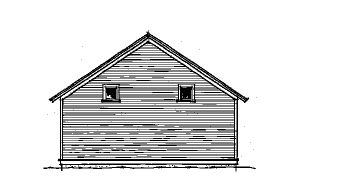
One simple way to add life to a gable end is to change siding materials. The illustration on the bottom of Figure 1 probably won’t win any design awards, but it’s a clear improvement on the version on top.
Figure 1.The gable-end elevation on top, with its two undersized windows, provides no sense of scale; from a distance it’s difficult to tell whether the structure is a house or a larger commercial building. Changing siding at the level of the second floor is a low-cost design improvement, providing the viewer with a clue to the structure’s height (bottom).
Even a relatively subtle change in the siding can have a pronounced effect on a gable end. Shingle-style buildings, for example, often provide visual relief to big open expanses with a flared belt course partway up a wall. A run of crown or bed molding can be added below the flared course to strengthen the effect.
Another approach is to add ornamental trim elements like bargeboards, brackets, or decorative trusswork (Figure 2). This was a common feature of houses in the gothic revival (sometimes known as “carpenter gothic”) and stick styles. In Greek revival designs, a horizontal band of trim at the level of the eaves accomplishes the same thing.
Figure 2.Dressing up a gable end with brackets or other applied ornamentation is another way to add a sense of scale. The contrast between the large windows at the roof peak (each of which is nearly the size of the entry door below) and the much smaller ones to either side is another scaling element.
Lower the Roof
From a standpoint of cost and convenience, a full two-story house has some substantial advantages over a similar story-and-a-half design. The full-height upstairs walls are easier to insulate and finish than the combination of vertical kneewalls and sloping eaves walls found in the story and a half. Two-story designs offer full standing headroom throughout, which adds flexibility to the upstairs floor plan. If the roof is stick-framed, there’s also potential for a roomy attic storage area.
On the other hand, full two-story designs are more challenging to design on the outside. Especially at the gable end of a house with a simple rectangular floor plan, the added height of a full second story can make an elevation seem awkward and boxy (Figure 3). This doesn’t mean that the story-and-a-half approach is “better” (although it may account for some of the design’s long-standing popularity). But it does suggest that as the height of a gable end increases, more care is needed to maintain a satisfying sense of scale.
Figure 3.A two-story plan is a fine way to enclose a maximum amount of space at minimal cost, but without skillful detailing, the gable end often presents an awkward, top-heavy look (top). Lowering the roofline is a simple way to provide a better-proportioned facade, although it complicates the framing and interior finish. Shed dormers can be added if additional space is needed upstairs (bottom).
Add Wrap-Around Elements or Change Shape
One of the best ways to add scale to a tall gable end is to incorporate wrap-around elements like porches or floor-plan bumpouts to the basic structure (Figure 4). This accomplishes two things: It visually broadens the base of the structure, and it provides a way to introduce human-scaled elements.
Figure 4.The stripped-down gable elevation on top is improved by the addition of a wraparound porch and low-pitched dormers (bottom). The broader base also helps tie the house to the ground and provides a sheltering entryway.
Gable ends don’t always have to be symmetrical; where appropriate, they can be stretched or carved into less standard forms. For example, introducing a saltbox profile, with or without additional massing, can add interest to an otherwise bland elevation (Figure 5).
Figure 5.The gable-end elevation on top is balanced and reasonably well proportioned but lacks punch. Stretching the roof into a saltbox shape and adding a subsidiary roof over the entry and floor-plan bumpout make for a more interesting appearance (bottom).
Mark Bromley is an architect in Cabot, Vt.