Last year, while our company was building a large custom home, someone got in over the weekend and stole tools from one of our subs. We were lucky the thief didn’t get any of our stuff — we had ladders, staging, and some stationary shop equipment unsecured in the house, and all the usual smaller tools locked in a 14-foot trailer outside. We’d always done our best to secure things by locking and chaining them as needed, but there’s really not much you can do to protect an unoccupied job site.
After a second, similar theft, I looked into getting an alarm system. There are plenty of products that will protect a trailer, but I wanted one that would also protect equipment in the building and around the site. DeWalt’s Sitelock alarm system (800/433-9258, www.dewalt.com) seemed to fit the bill, so we decided to buy it.
We didn’t know it at the time, but a very similar product is available from Tattletale Portable Alarm Systems (888/835-5668, www.tattletalealarm.com).
We bought DeWalt’s system almost a year ago; here’s what we’ve learned about it since then.
Sitelock Components
The Sitelock consists of a base unit and a variety of 900-MHz wireless sensors. Components are sold separately, so you buy only the ones you need.
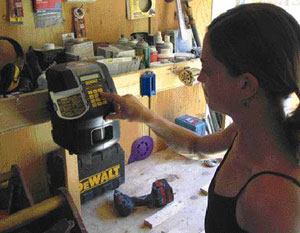
Base unit. The base unit is the “brain” of the system. It uses 110-volt power and contains a keypad, a siren, a strobe, a cellphone, and a backup battery. When a remote sensor is tripped, a message travels to the base unit, which activates the siren and strobe. If you pay the monthly fee for a monitoring service, the base unit also sends a signal to the monitoring station. The station notifies whomever you tell them to — the police, you, or both.
The base unit contains a motion sensor and an internal vibration sensor to trip the alarm if someone tampers with the unit or enters the area where it’s installed. Although I put the base unit in my cargo trailer, I could just as easily have put it in the building.
The unit can be plugged in and placed on a shelf, or hung from the wall with an optional lockable bracket. The system includes stickers and signs to post around the site to indicate it’s protected by an alarm.
Cable sensors. A cable sensor is basically an electronic bike lock. On one end is a black weatherproof box containing a transmitter and battery. The other end plugs into the box and can be further secured by adding a padlock. Once the system is activated, cutting or unplugging the cable sends a signal to the base unit and trips the alarm.
We use cable sensors to secure ladders, scaffolding, compressors, and any other stationary tools we can loop them through. One of our cables malfunctioned after water got into the box, and DeWalt replaced it free of charge. The cables come in several lengths: 2, 6, 12, and 24 feet.
Container sensors. A container sensor is a plastic box that contains a transmitter, a battery, and a vibration sensor. You can attach it to objects like job boxes and stationary power tools, with screws or built-in magnets. Installing the sensor depresses a spring-loaded button on the back; if someone removes an active sensor, the button pops out and trips the alarm. The sensor also goes off if someone moves the object it’s attached to.
The sensor’s sensitivity is adjustable. At the most sensitive setting, the alarm won’t go off if you walk by, but it will if you brush against the object. I use the least sensitive setting; it’s less likely to cause false alarms but will still go off if someone moves the tool.
Conventional security sensors. DeWalt also sells an indoor motion sensor and a door/window contact sensor. These sensors are much like the ones found in a wireless home-security system. The motion sensor uses passive infrared to detect moving heat sources — people — up to 50 feet away. The door/window contacts mount on individual doors and windows, and trigger an alarm when they are opened.
Since we were mainly interested in protecting the trailer and specific pieces of equipment, we didn’t buy either of these sensors. We could have used them to alarm the perimeter of the buildings we work in, but chose not to because our customers often stop by the site when we aren’t there; we wouldn’t want them tripping the alarm.
Using the System
The Sitelock comes with a clear set of instructions and is fairly easy to set up. It took me about an hour to program the base unit and six sensors.
Remotes. The simplest way to arm and disarm the system is by using a key-chain remote. Or if you forget to bring the remote, you can use the keypad on the base unit to punch in a security code.
The first time I tried the key-chain remote, it didn’t work. I called tech support and was told I wasn’t pushing hard enough on the button. I kept trying, and it still didn’t work. In frustration, I pushed so hard I was afraid I’d crushed the thing, at which point it chirped to indicate the alarm was armed. Eventually, the button loosened up and got easier to use.
One peculiarity I still find annoying is that the remote chirps when you arm the system but not when you disarm it.
Monitoring service. The monitoring service costs us about $30 per month. I suppose you could do without it, but really, monitoring is the best part of the system. Each time the alarm is tripped, I get a call from the service. The person who calls asks for my password, tells me which sensor was tripped, and asks if I would like the police to be sent.
Technical Difficulties
During the time I’ve used this system, we’ve encountered a number of problems — some that could be fixed and others we’ve had to live with.
False alarms. We’ve had about eight false alarms, and the cops have been out at least three times. Most of the false alarms happened because someone with a legitimate reason to be on site showed up when the alarm was on and accidentally set it off. For example, a client came through one weekend, saw a container sensor on the table saw, and — wondering what it was — picked it up.
Actually, I’m not unhappy about the false alarms. Considering how long we stay on the same site and how many people come and go, there have been very few. Plus, having the police show up helps prevent “inside jobs” — everyone on site sees that the alarm system is working.
A couple of false alarms were caused by technical glitches — once when the battery in the base unit was totally discharged and another time when the base unit detected false signals from the sensors.
I phoned tech support about the false signals, and the person I spoke with diagnosed it as a problem with the base unit. To DeWalt’s credit, the company replaced the original base unit with a newer model free of charge.
After that, there were no more false alarms from the sensors.
Battery backup. We’ve lost power to the base unit a number of times, which is not a problem as long as the power comes back before the battery is completely dead.
But we did have trouble once when someone unplugged the power over the weekend. The backup battery kept it going for a day, but the system is designed to call the alarm service just before the battery dies. I don’t mind — I want to be notified if the unit loses power.
The real problem came several days later. After the totally dead battery was completely recharged, it sent in a false alarm signal. I called tech support and was told it was a glitch in the system. According to the manufacturer, this glitch does not exist in the newer model we have now. I don’t know for sure if this is true, because the battery on our unit went completely dead only that one time.
Sensor range. DeWalt claims that the base unit can communicate with sensors up to 2,000 feet away. That may be true for certain site conditions, but it was not the case for us. I installed the base unit in an aluminum cargo trailer and discovered that obstructions — especially metal walls — seem to reduce its range significantly.
When the trailer was 60 feet away from the garage where the stationary tools were, the system worked fine. But when the trailer was parked 150 feet away on the other side of the house, it was only about 75 percent reliable. Perhaps the range would have been better if I’d put the base unit in the building and a sensor on the outside of the trailer, but since the trailer is mine I wanted to keep the base unit there.
DeWalt has plans to release a repeater for this unit later this year. The repeater — designed to be mounted outdoors somewhere on site — is supposed to boost the strength of the signal between the sensors and base unit, making the system more effective on large job sites.
Cell signal strength. My only major complaint about the Sitelock is the weak cellphone in the base unit. People working late on the job site have accidentally set the alarm off, but the call didn’t always reach the monitoring center because the cell signal was too weak.
When DeWalt replaced our original base unit, we were told the cell in the new one was twice as powerful as a handheld cellphone. Maybe so, but I can’t tell: I’ve stood in front of the base unit talking on my cellphone while the unit’s indicator light says there is no signal.
I called tech services and was told the cell doesn’t work well in metal enclosures. If that’s the case, the manufacturer ought to produce an external antenna, because a lot of people will want to put the base unit in a metal trailer or storage container.
Frankly, I doubt it was just the trailer; I experimented by putting the base unit in the building, and the cell reception wasn’t much better there.
In fairness to DeWalt, the area where we were working is extremely hilly and can have spotty cell reception. (On the other hand, my own cellphone worked just fine.)
The current fix is to back up the cellular connection with a land line. The base unit can be plugged into a regular phone jack; if the alarm is tripped, it will try to call the monitoring station by cell, but if that doesn’t work it will automatically switch to the land line.
The Bottom Line
In spite of its various shortcomings, I like this system, mostly because it can secure an entire job site and notify the police in the event of a break-in. We haven’t had any more thefts since we installed the Sitelock, and I feel more confident leaving my tools on site with the system in place.
It isn’t perfect, of course; certainly the cell reception could be better and the sensor range more reliable. But given that the system is portable and wireless, it is in general very good.
Moreover, on the occasions that we did have trouble with the Sitelock, DeWalt was quick to replace broken or defective components, and its tech-service advisers were excellent.
Kye Brewer owns Veritas Builders in Sonoma County, Calif.