Compound-angle cuts can put your sawing skills to the test, especially when the angle exceeds your circular saw’s tilt capacity. One solution is to draw the appropriate angle across the top edge of the rafter, align your handsaw, recip saw, or even chainsaw, and make the plumb cut as best you can.
Confronting a double cheek cut on an irregular hip rafter, I made a quick, logical jig to adapt my circular saw to cut acute angles greater than 45 degrees. Every angle has a reciprocal angle, easily determined by subtracting the primary angle from 90 degrees.
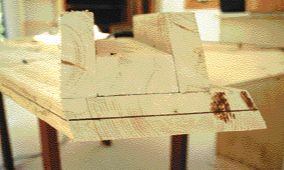
Let’s say you want to cut a 62-degree angle; its reciprocal is 28 degrees, well within the capacity of any power miter saw. Set the miter saw to 28 degrees and cut three short pieces of 2×4 — one across the edge and two across the face — and shoot the pieces together with their angles aligned. Cut your rafter to length with the circular saw tilted to 28 degrees, align the jig along the cut, and screw or clamp it to the workpiece. The jig creates a surface wide enough to support the base of your circular saw. Draw the rafter centerline down the face of the single cheek cut, set the saw to cut at 90 degrees, and cut along the line.
Even if you have only one or two cuts to make, you’ll probably beat the time it would take with a handsaw and be more accurate than a chainsaw.
Align and fasten the jig block along the beveled plumb cut (top). With the circular saw set to cut at 90 degrees, cut down the center of the bevel face using the jig as a base for the saw (middle). Above, the finished 62-degree cut. Patrick Walsh is a carpenter in North Eastham, Mass.