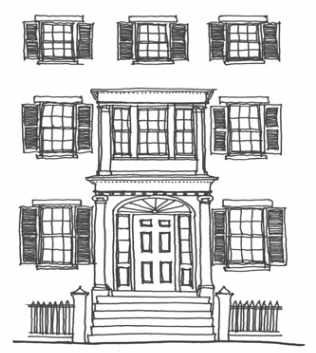
A bay window relates to an exterior wall in much the same way that a dormer relates to a primary roof. Like a dormer, a bay window captures extra space and daylight for the primary volume. Also like a dormer, it can enliven an exterior elevation. If formed, scaled, and positioned appropriately, it can contribute to a favorite interior space while creating a unique exterior feature.
There are essentially three types of bay windows — entrance bays, novelty accent bays, and expanded footprint bays. An entrance bay serves two primary purposes: providing cover for and calling attention to the entrance below. A novelty accent bay is generally trimmed underneath with brackets or corbels — rather than extending to the foundation — and punctuates the elevation, giving it personality. An expanded footprint bay can be a single- or multiple-story component; it extends to the foundation and increases interior square footage while remaining subordinate to the overall mass of the structure.
Each type of bay can take a variety of forms — rectangular, triangular, multifaceted, semicircular, bowed — and can be capped with any of a number of roof types: flat, hipped, shed, domed. The challenge is to select a form and a roof type compatible with the bay itself and with the building in general. As with dormers, combining too many different forms or roof configurations on one structure will result in a confused hodgepodge.
Rectangular Entry Bay
Placing a bay on an otherwise flat continuous exterior wall can announce an entry while providing shelter for the doorway. Such bays offer prized views down the street as well as across it, while admitting daylight from several directions.
Because these bays are rectangular, they create interior niches well suited to a desk or built-in bench.
This bay type needn’t be restricted to traditional homes. By changing the window type, trim, and post configuration, you can create a more contemporary bay. In the case shown here, the flat roof is appropriate to the bay’s rectangular form and the building type it adorns.
Rectangular Entry Oriel
The bracketed bay at left is also known as an oriel: It doesn’t extend down to a foundation or supporting columns. This bay uses supporting brackets instead of columns, probably because it isn’t quite deep enough to accommodate a generous entry porch below; columns might have resulted in a more confined and formal entry. The brackets allow unencumbered, open space underneath.
Angled Oriel
The angled oriel below punctuates a playful faade. Its hipped roof and hipped wood corbeling complement its angled form.
The decision to place the bay off-center may have resulted from an interior floor-plan requirement, or it may have been an effort to create a counterpoint to the entry door beneath. However, it appears a little too large to function as a counterpoint to the rather modest entry.
If we could take it back to the drawing board, it might work better in its current location if it were scaled down with smaller windows. This would result in a smaller bay that would relate better to the scale of the entry. Or we could relieve the balance issue by shifting it, at its current size, to the center of the gable.
Semicircular Oriel
The semicircular novelty oriel at left provides an otherwise austere elevation with whimsical visual relief. The domed roof and curved corbeling underneath are well suited to the cylindrical form, and together create a jewel-like feature.
From within, this bay creates a peekaboo 180-degree view and welcomes omnidirectional daylight.
Both of these oriels — angled and semicircular — grow more organically out of the exterior wall than rectangular bays would. Their shape helps keep them clearly subordinate to the primary volume while furnishing an animated visual accent.
Offset Two-Story Expanded Footprint Bay
The two-story rectangular bay below adds considerable floor space and daylight to the interior without overwhelming the exterior elevation. The roof skirt between the first and second floor relates nicely to the bracketed entry roof overhang; without the skirt, the bay might have seemed towering. The flat roof keeps the bay from visually interfering with the triangular pediment suggested by the eaves returns and is stylistically appropriate for this Greek Revival hybrid.
Repeated One-Story Expanded Footprint Bay
Angled bays with hip roofs add rhythm to this elevation and work well with the hipped roof of the entry porch. The bay to the left lends the entry a touch of privacy, too, without obscuring it. And, because the bays extend down to the foundation, they bring space and light into the basement.
The hip roofs allow the bays and the porch to appear more integral to the main volume. The hips are perhaps more informal than flat roofs, which also would have worked stylistically with the Greek Revival hybrid.
Bays That Don’t Work
The bowed bay at right fails functionally, in both type and form. For one, the angle of the segmented windows is too shallow to provide additional interior space or even to admit light from multiple directions. Plus, the window type isn’t compatible with the primary windows. Even worse, the bay cuts awkwardly into the rake fascia. Although perhaps meant to be a novelty bay, the result is more of a blemish on the gable end than a desirable accent. If the goal was to admit light within this pediment, a small oval window may have done the trick.
The stock bay unit below is too small for the overall gambrel end elevation. An enlarged bay surround with wider mullions, taller head trim, and panels or shingles underneath — as well as beefier brackets — would look better. This better-articulated, larger bay would “mediate” between the scale of the garage door and the upper windows. Also, swapping the blank center picture window for a pair of double-hungs and replacing the flanking casements with one double-hung each might further improve the bay’s relationship to the windows above.
Last, the shutters on this bay have got to go. For shutters to work visually, they need to be sized as if they could actually close over a window to fully protect it. Closed, these little shutters would leave the center window completely vulnerable. Though the shutters may have been included to help the bay look larger, they’re not effective.
Design Opportunity
Bays present an opportunity to create a distinctive feature. Rather than opting for an off-the-rack bay-window unit, consider assembling stock window sizes within a custom surround. Stock units generally lack the charm of a carefully designed one-of-a-kind bay.
Start by focusing on what you hope a window bay will help you achieve, then select the appropriate type — entry, accent, or expanded footprint — to accomplish your goal. Next, look to the overall house to shape the bay form and roof type.
Katie Hutchisonis an architect and the owner of Earthlight Design in Salem, Mass.