All stairs, from the humblest flight of cellar stairs to the most elegant curved entryway stairs, share the same broad functional requirements: to provide safe and comfortable passage from one level of a house to another.
But beyond practical considerations, a main stair is also one of a home’s most important design features. It’s often located in the front entry, where its craftsmanship is on display, and its positioning and layout have an important bearing on the overall character of the space it serves.
Straight Stair
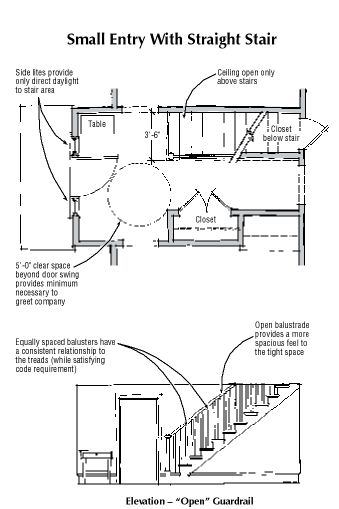
Consider the moderately scaled traditional entryway, which includes vertical circulation space to the second floor as well as horizontal circulation in three directions. The single-run stair is set off to one side of the hall to save space in this relatively tight passage. To avoid feeling cramped, an entry benefits from a 5-foot clear space beyond the swing of the front door for greeting guests, which this plan just achieves.
Had an L-shaped stair been used instead, it would have closed off the straight-ahead path to the rear of the house and forced all circulation through the more formal front rooms to either side. At 3 feet 6 inches wide, the stair shown here is more comfortable than the general building code minimum width of 3 feet, but it’s not overly grand and doesn’t draw too much attention to itself.
The no-nonsense mood of this entry extends to the opening in the floor above, which is no larger than the stair itself. While it might seem appealing to give the entry a more open feel by enlarging the opening above, that could be a mistake, limiting upstairs floor space and privacy without improving the downstairs.
Ell-Shaped Stair
Like the previous entryway, this provides a greeting space, access to a closet, and circulation. But here the scale is slightly increased, and the flow through the space has a more expansive, less traditional feel. Rather than entering into the center of the home, this entrance is off to one side to allow the stair to follow the ell shape of the exterior wall.
The generous width and length of the room allow it to accommodate a comfortable ell stair as well as a gathering of guests and furnishings, making this entry suitable for entertaining. Thanks to the intermediary landing where the stair changes direction, there’s opportunity when descending to pause and take in the scene below as well as to be seen. The stair’s change of direction prevents guests below from seeing directly into the private realm of the hall above.
The width of the ell stair is 4 feet at each run to correspond to the larger overall scale of the space. The increased scale also makes it possible to extend the second-floor opening well beyond the stair to admit daylight from above. The double-height space adds a touch of drama, drawing guests away from the side hall toward the main entertaining space of the adjacent living room.
The “semi-open” guardrail used here is a whimsical collection of simple components. It needn’t be as open as the guardrail illustrated in the straight stair example since the space it occupies isn’t as confining. Some small solid infill panels produce a decorative treatment without creating a visually heavy guardrail. The closed stringer provides a little more flexibility in developing a baluster rhythm independent of the treads. The overall guardrail pattern may be influenced by other motifs in the home or might introduce a theme to be reflected elsewhere. The post-to-post rail acknowledges the slower pace of ascending a stair that includes an intermediary landing and change of direction.
Katie Hutchisonis an architect and owner of Earthlight Design in Salem, Mass.