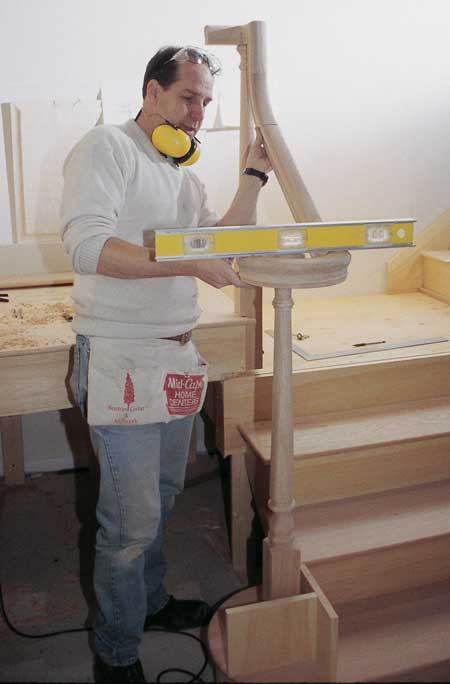
Building stairs is one of the most difficult parts of building a house, and building handrails is the most difficult part of stair building. There are two types of open handrail systems. The first is the post-to-post system, in which the rail is cut to fit between the individual newel posts and the posts extend above the rail line. Height change is achieved by using different post lengths and types.
In the second method, known as the over-the-post system, the handrail runs in an unbroken flow from bottom to top of the stair flight. This provides a nice clean look, but it makes for a more challenging installation. Unlike the post-to-post system, where the rail can be cut into the post at one height and exit the post at another, changing height or direction in an over-the-post system involves several types of stock transition fittings that must be precisely cut and fitted at the job site.
Every cut has to be dead on, and because fittings range in price from $30 to $300, errors quickly become costly. I use stair parts from two companies, L.J. Smith Stair Systems (740/269-2221, www.ljsmith.net) and Coffman (276/783-7251, www.coffmanstairs.com).
Establishing the Handrail Centerline
In most installations, the 3/4-inch turned tenons at the base of the balusters are simply glued into matching holes in the treads. Standard baluster alignment is usually flush with the face of the skirtboard. But long balustrade runs, and especially long over-the-post runs, must be made as stiff and strong as possible. I sometimes reinforce the connection with dowel bolts — double-ended wood screws that anchor the bottom of the baluster directly to the stair carriage. For the bolts to have something to bite into, the centerline of the railing has to sit squarely over the carriage; so I plan my layout with that in mind.
Another exception to standard centerline layout is a partly enclosed staircase, which often has only three or four treads open at the bottom of the run. In that situation, the upper end of the handrail has to land squarely on the center of the buttress wall, thus determining the centerline.
Band-aid blocking. Where the end of the handrail terminates at a buttress wall, as described above, the face of the last wall stud provides solid backing for the railing. In other cases, though, the handrail terminates in the middle of an unbacked drywall-covered stud bay. This is outside my control, since I’m not around when the blocking is installed. Hollow wall anchors are far too weak to support a railing, so I’ve worked out a method of quickly adding a backer block or two where needed (see “Retrofit Blocking,” below).
Retrofit BlockingAll too often, I encounter a hollow stud bay right where I need a solid mounting for a handrail or end-newel. Because I’m a finish guy, I’m reluctant to tear open the wall and install blocking. To avoid that, I’ve learned to reinforce the wallboard where needed without creating an extra drywall repair job. After marking the handrail or bracket location and tracing the outline of the handrail rosette on the wall, I cut a rectangular hole in the drywall within the traced outline and set the cutout aside. The hole is wide enough to allow me to slip a strip of 3/4-inch plywood, well coated with construction adhesive, inside the wall cavity and secure it to the back of the wallboard with a couple of drywall screws (above). Then I screw the cutout back in place, and the rosette conceals everything. Once the construction adhesive cures, the connection is quite strong. –K.R. |
Newel Posts
Once the centerline of the handrail is determined, it’s easy to locate the newel posts. On a stair with a change of direction, posts are best located where handrail centerlines intersect. In some cases, though, I can’t place a post exactly where I’d prefer. For example, the ideal newel location may coincide with a metal joist hanger, preventing doweling or bolting in that location. I-joists and LVL beams can also create connection problems, as notching or drilling may compromise their engineered performance rating.
The need to keep baluster spacing uniform may also force me to adjust or relocate a newel forward or back of center. But any change in newel location, forward or back along the rail line, affects the height of the rail relative to the post, so individual post height is a critical concern.
Using a pitch block. To calculate a gain or drop in post height, I make a simple gauge called a pitch block for every stair I build. A pitch block is just a scrap of finish lumber or plywood, cut square to the height and depth of a single riser and tread, then cut diagonally from corner to corner (see Figure 1).
Figure 1.A pitch block is a simple gauge that’s useful for determining post and rail height adjustments on offset newels. It’s easily made by marking the diagonal between tread and riser on a square-cut lumber scrap (top), then cutting it to the line with a radial arm saw (bottom).
Measuring a plumb line anywhere along the base, or tread line, of the block shows the exact rise relative to the horizontal distance traveled, and thus how much to add to, or deduct from, standard post height.
Rail height. In most cases, rail height is regulated by code. Generally, standard handrailing must be between 30 and 34 inches, measured plumb from the tread nosing to the top of the hand rail. But the building inspector may determine that the handrail must also qualify as a guardrail. Minimum guardrail height starts at 34 inches, so I typically default to a 34-inch-high hand railing as a play-it-safe standard.
Starting newels. At the bottom of the rail, a starting newel supports a handrail volute — a starting rail fitting that scrolls left or right — or a curved starting-rail fitting called a turnout. Starting newels are available in both adjustable and nonadjustable versions. A nonadjustable newel typically has a 9-inch-long by 1 1/2-inch-diameter dowel bottom and a 1-inch-diameter pin top for securing the rail fitting. Because its length is fixed, this type of newel dictates the height of the finished railing.
Adjustable newels are similar, but instead of having a fixed dowel bottom, they’re end-bored for a separate anchor dowel and can be trimmed to the exact length needed (Figure 2). I prefer the adjustable option so that I can fine-tune the railing height as needed.
Figure 2.Adjustable starting newels are end-bored for an anchor dowel, which permits trimming them to length as needed (top). Once the position of the starting newel has been determined with a paper template (middle), the starting step is drilled through to the subfloor and the newel is dropped into place (bottom).
The starting step is drilled full-depth, through to the subfloor, to accept the newel dowel. A starting volute comes with a paper template, used to determine the newel location on the starting tread. Although baluster locations are also indicated on the template, I ignore them — they almost never match the on-site spacing.
Transition newels. Newels at a landing where the stair and handrail make a turn are typically notched onto the riser and tread and anchored using hardened-steel lag bolts. I like RSS screws (GRK Canada, 800/263-0463, www.grkfasteners.com). The post should be notched only enough to center it on the railing layout line and baluster spacing in both directions. Two lags are normally sufficient to secure the newel post (Figure 3).
Figure 3.Newels at a landing are notched and fastened with hardened lag bolts (left). The recessed holes will later be plugged and sanded smooth. Where the newel is let into the stair nosing, the author provides a neat joint between post and tread by cutting an undersized notch and routing a matching profile in the face of the newel (right).
In addition, I always use a good construction adhesive, such as PL-400 (OSI Sealants, 800/321-3578, www.osisealants.com), when fastening newels. The lag heads are recessed in 1-inch-diameter holes, which are later plugged and sanded flush. The overall height of a simple transition newel must be at least equal to the starting newel height plus the first riser of the continuing flight.
Nosing support. The overhanging tread nosing must also be notched to let the newel in against the riser. Rather than notching to the full width of the newel, I cut out the nosing 1/2 inch narrower than the newel, flush to the face of the riser. Then, at the tread line, I trace the projection of the nosing profile onto both sides of the post face and use a router to plow a 1/4-inch-deep, contoured recess. This method makes a strong, neat joint between tread and newel and supports the nosing at the cut.