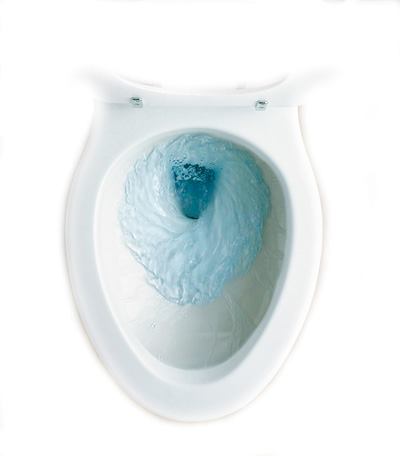
When Congress passed the Energy Policy Act of 1992, plumbing-fixture manufacturers were given less than two years to convert from the standard 3.5-gallon flush to 1.6 gallons. With little time available to completely re-engineer their products, most of them approached the problem in the simplest way possible: They rolled out water-saving toilets that were essentially modified versions of existing products, with smaller tanks and narrower trapways meant to give the reduced water volume enough velocity to provide an adequate flush (see Figure 1).
Figure 1.The pre-1992 fixture (top) had an open trapway design that resisted clogging but required 3.5 gallons of water per flush to develop the force needed to move waste through. The early low-flow toilet (center) relied on a much narrower trapway that added velocity to the flow but was far more likely to clog; the limited supply of water also translated into a smaller water spot in the bowl, increasing customer complaints about “skid marks.” While the modern fixture, at bottom, also has a narrow trapway, better engineering provides a more efficient flush and a water spot almost as large as that of the old 3.5-gallon model.
The results left a lot to be desired. The early low-flows quickly earned a reputation for clogging and failing to clear the bowl, often requiring the user to double flush. “It was like Las Vegas,” says Virginia plumber Rex Cauldwell. “You’d pull the lever and take bets on whether it was going to go down or not.”
That reputation persists because toilets last a long time and many of those early versions are still in service. In reality, though, fixture manufacturers have come a long way in the past decade. Most of the current crop of 1.6-gallon toilets perform as well as or better than the 3.5-gallon models they replaced.
Gravity Toilets
Like their predecessors, most of today’s low-flow fixtures are powered purely by gravity. Depressing the flush lever lifts a flapper valve in the base of the tank and allows water to flow through the hollow interior of the rim and through strategically placed holes in the rim. At the same time, part of the flow — the so-called siphon jet — is directed into the outlet, where it pours up and over the trap to start the siphoning action that drains the bowl of waste.
Traps and tanks. What makes the new toilets perform so much better than the old ones? For one thing, the science of trapway design has come a long way in the past few years. Toilet manufacturers now use sophisticated computer-modeling techniques to develop traps that provide optimum flow and reduce the frequency of clogs.
Another improvement has been the use of larger tanks to provide increased head. Victorian-era toilet designers accomplished this by mounting the tank on the wall, several feet above the bowl, but modern low-flows use a simpler approach. While the toilets use the required 1.6 gallons per flush, their tanks may contain three gallons or more, which means that the tank never empties completely. As the water flows from the bottom of the tank during the flush cycle, the added weight of the unused water above provides a more forceful flush.
This suggests that, all other things being equal, a one-piece “lowboy” toilet could be expected to deliver a less forceful flush that its two-piece counterpart. American Standard engineer Peter DeMarco confirms that one-piece fixtures do pose some design challenges. “You don’t have the gravity head, so it’s more difficult to get them to perform,” he says. “You have to change the internal configuration in other ways to compensate.”
Another advantage of increased-head tanks is reduced sweating in hot, humid weather. Because the tank isn’t completely refilled with cold water after each use, the water left in the tank has time to warm up to room temperature. That tempers the incoming water and is often enough to keep the outer surface of the tank above the dew point.
Valve size. Most toilet manufacturers use the 2-inch flush valve that has been the industry standard for about a century. The sole exception is Toto, which introduced a 3-inch valve in 1997 (Figure 2). According to Toto engineer Fernando Fernandez, the resulting high rate of flow from tank to bowl results in an especially rapid, forceful flush. Fernandez claims that other manufacturers haven’t adopted the 3-inch valve because Toto holds the patent to the specific trap configuration needed to make its system work.
Figure 2.The 2-inch flapper valve at right has long been the industry standard. A new 3-inch valve recently introduced by Toto (left) empties the tank faster and provides an aggressive flush with little swirling in the bowl.
Pressure- and Vacuum-Assisted Toilets
Consumers who want or need a more powerful flush than gravity alone provides can choose from a wide range of pressure-assisted models. In place of the unpressurized water tank, flapper, and fill valve found in the back of a standard toilet, pressure-assisted fixtures contain a manufactured energizing unit that works something like the pressure tank in a private well system.
After each flush, household water pressure fills a sealed vessel, creating a cushion of compressed air at the top. When the lever is depressed again, opening the flush valve, the pressurized air rapidly forces the trapped air into the bowl to provide what’s best described as a commercial-type flush. In fact, pressure-assisted units were largely confined to commercial applications until a decade or so ago, when the relatively poor performance of the early low-flow fixtures brought them into the residential market. Two Michigan-based companies — Sloan Flushmate and W/C Technology Corp. — manufacture all of the pressure units installed as original equipment by U.S. plumbing-fixture manufacturers (Figure 3). In addition to the standard 1.6-gallon unit, Sloan recently introduced a new model, the Flushmate IV, which uses just 1.1 gallons per flush.
Figure 3.Pressure-assisted toilets use air trapped in a sealed vessel to deliver a forceful — and noisy — flush. Although pressure-assisted fixtures are outwardly similar to conventional gravity toilets, bowl and trapway designs differ. As a result, existing gravity fixtures can’t be adapted to work with a pressure-assisted unit.
Bang for the buck. Pressure-assisted toilets typically cost about $150 more than comparable gravity fixtures. Some plumbers find that they’re a good choice in problem applications, such as in an old drain system with marginal venting.
Aside from the added cost, the biggest drawback to pressure-assisted units is noise. A pressure-assisted flush is both louder and more abrupt than that of a gravity fixture, which gives them a high “startle factor.”
“Women hate them,” says Bellevue, Wash., plumber Terry Love. “When you’re trying to be quiet when you get up in the middle of the night, you’re not going to want to flush it at all.” Another drawback, Love observes, is that the rapid flow through the trap tends to shred toilet paper, allowing small particles of paper to drift back into the just-emptied bowl.
The “tank-within-a-tank” approach of pressure-assisted toilet units prevents condensation from forming on the external porcelain tank. On the other hand, condensation can form on the surface of the pressure vessel inside the tank, where it may provide a breeding ground for mildew.
Fixtures with pull. A quieter but less aggressive method of adding force to a flush is the vacuum assist incorporated in several models offered by Crane and Briggs. Like pressure-assisted fixtures, vacuum-assisted models contain sealed vessels that refill with each flush. But instead of becoming pressurized during the fill cycle, the vacuum chamber is designed to create negative pressure as water drains from the tank during the flush. Integral tubing connects the vacuum chamber to the upper bend in the trapway, providing added suction to help clear the bowl (Figure 4).
Figure 4.The outwardly conventional-looking Briggs Vacuity (top) develops increased flushing force with an internal tank-mounted vacuum-assist unit (above). As water drains from the closed unit during the flush cycle, an internal connecting tube induces a partial vacuum in the upper portion of the trapway.