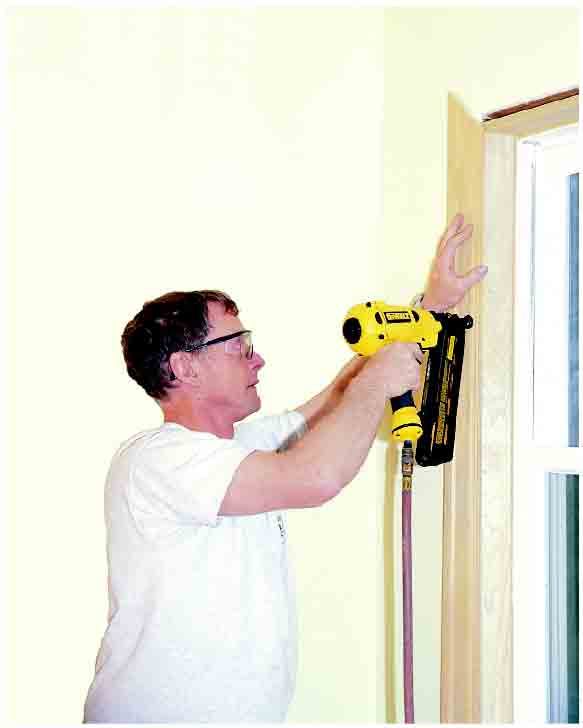
A finish gun is at the heart of any trim carpenter’s tool kit. Production carpenters may favor 16-gauge tools because the fasteners are cheaper. But as a custom finish carpenter, I’ve always preferred 15-gauge guns because the thicker nails hold better and are less likely to bend. And because 15-gauge fasteners are collated at an angle, the guns work better in tight spaces. For this article I tried out nine different 15-gauge angle nailers. Some of them have been around for years, but a few are brand new.
Power
Most guns have adequate driving power, but some are better than others. According to Senco, its gun generates 380 inch-pounds of force. And Bostitch says its gun packs a 400-inch-pound wallop. But most companies don’t release this data, and the only test that counts is how well the tool drives nails.
I tested power by shooting 2 1/2-inch nails into 3-inch fir and mahogany. Most guns had no trouble setting fasteners in either, so I tried them on hard maple. It was asking a lot, but I figured any gun that sets nails in maple will have no trouble with standard trim items.
Most of the guns set nails in everything I put in front of them. But a few had trouble. Makita’s gun set nails in maple but just barely. The Campbell Hausfeld would not set nails in maple and barely handled mahogany, which is similar in density to poplar. Unless I removed the rubber tip protector, the Duo-Fast wouldn’t set nails in much of anything.
Weight
A light gun is easier to handle than a heavy one and produces less fatigue over the course of a workday. Until recently, Hitachi’s 4.2-pound nailer was the lightest tool around. But that was before Bostitch and DeWalt broke the 4-pound barrier by substituting magnesium for aluminum in the castings. The Max and Senco guns fall in the middle range with guns that weigh just over 4.5 pounds. I would consider the rest of the guns heavy, with weights between 5.4 and 6 pounds.
Configuration
Except for Max, the companies that make high-end nailers have all gone with in-line magazines. In-line guns are symmetrical so they work equally well in either hand. The magazines of some tools are set to the left, which makes it easier to keep the hose out of the way when you work right-handed.
Firing Modes
In a few years, most finish nailers will come with sequential trip. That is, you won’t be able to bump-fire them in their factory configuration. Most guns come ready to bump-fire, but others have to be converted from single-shot. Campbell Hausfeld’s gun is easy to change over; all you do is remove a set pin. The Bostitch and Porter-Cable tools are sequential trip but can be converted to bump-fire by changing triggers. Duo-Fast’s gun is sequential trip only.
Max and DeWalt both bump-fire but come with user-activated trigger locks. In addition, the Max gun has an anti-double-fire mode that prevents accidental second shots.
Max’s NF550 features both a trigger lock and an anti-double-fire mechanism.
Depth-of-Drive
At one time, carpenters controlled depth-of-drive by changing compressor settings. These days, though, finish nailers have depth-of-drive mechanisms that work by changing the length of the contact element. On most tools, you make the adjustment by turning a thumb-wheel on the safety linkage. The DeWalt gizmo is different; you operate it by sliding a lock button near the trigger. I particularly like the mechanisms on the DeWalt and Hitachi guns because settings are indexed to a scale, which lessens the need for test shots.
It’s easy to gauge depth-of-drive on the Hitachi nailer because the adjuster wheel is indexed to a scale.
DeWalt’s depth-of-drive is easily adjusted by sliding a button under the trigger.
Tips
Metal contact elements can scratch the work, so finish guns come with protective plastic tips. Big button-shaped tips prevent scratches, but they also block your view. Senco and Porter-Cable make it easier to see what you’re doing by covering their elements with thin plastic sheathes. DeWalt took the idea further by bonding strips of padding onto the parts that touch the work. Short of working with a bare metal tip, this design gives you as good a view as you’re going to get.
Tips work pretty much the same when you nail straight into the stock. But curved tips are better for nailing at an angle because they maintain a constant distance between the driver and the work. This decreases the likelihood of under-driven fasteners. The Senco, DeWalt, and Porter-Cable guns have heavily contoured tips. Bostitch, Makita, and Max achieve similar results by chamfering the edges of their buttons.
DeWalt’s tip protector is bonded to the contact element and doesn’t block your view of the work.
The contoured tip on the Porter-Cable gun makes it easier to nail from an angle.
Adjustable Exhaust
Finish nailers used to have fixed exhaust ports, which meant you were bound to catch an occasional face full of drywall dust while nailing baseboard. But those days are gone — adjustable ports have become standard equipment on finish nailers. Most guns have ports that rotate 360 degrees, but Senco uses a dated design that allows you to aim the blast in only one of four directions.
A few of these guns are so light that if you aim the port sideways, the recoil from the air blast will kick the gun to the side. It’s especially noticeable with the DeWalt nailer, and you can feel it slightly on the Bostitch. However, the problem is easily solved by aiming the port slightly forward or back from 90 degrees.
Magazines
Some magazines lock and load, while others load and lock. It’s a three-step process to put nails in a lock-and-load gun, retract the pusher, load the fasteners, then release the pusher. I prefer load-and-lock because you can skip the last step — just slide in the nails and pull back on the pusher.
Big magazines are better because they’re easier to top off and you don’t have to load them as often. The average gun holds 100 fasteners, but some take more. Senco and DeWalt hold 110, Makita 125, and Bostitch 130.
Manufacturers save weight by substituting composition materials for metal in magazines. The composition magazines often have an open web design, which saves more weight and makes it easier to see what size fasteners are inside.
Other Features
It wasn’t long ago that you had to disassemble the front of the gun to remove bent fasteners. But these days you can clear jams without tools. In most cases you do this by popping a latch on the nose of the gun. On the Bostitch, you do it by releasing a catch on the magazine and popping it back from the tip. Every tool I tested comes in a plastic case and has some kind of padded or molded grip surface.
The front of the Bostitch gun is particularly sleek because jams are cleared by popping the magazine back from the nose.
Oil vs. no oil. The problem with oil is that if you forget to use it, the gun wears out quicker. Plus, oil will blast by worn seals and spray the work. Senco invented the oil-less nailer and for a long time was the only company that made one. But the latest version of the Bostitch gun is also oil-less.
A built-in air gun on the Hitachi nailer makes it possible to clear dust from the work without using a separate air nozzle.
Fastener Type
There are two types of 15-gauge angle nails: the DA type that was invented by Senco and the FN type from Bostitch. The only two guns that take FN nails are the Bostitch and the Makita. Most guns take DA nails. There are only minor differences between the DA and the Bostitch-type fasteners. DA fasteners are collated at a slightly steeper angle and have rounder heads than the Bostitch nails. Both types are available in a variety of finishes and materials. Senco recently introduced a hardened DA nail designed to fasten trim to steel framing.
Favorite 15-Gauge Nailers
It’s hard to choose a favorite 15-gauge nailer because there are so many good ones out there. If I had to buy one tomorrow, I’d probably go for DeWalt or Hitachi. But you wouldn’t have to twist my arm to get me to consider Bostitch or Max. All four guns have power to spare.
DeWalt’s D51275 is one of my favorites because it’s powerful, extremely light, and equipped with well-conceived features like a belt hook, indexed depth-of-drive, and a tip that doesn’t block your view. I like the Hitachi NT65MA because it’s a lighter-than-average gun with a comfortable padded grip and a very cool built-in blow gun. The Bostitch N62FN is extremely powerful and is the lightest 15-gauge nailer you can buy. It’s sleek and uncluttered and is one of only two guns that doesn’t need oil. Max’s NF550 is a well-made tool with superior features like a trigger lock, a large depth-of-drive wheel, and an anti-double-fire mechanism.