I’m a small custom home builder and remodeler in northern Vermont. I install enough strip flooring every year that I found it necessary to buy a Bostitch flooring stapler seven years ago. The tool has always been dependable, so I wasn’t really in the market for a flooring nailer, but when JLC asked me to test five pneumatic flooring nailers on a recent job, I thought it would be interesting to compare. My helper, Kyle Darling, and I laid around 2,200 square feet of 3/4-inch oak and ash flooring using the five guns and kept notes on how the guns performed.
We looked for the same features in these nailers that you would look for in any pneumatic nailer: power, ease of use, ease of loading, weight, and balance. Because flooring nailers are specialized, we also looked for features that might make one gun more useful than another, when nailing close to a wall, for instance.
Pneumatic floor nailers, from back to front: Porter-Cable FCN200, Bostitch MIIIFN, Senco SHF50, Powernailer 445, Portamatic Hammerhead 2 (set up for face nailing).
Bostitch MIIIFN
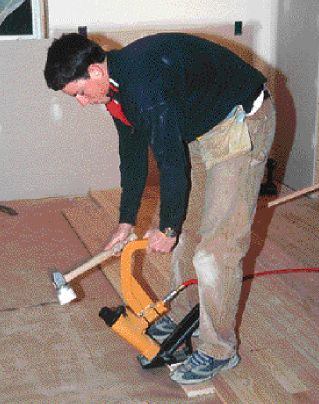
This tool was very familiar to me — it’s essentially the same tool as my stapler, only set up for floor cleats. Like other Bostitch tools I’ve used over the years, this one is ruggedly built. It was easy to load and had plenty of power. It took only a light strike with the mallet to actuate the driving pin, which enabled us to nail fairly close to a wall, where there wasn’t room for a full mallet swing. However, with a more energetic swing, the nailer had the power to drive the flooring tight.
Bostitch MIIIFN
The nailer was well balanced and easy to grip and position on the flooring. At first, the gun would hang up on the tongue when we set it in place, but we found that a thin cardboard shim placed under the plastic shoe took care of that. (This may well have had to do with the milling of the particular lot of flooring we were working with.) The gun was not excessively heavy or loud. Unlike the other tools we tested, this one has no safety to prevent misfires. Of course, the nature of flooring installation means that the gun is always pointed down; plus, it takes a hammer strike to actuate the driver. So we never missed the safety.
Portamatic Hammerhead 2
The Portamatic Hammerhead is the pneumatic version of the Porta-Nailer. It’s a well-built tool, clearly designed with the professional in mind. The tool was easy to load and use. It comes with a convenient conversion kit that allows you to change the tool over to face nailing (see photo at top of article). This is a matter of removing and replacing three screws to swap shoes and takes only a couple of minutes. A professional floor contractor might prefer to avoid even that minimal setup time by having separate guns for blind nailing and face nailing, but it’s a useful feature for someone who installs flooring only occasionally.
Portamatic Hammerhead 2
The Portamatic had plenty of power to drive the flooring together and set the fasteners in blind-nailing mode, but it didn’t always completely set the fasteners in face-nailing mode. We actually found that a lighter hammer strike was more effective than a heavy one in setting the nails when face nailing.
The nailer aligned well on the flooring in blind-nailing mode. It was well balanced and not excessively noisy or heavy (though it is slightly heavier than most of the other guns tested). The safety trigger is automatically squeezed when you grasp the handle and not an inconvenience in any way.
The Hammerhead 2 kit comes in a case and includes an adaptor plate for face nailing. The adaptor plates for different flooring thicknesses are options.
In several days of nailing, this was the only tool that jammed (only once), but it was fairly easy to clear the jam.
Alone among the nailers, the Portamatic uses proprietary T-shaped cleats. Though they are priced in line with the L-shaped cleats the other tools use — around $10 to $14 per thousand — you might want to check local availability if you consider buying this tool. Nails are available directly from the manufacturer.
This was the only tool that came with a case, which is convenient because floor nailers are so oddly shaped.
Alone among floor nailers, the Portamatic tool uses a proprietary T-shaped cleat rather than the L-shaped.
Porter-Cable FCN200
The Porter-Cable FCN200 is similar to the Bostitch nailer. In fact, the foot of the tool is an identical casting, though the upper parts are slightly different. One difference is that the Porter-Cable has a small safety trigger on the handle — too small, we thought. Sometimes we had to make a conscious effort to find the trigger as we worked.
Porter-Cable FCN200
The tool seemed to have plenty of power and drove the flooring together well. Though built like the Bostitch nailer, the Porter-Cable’s center of balance was a little far forward, toward the user. This meant that aligning the shoe on the flooring took a little more attention. The Porter-Cable was perhaps the quietest of all the guns.
Powernailer Model 445
The Powernailer 445 is a tool clearly intended for professional-duty use. It had plenty of power to sink the cleats and drive the flooring together well. It took only a moderate blow to actuate the driver, which was useful when nailing near walls. The tool was well balanced and light; noise was average. It’s easy to load. Also, the magazine has handy marks on the side that indicate that it’s time to reload when the nail follower reaches a certain point.
Powernailer Model 445
The handle of the tool we tested seemed a little short, but I understand that the tool can be set up with an extra-long handle, as well as a long (200-cleat) magazine.
The hose attachment was awkwardly placed on this gun, directing the hose out to one side, where it was often in the way (when we were nailing next to a wall, for instance). We turned the angled fitting so that it pointed straight back, which improved the situation.
An indicator on the Powernailer’s magazine tells when it’s time to reload, helping to avoid end-of-collation nail jams that can happen with any pneumatic nailer.