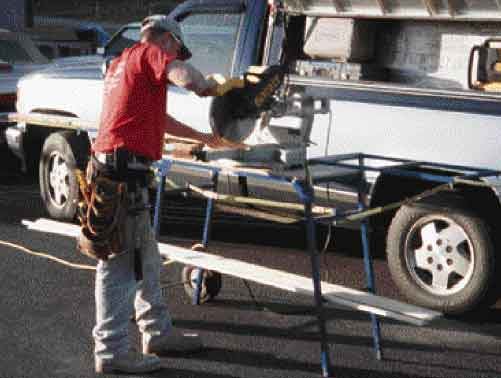
I use a miter saw almost every day, but until recently I’d never owned a really satisfactory stand. The homemade stands I’ve tried over the years were invariably heavy, bulky, and difficult to move around, so I usually found myself setting up the saw on the floor and using 2×4 blocks as stock supports. Although that produces good results, it’s both inefficient and hard on your knees and back. I finally decided it was time to invest in a good manufactured saw stand.
As a remodeler, I need a stand that’s versatile enough to handle both my 10-inch Delta compound saw and my 12-inch DeWalt sliding saw. Changing from one saw to another has to be quick and easy, because I need to do that fairly often. The stand also has to fit in the back of my truck and leave room for tools and materials. Finally, it must be rugged enough to handle the weight of long joists and rafters, not just lightweight trim.
As I began shopping around, I quickly learned that the term “miter-saw stand” means different things to different people. Some manufacturers classify universal tool stands and portable workbenches as miter-saw stands, even though a professional builder would be unlikely to use them in that capacity. For this article, I decided to zero in on dedicated portable miter-saw stands that could handle a variety of saws, transport easily, and stand up to contractor use.
I found nine stands that seemed to fill the bill. They all promised to fit most saws, and they represented a variety of price points. They looked as if they’d be good at most miter-saw tasks, and while they offered varying degrees of portability, all could be moved fairly easily by one person.
Features to Look For
As I began a hands-on evaluation of the stands I’d selected, I kept several criteria in mind. First was portability. It doesn’t matter how well a stand works if it’s too big and heavy to be practical on the job site. Does it have wheels? Can I move it while it’s assembled, or do I have to break it down?
Saw stops. One of the most important benefits of a saw stand is its ability to speed production. A well-designed stop is a great convenience when it comes to making accurate repetitive cuts. All the stops I tested held their position well, even when bumped repeatedly with 2×6 studs.
The best-designed stops extend the full width of the work supports, allowing accurate cuts even with mitered stock. Some stops allow the point of a miter to slip past, throwing accuracy out the window. It isn’t a problem with square stock, but if you do a lot of trim work, it could be an important consideration.
Stock supports. There are two basic types of stock supports: roller- or bar-type supports and table supports. Supports that use a single roller or bar tend to be lighter and more portable. They come in handy when you’re lining up a heavy length of pressure-treated lumber. On the other hand, rollers can make it difficult to pull measurements by hooking a tape to the end of the stock, and they require frequent adjustments if you’re cutting stock to significantly different lengths. Table-type supports offer optimum support but are heavier and frequently have to be transported in several pieces.
Some stock supports have their own legs; others have legs that cantilever out from the side of the stand. Separate legs mean that you’ll need to spend a little extra time to get everything level, but they can support the most weight. Cantilever supports don’t require extra set-up time, but generally they aren’t quite as sturdy.
Switching saws. Ease of mounting is another important consideration. Some stands use brackets or quick-release clamps to simplify switching from one saw to another. The best of these made such changeovers practically effortless. At the other extreme are stands that require the user to bolt the saw in place. This approach provides a solid mount, but it’s not practical if you expect to use the stand with more than one saw.
Making a Choice
As a remodeler, I might be on two or three different jobs in the course of a week, so I need a lightweight stand that sets up quickly. The DeWalt filled the bill on both accounts, and it’s a purchase I’ve been very happy with. I can carry the stand by myself without bashing holes in the walls of my customers’ homes, and it fits in my truck bed with some room left over for building materials. The saw base’s quick-release clamps work well, and with an additional set of clamps I can mount my other saw without a hassle. The stock supports and saw base are flexible in their placement, and the stop system works better than those on other lightweight stands.
Carpenters who work on bigger projects with no portability or space restrictions would probably find the Sawhelper, Trojan MS2000, or Rousseau the best tool. All three handle heavy loads and have ample surface area to support bigger stock. The Sawhelper was my favorite of these. It handles long stock and comes standard with the best stop system of any of the stands I reviewed.
In my opinion, the value winner is the Trojan Workcenter. It’s inexpensive, light, and sturdy, and its components can be used separately for other tasks.
If you purchase a stand, I recommend looking into some of the accessories. Most stands can be made more useful and versatile by adding an extra extension table, support, or stop.
Jeremy Hessis a carpenter with D.E.R. Construction Inc. in Bainbridge, Pa.
AD&E Sawhelper Ultrafence
This well-designed stand is made up of three components: a four-legged folding table that supports the saw and two support wings with an integral stop system. The legs on the support tables are adjustable to compensate for uneven ground, and the two support wings fasten to self-aligning brackets that are permanently bolted to the side of the saw. According to the manufacturer, the brackets are accurate to 1/100 of an inch. I found that the tables stayed perfectly aligned, and the calibrated flip-up stop that comes with the stand is also dead-on every time. The stop can be used on either side of the saw, and the supplied stick-on tape measures make setting it to a measurement quick and easy. The solid, continuous aluminum table eliminates the need to move a support to cut stock of varying lengths. This stand can be ordered with two different-size tables from a choice of 5-foot, 8-foot, and 9-foot-4-inch. Because the specified lengths are measured from the blade, the tables themselves are somewhat shorter than those dimensions. I found the 9-foot-4-inch table a snug fit in the 8-foot bed of my truck. If you plan on using two different saws with this stand, you’ll need to order an extra set of wing mounts ($35) for your other saw. If you’re using a saw with an auxiliary fence that slides to permit bevel cuts, you’ll need to remove the fence or cut the top of the extension wing to allow clearance. Also, with the mounting brackets bolted on, I found that I couldn’t use the crown stops for my DeWalt 12-inch sliding saw. Overall, however, this is an excellent system that doesn’t take up too much space and readily handles stock of almost any size. Contact: American Design and Engineering, St. Paul Park, Minn.; 800/441-1388, http://www.sawhelper.com.
Sawhelper’s extension wings mount with self-aligning brackets (left) that provide an extremely precise stop system. The manufacturer claims it to be accurate within .01 inch. Its best feature is the integral stop system (right). The applied measuring tape makes the stop useful for all cuts, not just repetitive ones.
Delta 50-155
Of the stands I examined, the Delta had the largest footprint when folded. Plus, when you bolt a saw to the already heavy stand, the weight climbs to almost 140 pounds. That’s two significant drawbacks for those who frequently work alone or have limited truck space. Once you get it out of the truck, though, the Delta’s 12-inch rubber wheels and padded handle make moving the folded stand easy, even with a lot of scrap material or mud in the way. The legs lock solidly into place when folded, although they lack an adjustment to compensate for uneven ground. Stabilizers bolted to the back of the rear legs prevent the stand from tipping over backwards. The roller-type work supports are easy to adjust and provide good support; an anti-lift finger keeps the long cutoffs from kicking up once the saw has passed through them. This stand is the only one I reviewed that has a built-in cord wrap. On the other hand, the small support table, which includes the stop system, wouldn’t work with my 12-inch sliding compound saw. The stop system has a maximum capacity of only 26 inches. Contact: Delta, Jackson, Tenn.; 800/438-2486, http://www.deltamachinery.com.
The Delta 50-155’s comfortable handle and big wheels make it easy to move around the job site, but getting it into the truck is complicated by its substantial size and weight. The 26-inch maximum capacity of the Delta’s stop system (above, right) limits it to cutting blocking or cripple studs, and its hollow design is unsuitable for cutting mitered stock.
DeWalt DW723
This stand weighs a mere 35 pounds and collapses to only 66 inches in length, but it’s extremely rugged and stable. On level ground it handled even my heavy slide saw with ease. The quick-release clamps that hold the saw in place are easy to use, making it simple to switch from one saw to another. The bar-type stock supports have flip-up stops that run the full width of the support and stay accurate even after many repetitive cuts. With the saw at the far right of the stand and the extension at the far left, the stop will accept up to 8-foot stock. The two supports are easily moved from the extensions to the main beam of the stand to provide ample support even with shorter stock. This is a nice feature, but the supports seemed slightly too small; enlarging them would provide more solid support to wide material. An adjustable leg to eliminate wobble on uneven surfaces would be another welcome addition. The carrying handle on the stand I was testing soon broke; although DeWalt quickly sent a replacement, it would be nice to see a stronger handle.
Contact: DeWalt, Hamstead, Md.; 800/433-9258, http://www.dewalt.com.
The DeWalt’s quick-release mounting system is easy to use and locks positively to the stand (left), simplifying transport. A full-width flip-up stop (right) keeps miters from slipping past, but the stand’s compact design limits the maximum stop setting to 8 feet.