The first time I saw a cordless drill, I knew it would change my life. It was clear to me after driving only one screw that I’d never be able to live without this tool.
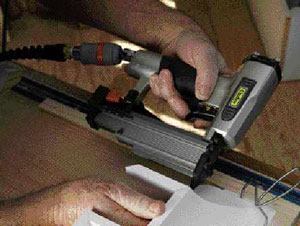
Twenty-three-gauge pin nailers may not inspire the same broad enthusiasm, but they too are fast becoming an essential part of the professional trim carpenter’s arsenal. Along with other new fastening tools, adhesives, and clamps, pin nailers are useful for preassembling crown, panel molding, baseboard, and casing, either on or off the site.
The pins aren’t meant for applying full-size casing, so you’ll still need your 15- or 16-gauge finish nailer. But for small caps, parting beads, returns, dentil blocks — any delicate parts a large nail might split — they’re ideal: A pin nail will never split anything, not even the smallest return.
Fastener Lengths and Types
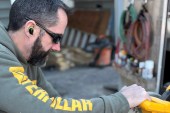
I’ve tried to include all major brands in this review. Testing procedures were simple: For several months, these guns circulated among the carpenters on our crew. As you can tell from the photos, they got plenty of use.
For more controlled results, I also tested the guns in my shop, shooting a variety of nail types and lengths with each gun into soft pine and solid hardwood.
Fastener lengths. Omer’s earliest gun fired only two lengths of pins, 14mm and 17mm (approximately 1/2 inch and 5/8 inch). And the first Senco pin nailer I ever used fired 1/2-inch to 1-inch fasteners.
Improvements come slowly in this industry, but several of today’s guns fire up to 1 3/8-inch pins, including the Grex, the Cadex, and the Max. The Nikle handles lengths up to 1 9/16 inches, in both headless pins and brads. And a new Cadex gun due out this summer will fire 2-inch headless pins and 2-inch brads.
The length of the pins means a lot to finish carpenters: The longer the fastener, the more versatile the tool. That’s the area where we’ll see the most improvement in future pinners.
The ability to fire fasteners other than headless pins is a big plus, too. So-called “slightly headed” brads are great for fastening extremely thin moldings; headless pins tend to pull through a thin piece of wood. The brads also have more holding power. At this point, two of the guns fire both pins and brads: the Cadex and the Nikle.
Buy good-quality fasteners. I’d be remiss not to mention fastener quality. You can buy the best pin nailer made, but unless you use well-made fasteners, you can’t expect the tool to perform well. Most new nailers are imported from Taiwan and China, and you’d be surprised by the quality of these tools: Just because they’re imports doesn’t make them cheap. The design and manufacturing are superb.
Still, when it comes to fasteners, inexpensive Asian imports don’t measure up, so always buy name-brand pins.
Pin nails, like all finish nails, must be cut with perfectly flat heads, or the driver will graze off the head, leave a mark on the work, and possibly even drive the nail askew, creating an oversized hole. Also, imprecise heads will cause the driver to wear and fail prematurely, as will loading the nails incorrectly. Always load headless pin nails with the arrows pointing toward the workpiece.
Pins are interchangeable among guns and widely available, though not every manufacturer makes the longer sizes.
Magazine Adjustments
The first pinners I used years ago had to be adjusted for the different lengths of fasteners. Three of the guns in this review still require adjustments for nail length.
The Omer and the Senco have slide switches for protecting the driver while shooting shorter nails; the Porter-Cable has a unique spring mechanism. After inserting the fasteners into the Porter-Cable’s magazine, you push down and then slide the nails up into firing position.
Overall, we found it easier to use the tools that didn’t require nail-length adjustments.
Safety Triggers
The new nailers are safer to use than the old ones were. Since my first gun did not have a safety, I unplugged the hose each time I finished using it. Doing so was a must, just in case some kids came around.
But carpenters can be like kids, too: I’ve seen more than one pick up my small nailer and look at it curiously, sighting right down the barrel with his finger on the trigger.
Pin-nailer safety devices differ from those on larger guns, and for good reason. Most guns have a safety plunger on the tip of the tool; unless the plunger is depressed the gun won’t fire. But plungers tend to mar fine finish work. Plus there are times when you don’t want to apply even the slight pressure required to depress a plunger — you just want to fire the nail, perhaps through a delicate molding return in perfect position.
That’s why most pin nailers have a double-trigger safety device — you have to pull the rear trigger before pulling the main trigger. On some of the guns, getting used to these two closely set triggers takes some time.
In fact, while firing the Nikle, you’ll find it’s almost impossible to use your index finger to pull the trigger, because there isn’t enough room between the magazine and the trigger. First it’s difficult to get a finger on the safety trigger, and then, if you can get all four fingers in there, you won’t be able to pull the trigger anyway because it bottoms out on your middle finger. We found it easiest to fire this gun with our middle fingers.
Double triggers with more separation between them were easier to use, like the ones on the Porter-Cable, Bostitch, and Cadex. Though the triggers on the Cadex, Grex, and Max are piggybacked, the design lets you use your index finger to fire the gun while holding back the safety with your second or third finger. Overall, once we had gotten used to the individual guns, none of them were problematic.
One word of warning: Just because the gun has a safety doesn’t mean you won’t fire a nail accidentally. Because of the trigger design, we all found ourselves picking up the tool and depressing the trigger simultaneously — which means we all carried the tool ready to fire.
Nose Size
The size and accuracy of the nose has been improved on the new pinners. Nearly every tool available has a needle point, which makes it much easier to get the nose and pin right where you want them. Not only can you see precisely where you’re placing the fastener, but you can tuck the sharp nose against a small filler or inside a tight quirk.
Several of the guns come equipped with soft tips, which protect your workpiece. I rarely had a chance to use them, but not because I didn’t want to. The Cadex, Grex, and Max come with two tips on each gun, one on the nose and one stored near the magazine, but the guys on my crew lost all but one in less than a month!
Pin Depth Adjustment
As a rule, depth of set is not an issue with pins, so pinners don’t come with depth adjustment, as larger brad nailers and finish nailers do.
Adjusting the air pressure on a pin nailer won’t affect the depth of drive, either — these guns don’t use much air. Only the Bostitch gun comes with a “power” adjustment, but we simply kept it on high, to be sure the nails would set in both hardwood and softwood.
Intake and Exhaust
Once directed-exhaust ports were introduced on pneumatic tools, finish carpenters no longer had to close their eyes and hold their breath every time they shot a nail into baseboard. Instead, they could direct the exhaust off the dirty floor and reverse it back along their hands.
The Porter-Cable and Spotnails tools have nonadjustable ports on the head, the Senco and Bostitch have nonadjustable rear exhaust, and the Nikle has a swiveling adjustable port on the head. The most recent innovation is a rear filtered port right beside the air intake. These ports, available on the Cadex, Grex, Max, and Omer, never blow dust or dirt in your face.
All the guns except the Cadex have a fixed intake fitting; the Cadex has a swivel fitting. This is a helpful addition to a tool frequently used in tight spaces with a light touch.
Dry-Firing and Jamming
To prevent dry-firing, most of the guns have a reload indicator — a port in the magazine that lets you see if there are nails in the tool. Some of the ports or windows were large enough to be helpful, but others were so small it was difficult to tell if nails were in the gun or not.
Only the Max is equipped with a dry-fire switch, which won’t allow the tool to operate without nails in the magazine. This is a nice feature on any pneumatic finish nailer, because it’s easy to think you’re firing nails when you’re not. However — and don’t spread this around — some of the guys on our jobs intentionally dry-fire the driver to set proud nails. Although this practice leaves a smaller mark than most nail sets, it can prematurely wear out the driver.
When it comes to clearing nail jams, most manufacturers have adopted a simple system: Loosen two screws and slide off the nose plate. On the Senco, you have to remove two screws, then loosen two others before pivoting the nose plate out of the way.
Belt Hook
I’ve been in this business long enough to know that you need a belt hook on every gun, whether it’s a nail gun or a screw gun. Of the pinners we tested, the Cadex, Grex, and Max come with factory-installed hooks.
Test Results
As soon as I started opening the plastic gun cases, I noticed that three of the tools — the Cadex, Grex, and Max — are manufactured at the same factory in Taiwan. Their bodies and firing functions are identical, but slight changes to the exterior design and accessories produce noticeable differences among them.
With nine tools in the field, making a decision is easier if you eliminate some choices. After using all the new pin nailers that shoot up to 1 3/8-inch fasteners, I wouldn’t advise buying an older model that’s limited to 1-inch fasteners; it’s just not worth the dollar savings.
Hands down, the best pin nailer currently available is the Cadex. It shoots both brads and pins in lengths up to 1 3/8 inches, comes with all necessary accessories, is easy to operate, and held up well during a tough testing period on our jobs. The Grex and Max are close seconds.
You’ll note that these three guns are among the more expensive we tested. But if you’re making a professional investment, you’ll eventually recoup the difference.
On the other hand, I do know what tight times are like. So if you’re looking to save and plan to use the gun only occasionally, the Bostitch is a decent tool at almost half the price. Just keep in mind that it shoots only 13/16-inch pins and doesn’t have a belt hook or swivel fitting.
Gary Katz is a finish carpenter in Reseda, Calif., and moderator of the jlconline.com finish-carpentry forum.
Pinner Specs

Bostitch HP118K
Street price: $119
Weight: 2.5 pounds
Fasteners: 1/2-inch to 1 3/16-inch pins
Exhaust: Rear, nonadjustable
Mars work? Leaves slight driver marks
Jams? No
Belt hook? No
Comments: Best safety trigger, provides plenty of finger room. Broader nose than other guns. Power control switch on side useful for shooting smaller fasteners.

Cadex CP23.35
Street price: $209
Weight: 2 pounds
Fasteners: 1/2-inch to 1 3/8-inch pins and brads
Exhaust: Rear, filtered
Mars work? Slight driver marks in softwood when used without nose cover; no marks in hardwood
Jams? No
Belt hook? Yes
Comments: No difference in nail-hole size between pins and brads. Needle nose, two soft tips; on-board wrench for jam-clearing; comfortable safety trigger.

Grex P635
Street price: $195
Weight: 2.2 pounds
Fasteners: 3/8-inch to 1 3/8-inch pins
Exhaust: Rear, filtered
Mars work? Slight driver marks in softwood when used without nose cover; no marks in hardwood
Jams? No
Belt hook? Yes
Comments: Good reload locator; needle nose, two soft tips; on-board wrench for jam-clearing; comfortable safety trigger.

Max NF235A/23-35
Street price: $225
Weight: 2.2 pounds
Fasteners: 1/2-inch to 1 3/8-inch pins
Exhaust: Rear, filtered
Mars work? Slight driver marks in softwood when used without nose cover; no marks in hardwood
Jams? No
Belt hook? Yes
Comments: Swivel fitting, good reload locator; needle nose, two soft tips; on-board wrench for jam-clearing; comfortable safety trigger.

Nikle NS2340
Street price: $219
Weight: 2.2 pounds
Fasteners: 1/2-inch to 1 9/16-inch pins and brads
Exhaust: Head, adjustable
Mars work? Slight driver marks in softwood; no marks in hardwood
Jams? No
Belt hook? No
Comments: Slightly larger, louder. More kickback. Tight trigger space, difficulty with safety unless you fire with second finger. Needle nose, no nose covers. Doesn’t set 19/16 nails consistently in hardwood; some driven flush.

Omer PR.28
Street price: $249
Weight: 2.5 pounds
Fasteners: 5/8-inch to 1 1/8-inch pins
Exhaust: Rear, filtered
Mars work? No
Jams? Small pins jam if tool not adjusted correctly
Belt hook? No
Comments: Requires adjustment for nail size. No reload indicator. Needle nose, no nose covers. Somewhat tight trigger space. Didn’t set nails in hardwood every time.

Porter-Cable PIN100
Street price: $99
Weight: 2.5 pounds
Fasteners: 1/2-inch to 1-inch headless pins
Exhaust: Head, nonadjustable
Mars work? No
Jams? Some jams when tool not adjusted properly
Belt hook? No
Comments: Needle nose, no nose covers. Good safety and adequate room for fingers. Spring-loaded nail adjustment. www.portercable.com

Senco FinishPro 10
Street price: $125
Weight: 2.4 pounds
Fasteners: 1/2-inch to 1-inch pins
Exhaust: Rear, nonadjustable
Mars work? No
Jams? Occasionally
Belt hook? No
Comments: Comes with spare driver. Requires removal of two screws to clear jams, wrench in case; older-style wide nose. Requires adjustment for nail size. Pins set flush in dense hardwood, even with pressure on tool; countersinks pins in softwood without leaving driver marks. www.senco.com
Spotnails SP2340
Street price: $113
Weight: 2.6 pounds
Fasteners: 1/2-inch to 1 9/16-inch pins
Exhaust: Head, nonadjustable
Mars work? Leaves driver marks
Jams? Frequent
Belt hook? No
Comments: Largest of the guns. Needle nose, no nose covers. Had to push to set nails. Plenty of space for fingers on safety trigger. www.spotnails.com