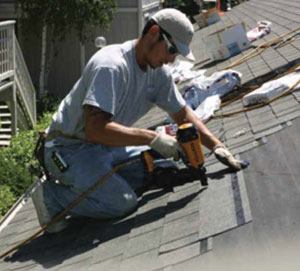
We’re professional roofers: The company we work for does all kinds of roofing, including built-up, wood shake, and clay tile. But more than anything else, we install composition shingles. Though roofers used to nail shingles by hand or with a roofing stapler, these days the tool of choice is a coil roofing nailer.
On large projects, we might have as many as a dozen roofers on the crew, and because we supply our own guns, there are likely to be many different models on site. Like anyone else in construction, we’re always looking for better tools, so we thought it was great when JLC delivered 12 of the newest coil roofing nailers to one of our jobs and asked us to try them out.
We had the guns throughout the fall of 2005, and shared them around the crew. In this article, we’ll tell you what we learned.
The main qualities we look for in a coil roofing nailer are light weight, good balance, speed, and ease of loading. Durability is also important, but we didn’t have these guns long enough to wear them out, so there’s no good way to address that here.
Weight and Balance
Each generation of roofing nailer is lighter than the last — a good thing, because light tools are more comfortable to use. A few ounces doesn’t make much difference, but when one gun weighs a half pound more than another you can definitely feel it.
The published weight specs are frequently incorrect, so we weighed each tool (including an air fitting) on an electronic postal scale. Several models were significantly heavier than the manufacturers claimed (see “Coil Roofing Gun Specs,” below). We found that the average roofing gun weighs about 5.5 pounds. The lightest models — Bostitch, DeWalt, and Porter-Cable — all weighed in at 5.0 pounds. The heaviest guns — 5.8 pounds and up — included the models from Senco, Spotnails, and Max.
In a couple of cases, the tool’s balance (or lack thereof) fooled us into thinking it was lighter or heavier than it really was.
For example, the Ridgid weighs 5.2 pounds but didn’t feel much heavier than the 5-pound models because it’s well-balanced. The Grip-Rite, on the other hand, felt heavier than its 5.2 pounds because it’s nose-heavy. A nose-heavy gun puts extra strain on your arm and wrist; it may not be a lot, but you’ll notice it over time.
Most of the guns we tested are pretty well-balanced, except for the Senco, Spotnails, and Grip-Rite models, which all feel nose-heavy.
Nailing Speed
Nailer manufacturers sometimes list a spec related to speed — the number of times the gun can cycle per second. The only number we found among the roofing nailers — eight nails per second — seems impossibly high. There may be guns that can cycle this quickly, but no coil roofing nailers we know of can feed fasteners that fast.
We didn’t have a good way to measure how fast each gun fired, but we could tell by using the tools that some were faster than others. To us, a gun feels slow if it can’t keep up with the speed at which we’re working. Most of the guns could keep up, though the Senco, the Spotnails, and especially the Paslode seemed slower than the rest.
Power. Most of our jobs involved reroofing over OSB or old wood sheathing; all of the guns had enough power to drive nails home in these materials. That said, some felt slightly more powerful than others — a quality we describe on site by saying the gun has a good “pop” to it.
Magazine Design
We go through a lot of fasteners installing shingles, so we need a gun that’s quick and easy to load. Most coil nailers require you to open two separately hinged pieces to load nails. One piece covers the magazine, and the other — the feed cover — holds the nails against the pawls that pull them forward to be driven.
On a few models, the magazine cover and feed cover swing open as a single piece. We like this design; with fewer parts to manipulate, it takes less time to load. The time savings may not be huge, but every little bit helps when you are working fast in a rhythm.
The Bostitch is especially easy to load because the cover assembly pivots down as a single piece. Loading it is a simple matter of dropping in a coil of nails, laying one end of the coil across the pawls, and flipping the cover back up. We also found the Makita and Paslode guns easy to load; they both have single-piece covers that are hinged at the nose and swing open from the rear.
Most of the guns load from the side. However, the Spotnails and one of the Hitachi models load from the bottom. Since we’re accustomed to loading from the side, loading from the bottom seems slow and awkward to us.
Nail size. The guns we tested drive 15-degree wire-collated fasteners of up to 13/4 inches in length, the size used to reroof without stripping an existing layer of shingles. We typically use 11/4-inch fasteners, except at overhangs, where we don’t want nails to poke through the bottom side of the sheathing. In those areas, we use 3/4-inch or 7/8-inch fasteners.
Miscellaneous Features
Roofing guns are simple tools, but that does not stop manufacturers from trying to distinguish their models by including different features.
Trigger. The size and shape of the trigger may seem like a minor design detail, but when you nail as much as we do, your trigger finger can get tired or sore. This is less likely to happen if the trigger is large and has a smooth, contoured shape.
The Paslode has the best trigger — it’s wide, smooth, and long enough that you can get two fingers on it. We also like the triggers on the DeWalt, Makita, and Ridgid guns; thanks to their curved shape and, in Ridgid’s case, a rubberized pad, they’re very comfortable.
The triggers on the Hitachi and Spotnails guns are less comfortable than the others: They’re thin and not as heavily contoured.
Depth-of-drive mechanism. All of these guns have mechanisms that allow you to set the depth-of-drive — a handy feature when a bunch of roofers are sharing the same compressor, because a pressure setting that works for one gun might cause another to over- or underdrive the nails. With these guns, that problem can be remedied by adjusting the depth-of-drive on each — usually by turning a thumb-wheel on the nose or near the trigger.
Most of these mechanisms are very similar. The Bostitch version is especially intuitive and easy to use because it’s controlled by a large knob on the gun’s nose. We didn’t like the mechan-isms on the Paslode and Spotnails guns, because you can’t adjust them without using an Allen key or wrench.
Shape of driver. The drivers in most of these nailers are asymmetrical in cross section — with two exceptions: The Bostitch and Max tools have full round drivers.
In most cases, either shape is fine, though sometimes an asymmetrical driver will cause the head to curl up at one edge. This reduces holding power and may cause the nail to cut into the shingle above. With a full round driver, this won’t happen, because the driver makes contact with more of the head.
Shingle gauge. All of these guns have shingle gauges on the bottom of the magazine. You can set the gauge to the exposure of the shingle and use it to locate the edge of the next course up. This comes in handy if you install three-tab shingles.
We never use gauges, however, because the dimensional (laminated) shingles we use come with layout marks on them.
With most of these guns, it takes an Allen key to adjust the gauge; the Bostitch, Ridgid, and Makita have gauges that can be adjusted without tools.
Other features. The Bostitch is equipped with an anti-dry-firing device. We like this feature because it prevents you from thinking you put in a nail when you actually just fired an empty gun.
The Max comes with a swivel fitting to prevent the hose from getting kinked and a self-cleaning air filter to keep dirt out of the tool. Some of the guns come with adjustable exhaust vents. While this perk might be handy for a carpenter, for a roofer it’s not a problem if a gun exhausts forward only.
Some models have trigger locks and special firing modes — neither of which we would ever use. All we want to do is bump-fire — fast.
Similar Components
We don’t know where every gun comes from, but most were made in Taiwan. Some competing models look like they came out of the same factory, or at least share some of the same parts.
For example, the nose and the magazine of the Grip-Rite are nearly identical to those of the Senco. And while the Spotnails tool has a uniquely shaped housing, if you look closely you’ll see that it has the same magazine and trigger mechanism as the bottom-loading Hitachi.
These two models have very similar nose assemblies, too, the main difference being that Hitachi’s depth-of-drive mechanism adjusts without tools while Spotnails’ requires a wrench.
It wasn’t until after we decided that the Ridgid and Porter-Cable models were among our favorites that we noticed how alike they were. The cast housings are very similar, as are most of the parts in the nose and trigger assemblies.
David Lopez Jr. and Mike Ryan are foremen for Advanced Roofing Services in Alameda, Calif.
Coil Roofing Nailers

Bostitch RN46
The RN46 was just about everyone’s favorite roofing gun. It’s light, fast, and will not fire when empty. The one-piece flip-down cover assembly makes it especially easy to load. After using this tool, a couple of guys on the crew replaced their old guns with this model. We did have one problem with it: After a few roofs it stopped working because air was leaking from the head. It turned out that a seal had popped loose; we were able to fix it by removing the cap and snapping the seal back into place.

DeWalt D51321
Light, with a comfortable grip and trigger, the D51321 is one of our favorites. It seems to nail a little faster than most other models. We have one minor complaint about this tool: The latch is on the magazine instead of on the feed cover. You can’t simply flip the cover closed, because it’s necessary to pinch the latch to make it catch.

Grip-Rite GRTCR175
The GRTCR175 works well and hits the fastener with a pretty good pop. But it’s more nose-heavy than most other models and the particular gun we tested made a subtle but annoying ringing sound every time it struck the nail.

Hitachi NV45AB2S
A simple, reliable roofing gun with a two-piece cover assembly that opens from the side, the NV45AB2S is of average weight and feels a little bit slower than our favorite models. A bottom-loading version of this tool is also available.

Hitachi NV45AB2
Except for the bottom-loading magazine, this gun is identical to the NV45AB2S. It’s a pretty good tool, but if we were going to buy an Hitachi we’d get the side-loading model.

Paslode 3175/44RCU
Because its single-piece cover assembly is held shut by a “friction-fit” catch, the Paslode 3175/44RCU is fast and easy to load. Plus it has a very comfortable two-finger trigger. On the downside, it’s heavier than average and has an old-fashioned depth-of-drive mechanism that requires a wrench. The tool we tested fed very slowly. This may be because we use generic nails, though the generics worked fine in the other guns.

Makita AN451
The AN451 is a nice gun. The single-piece cover assembly swings forward, making it fast and easy to load. It has a comfortable grip and strikes fasteners with a pretty good pop. The only thing we don’t like about this gun is that it’s of average weight; it would rank higher if it were half a pound lighter.

Porter-Cable RN175A
Light, compact, and well-balanced, the Porter-Cable RN175A is one of our favorites. It seems to nail a little faster than most other models. Even with a two-piece cover assembly, it’s easy to load, because it takes very little pressure to snap the feed cover over the magazine cover.

Max CN450R
The CN450R has added features, including a swivel air fitting and a self-cleaning air filter. It’s fast, very powerful, and drives nails reliably without jamming. Overall, this is an excellent nail gun. The problem is that it’s heavy — a half pound heavier than average and a full pound heavier than the lightest models. Max has since come out with a new, lighter model, the CN445R (see facing page).

Ridgid R175RNA
The Ridgid R175RNA ranks among our favorites. It’s fast and light and has a good pop. It’s also one of the more comfortable roofing nailers to use, because it’s well-balanced and has a curved trigger with a rubberized surface. The two-piece cover assembly is easy to open and close, so it doesn’t take much time to load fasteners.
Spotnails VRN45
The Spotnails VRN45 is one of two bottom-loading models in this test — a strike against it, because we much prefer to load nails from the side. Most of the crew also said it was slow, and we all found it nose-heavy. With its bare-bones trigger and basic depth-of-drive mechanism — which requires the use of tools — this is definitely a no-frills tool.

Senco RoofPro 455XP
Although the Senco 455XP works well and is easy to load, it feels a little slower than average. It’s not very comfortable to use; it’s nose-heavy and at 5.8 pounds it’s one of the heavier roofing guns around.
Too Late to Test

Max CN445R
This new model from Max came out after we had completed our testing, so we weren’t able to try it out. It has many of the same features as the CN450R that we tested for this article — a swivel air fitting, a self-cleaning air filter, and a full round driver. According to the manufacturer, the new gun is faster and more powerful than the previous model, and has a new type of nosepiece that resists tar buildup. We liked everything about Max’s previous model except the weight. Max’s Web site says the CN445R weighs 5.2 pounds, but we weighed it (with an air fitting) and it’s actually 5.7 pounds — about a third pound lighter than the old gun but still heavier than average.
Bostitch
800/556-6696
DeWalt
800/433-9258
Grip-Rite
972/417-3701
Hitachi
800/706-7337
Makita
800/462-5482
Max
800/223-4293
Paslode
800/222-6990
Porter-Cable
800/848-5175
Ridgid
866/539-1710
Senco
800/543-4596
Spotnails
847/259-1620