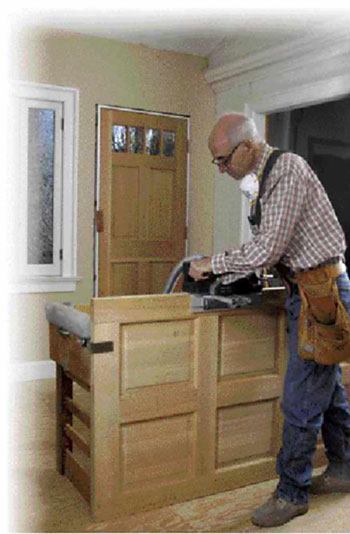
After a recent discussion about door planers on the jlconline.com finish-carpentry forum, a fellow door hanger, Al Constantin, and I decided we weren’t qualified to judge which plane was best for working doors because neither of us had used all three of the most popular tools: the Bosch 1594, the Festool HL850E, and the Porter-Cable 9118 Porta-Plane (formerly the 126). But now we have, and here’s what we learned.
Start With Snipe
Snipe — cutting a gouge at the beginning or end of a pass — is one of the banes of portable hand planers. In general, the longer the plane, the less likely it is to snipe. Also, having the handle located at the rear of the tool seems to enable smoother forward pressure while cutting, which helps eliminate the problem.
At only 11 inches long, the Bosch is prone to snipe because it has the shortest sole and the handle is directly above the cutter. It’s possible to avoid snipe when using this tool, but doing so takes care and attention.
The Porter-Cable, on the other hand, has a rear-mounted handle, which helps to reduce — though not completely eliminate — sniping. But we found we could get rid of snipe altogether by adjusting the rear sole of the plane so that the cutter shaved 1/64 inch when the front depth-adjustment knob was set at zero. With slight forward pressure at the start of the cut and slight rear pressure at the end of the cut, snipe disappears.
The Festool automatically cuts without snipe, thanks to the length of the sole and to the rear position of the tool’s handle.
Safety Switches
The handles on the Bosch and Festool planers include safety lock-out switches. On the Bosch, the switch is located slightly forward on the handle. This arrangement forces you to change hand position at the same time you’re pulling the trigger. We found it best to start the tool, then change hand position before cutting.
The safety switch on the Festool is easy to reach while gripping the handle. The Porter-Cable has no safety switch. However, the location of the motor on the Porter-Cable provides some protection from the cutter — it’s the only portable power plane with the motor mounted on the side of the tool, beneath the elevation of the cutter blade.
Fences
Because of its motor placement and because its fence is not meant to be removed, the Porter-Cable is useful only for planing doors and the edges of stock. In addition, the left-side motor interferes significantly with the tool’s balance, which increases the learning curve. While operating this tool, we were careful to keep our index finger on the front edge of the fence and in contact with the face of the door, which helped counter the imbalance of the tool and ensured a consistent bevel angle.
Planing a consistent bevel on a door is essential: If the angle of the bevel changes, the fit of the door might be affected. The fences on both the Porter-Cable and the Festool are long and wide, providing a secure surface against the face of the door. Only the Porter-Cable fence adjusts in both directions, and it’s the only one with an adjustable stop, which allows quick realignment of the fence.
The Festool has the widest fence of the three planes. This, together with the weight and overall good balance of the tool, contributes to a feeling of confidence when operating this plane.
The Bosch fence is not as long as the other two fences, but — considering the price of this tool — it’s adequate.
Blades
The Porter-Cable uses a two-blade spiral cutter, which makes the most aggressive and smoothest cut of any of the planes, but it comes at a cost. If you hit a staple in the edge of a door (not uncommon), you can toast a $100 blade.
The Festool single-blade spiral cutter never balked and also makes a smooth cut. Replacement blades are comparatively cheap (around $20). The Bosch twin-blade replacements are inexpensive, too, though they didn’t cut quite as smoothly, no doubt because of their straight design.
Depth Adjustment
Following a wiggly scribe line often means having to adjust the depth of cut on the go. Bosch has a top-mounted depth-adjustment knob above the front sole, and it’s difficult to operate that small plane with one hand on the depth-adjustment knob. In fact, Bosch recommends that users not change the depth of cut while planing. With this tool, the best technique is to make repetitive passes for the deepest cuts first, and then, once you’ve closed in on the scribe line along the entire length of the door, make long continuous passes.
Ingeniously, depth adjustment on the Festool is accomplished by twisting the front handle, just like on a motorcycle. A switch near the handle will lock the cutter at the desired depth, making it possible to change settings while planing.
Porter-Cable has the best depth-control adjustment system. The depth lever on the front of the plane is within easy reach of the fence, so you can alter the depth of cut without changing the position of your hands on the tool.
| Planer Specs | |||
Manufacturer & Model | Bosch 1594K | Festool HL850E | Porter-Cable 9118 Porta-Plane Kit |
Weight | 6 pounds | 8.6 pounds | 9 pounds |
Rpm | 16,500 | 10,000 | 22,000 |
Amps | 6.4 | ||
Maximum depth of cut | 3/32 inch | 5/32 inch | 3/32 inch |
Width of cut | 3 1/4 inches | 3 1/4 inches | 2 13/32 inches |
Length of base | 11 3/16 inches | 13 3/4 inches | 16 inches |
Maximum rabbet depth | 5/16 inch | unlimited | no rabbeting or chamfering capabilities |
Features | Belt-driven motor; dual dust ports (right- or left-hand), includes vacuum adapter; two mini tungsten-carbide reversible blades ($13/pair); three chamfer V-grooves for different widths | Belt-driven motor; dual dust ports (accepts dust bag or vacuum hose on either side of tool); single replaceable spiral cutting blade ($21); single V-groove on base for chamfering | Direct-drive motor; two-blade sharpenable spiral cutter ($90) |
Cord length | 8 feet | 13 feet | 10 feet |
Street price | $137 to $160 | $420 without fence ($68 for fence) | $399 to $429 |
Contact information | Robert Bosch Tool Corp. 877/267-2499 www.boschtools.com | Festool USA 888/337-8600 www.festool-usa.com | Porter-Cable Corp. 800/487-8665 www.portercable.com |
Dust Control
Dust collection may not always be required on new-construction sites, but it is always an issue when you’re working on owner-occupied remodeling sites. Dust control is also becoming more of a health issue, and catching dust at the source can help cut down on cleanup costs.
I’ve had clients complain even when I’m hanging doors in the driveway and the dust gets on the front lawn, not to mention on a freshly washed car or through an open door. On single-door jobs, cleanup can take as long as hanging the door, so having a reliable dust-control system is important.
Porter-Cable’s 126 has been the door hanger’s tool of choice for decades, but unfortunately neither it nor the newer 9118 is equipped with a dust port (though we’ve imagined a few simple ways of fashioning one). The Bosch has dual dust ports, so the bag or vacuum hose can be mounted on either side. The dust bag works well, too, unless the port clogs.
The Festool’s dust-control system is even better: The large ports never clog, and they can be switched to operate in either direction. The large bag collects nearly all the dust. When you use a tool-triggered vacuum, the Festool doesn’t leave a speck of dust behind.
Cords
Planer cords will snag on the end of a door or a door bench, which pulls on the planer, interferes with the cutting action, and, in some cases, produces a divot. Both the Festool and the Bosch suffer from this problem, while the Porter-Cable planer has a very clever knob on the back that guides the cord to the outside of the door, so it never snags.
Cord length is also important: The longer, the better. Bosch’s cord is 8 feet long, Porter-Cable’s is 10, and Festool’s is 13. (If your cord is snagging, try taping a short length of coat hanger to it, right at the back of the handle, so you can control how it drapes.)
Our Favorite?
Because the Bosch is the smallest and lightest of the three tools, it’s easy to handle overhead or while holding the tool in one hand and the workpiece in the other. We found it was good for touch-up and minor adjustments to doors after they were already swinging. It’s well-priced and adequate for hanging the occasional door, but it’s not quite up to production door hanging.
I’ve been using the Porter-Cable for a long time, which is probably why I’ll stick with it. I’ve learned how to live with the imbalance of the side-mounted motor, and I love the depth-control lever, the spiral carbide cutters, and the dual-pivot fence. I’ll work on designing a vacuum shroud and port on the right side of the tool.
After struggling with snipe from the other tools, Al thinks the Festool is the most comfortable to use and the overall best choice. For the price, it comes with a good carrying case capable of holding the plane, the fence, and all necessary cutters and accessories.
Gary Katz,a finish carpenter in Reseda, Calif., moderates the jlconline.com finish-carpentry forum and is a regular presenter at JLC Live. Thanks to Al Constantin, a door-hanging specialist in Southern California, for assisting with the testing for this article.