When it comes to purchasing a pneumatic finish nailer, the range of choices is as wide as a Texas prairie. But that hasn’t always been the case: When I was starting out, there were only a couple of brands and models to choose from. In recent years, most of the excitement about new finish guns has been about pinners, 15-gauge nailers, or tools that don’t have to be connected to an air hose. Far less attention has been paid to the 16-gauge pneumatic nailers that many of us have been using all along.
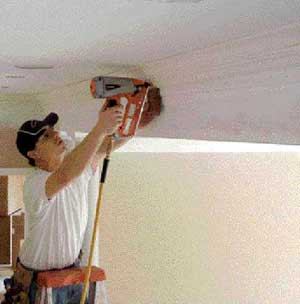
As an interior trim carpenter, I use a number of different pneumatic nailers, brad guns, and staplers every day. But for installing standing and running trim, my 16-gauge nailer gets the most use of all. The nails it takes (1 1/4-inch to 2 1/2-inch) are ideal for installing base, crown, face frames, and door and window casings. (I still use my 15-gauge nailer for structural items such as stair treads and door jambs.) The 16-gauge fasteners have enough holding power for decorative trim, leave small nail holes, and are significantly less expensive than 15-gauge nails.
So when JLC asked me last summer if I’d like to test the current crop of 16-gauge finish nailers, I readily agreed. Ten models arrived in the mail: a Bostitch, a DeWalt, a Grip-Rite, a Hitachi, a Maxus, a Milwaukee, two Paslodes, a Porter-Cable, and a Ridgid.
Side-by-Side Testing
Before using the tools on the job, I did a series of out-of-the-box tests to get a feel for each nailer’s performance. They were performed with the protective tips in place.
Rapid-fire test. For this test, I drove 25 2 1/2-inch nails into the edge of a pine 2×4 at approximately one-second intervals. A 50-foot length of 1/4-inch air hose connected the guns to a 4-gallon compressor with a line pressure of 110 psi, which was set to kick on when the tank pressure dropped to 90 psi. Each nailer started with a full tank.
Bostitch FN16250K-2 DeWalt D51256K Grip-Rite GRTFN250 Milwaukee 7145-21 Paslode T250A-F16 Paslode T250S-F16 | Hitachi NT65M2 Maxus MXN064 Porter-Cable FN250B Ridgid R250SFA |
Only three of the guns fully set all of the rapidly fired nails: the Bostitch, the Grip-Rite, and the DeWalt. The Maxus, the Ridgid, and both Paslodes performed well, cleanly setting most — but not quite all — of the fasteners. The performance of the other guns was mixed, with most setting the first few nails and leaving the remainder flush or just above flush.
I had the most trouble with the Hitachi and the Milwaukee: They couldn’t set any of the 21/2-inch nails below the surface. Some of these problems could be attributed to the rapid firing, but since the setup was the same for each tool, I consider the comparison fair.
Trim nailing test. Next, I performed a more realistic test by fastening pieces of 3/4-inch oak, poplar, and MDF onto a 2×4 with 1 1/2-inch, 2-inch, and 2 1/2-inch nails. All of the nailers successfully set the 11/2-inch and 2-inch nails, and most were able to set 2 1/2-inch nails. The exceptions were the Hitachi and the Milwaukee, which still had a hard time driving fasteners much beyond flush, especially in oak and MDF.
The clear winners in the trim nailing test were the Bostitch, the Ridgid, and both Paslode guns. All four tools set nails cleanly and consistently below the surface.
Use on Site
Once we finished bench-testing the nailers, we began to cycle them on and off the job. Every week for about three months my son, Scott, and I used two or three different nailers for standard trim work: constructing built-ins and nailing door and window casing, baseboard, and crown. Since we didn’t want to forget anything, we kept notes on what we liked and disliked about each tool. I also loaned out a few of the nailers to other carpenters to get their opinions.
The guns performed the same in the field as they did in the shop; some set nails consistently and others didn’t. I noticed that if I removed the protective tips, most of the guns that had been having a hard time setting nails were suddenly able to do it. However, the Hitachi and the Milwaukee continued to have trouble.
To avoid having to go back and set nails by hand, we ended up leaving the protective tips off the Hitachi, the Milwaukee, the Porter-Cable, and the Ridgid. The Porter-Cable and Ridgid set fasteners just fine with the tips in place when nailing perpendicular to the stock, but not when we nailed at an angle; we decided it was easiest to leave their tips off all the time.
Working without the tips did not cause undue damage to the trim. I’ve been using my own 16-gauge guns (old Porter-Cables) without protective tips for years. It’s rare for the wire bale to leave a dent, and if it does, the hole can be easily filled. When we’re working on cabinets or prefinished trim, we simply position the gun more carefully. Still, I would much prefer to use the protective tips that come with the tools. The fact that the tips keep some guns from fully setting nails is a problem manufacturers ought to address.
Ragged holes. When we started working with actual trim, we noticed that some of the drivers left tool marks or ragged entry holes. The Bostitch, the DeWalt, the Maxus, and both Paslodes were least likely to do this; they left no tool marks and very clean holes.
Corners. Guns with longer nosepieces, such as the DeWalt, the Hitachi, the Paslodes, and the Porter-Cable, were best at getting into corners. Thanks to its angled magazine, the Paslode T250A was the best tool for this application.
Line of Sight
The ability to place nails quickly and accurately is important to us. It’s very frustrating to have nails miss the intended target or blow out through the edge of the workpiece. These problems are less likely if the gun has a good line of sight.
Unfortunately, the protective tips on some of these tools make it hard to tell exactly where the nail will be placed. Many of the tips have alignment marks, but using them is an exercise in futility when you have to shoot many thousands of nails per job. I would much rather be able to see exactly where the nail will enter.
In terms of visibility, the Paslode tools have the best tip design. The U-shaped pad is open in front, allowing you to see exactly where the nail will exit the gun and enter the work.
After the Paslodes, the tool with the best line of sight was the DeWalt, which has an open wire bale surrounding its tip. The bale curls toward the back of the tool, so you can see through to the work.
The Bostitch gun has a clean line of sight but poor visibility at the tip because of its stubby nose and large protective tip. The nail doesn’t exit where you think it will, which is why you have to use the alignment marks. This nailer comes with a package of specialized tips that key to the shapes of various moldings: convex profiles, V-groove, T&G, and 5/16 offset. The tips are not a bad option — but again, I’d rather be able to see quickly and easily where the nail is going to go in. As with many other guns, we used the Bostitch without its protective tip.
I really wish nail-gun manufacturers would pay more attention to line of sight; few issue are more critical than nail placement when you’re installing trim.
Magazine and Loading
The average 16-gauge model takes nails between 1 1/4 inches and 2 1/2 inches long. A few take even shorter ones, down to 1 inch or 3/4 inch, but I see no value in using such short 16-gauge nails. For trim that thin I’d normally use an 18-gauge brad gun.
Most of the tools we tested load from the top or rear of the magazine. Of these two configurations, I prefer rear loaders, because they make loading nails in and out quicker and easier. The Grip-Rite and the Maxus (which appear to be identical) were the most aggravating to load. With these models, once the nails are in you have to squeeze and pull on the pusher in just the right way to make it slide forward and engage.
Unlike the other nailers, the Bostitch loads from the side. You just slide the cover open, add or remove fasteners, then slide the cover closed. Done. It takes only seconds, making this magazine the best of the bunch.
Added Features
For a long time, all the advances in finish-nailer design seemed concentrated in the 15-gauge models. But in recent years, 16-gauge models have caught up and now usually have adjustable depth of drive, cushioned grips, and toolless clearing of jammed fasteners. Manufacturers have also cut the weight of these tools by incorporating magnesium housings and composite materials. About half the tools we tested have belt hooks; all come in plastic storage cases.
Oil-free operation. The Bostitch and Paslode nailers don’t need to be oiled. This is convenient for the carpenter and means there is less chance the gun will spit oil and stain the work.
Belt hooks. Whereas the DeWalt, Ridgid, and Milwaukee nailers all have built-in swivel belt hooks, the Paslodes have a removable hook that can be placed on either side of the tool. Belt hooks are handy because they save you from having to search for a place to lay the gun down, especially when you’re up on a ladder.
Firing modes. There’s nothing more frustrating than nailing up a piece of trim only to have it fall off the wall when you release it because you ran out of nails. Bostitch, Milwaukee, and Paslode have helped eliminate this with a dry-fire lock-out feature that prevents their guns from firing when empty.
All of the nailers can be switched from sequential-fire to bump-fire mode. The Ridgid, the Milwaukee, the Hitachi, and the two Paslodes each have a switch on either the trigger or the housing that allows quick changeovers; the other models require changing the trigger itself.
Exhaust port. The ability to adjust the blast of air so that you don’t end up with a face full of dirt or drywall dust is both a convenience and a safety feature. All the tools in this test have adjustable exhaust ports except the Bostitch, which doesn’t need one because it’s designed to vent exhaust air through a diffuser at the back of the handle — a very nice feature.
An air gun built into the head of the Hitachi allows you to blow dust and debris out of the way without having to disconnect the gun and use a separate blower.
Nose assembly. With most of these guns, if nails jam you release a luggage-style latch, open the nose of the tool, and pull out the bent fastener. On the Paslodes, the latch is hidden under a smooth plastic cover, leaving the front of the tool clean and uncluttered.
The Porter-Cable unlatches by means of a spring-loaded lever on the side of the magazine. And if a nail jams in the Bostitch, you simply slide open the magazine and pull the bent fastener out from the side.
Favorite Models
After using these tools for several months, I had no trouble choosing a favorite: Paslode’s T250A-F16. The only 16-gauge pneumatic with an angled magazine, this nailer gets into corners easily, plus it’s sleek and compact and has a good line of sight. Useful features like a dry-fire lock-out and a belt hook — not to mention the fact that the gun doesn’t need oiling — make it even more appealing.
The T250A-F16 costs about $40 more than the average 16-gauge nailer — but for a pro, performance trumps price every time. After all, a savings of $50 or $100 can be lost in a single day if the tool performs poorly.
My only misgiving about this gun concerns the angled nails it takes: They cost two or three times as much as the straight nails used by other 16-gauge tools. Although cost shouldn’t be the main issue when buying the nailer itself, fasteners are different — their cost is recurring, and could quickly exceed the price of the tool.
Which leads me to my second-favorite tool: Paslode’s other nailer, the T250S-F16. In terms of function and features, it’s nearly identical to the T250A-F16, but it has a straight magazine and therefore takes the less-expensive straight fasteners.
My third favorite is Ridgid’s R250SFA. This gun performs well, is easy to load and unload, and packs a swivel air fitting and swivel belt hook. It also comes with the best case.
I really wanted to include the Bostitch FN16250 in my list of favorites; I appreciated its unique side-loading magazine, rear exhaust port, and extremely light weight. And I liked that it doesn’t need oil. But I couldn’t get past its visibility problem; the tool’s stubby nose and protective tip simply made it too hard for me to see exactly where nails would be placed.
However, for users who are willing to work without a protective tip or who are comfortable relying on index marks, the Bostitch could be an excellent choice.
Paul Allenis an interior trim contractor in East Tennessee.