I grew up in the West, and there I learned early in life that wormdrives were the superior circular saw. When I was a teenager, those were the only saws I ever saw on framing sites in Colorado and New Mexico. Carpenters in that part of the country talked about sidewinders in a deriding tone and called them bowling balls, owing to their purported tendency to roll off roofs.
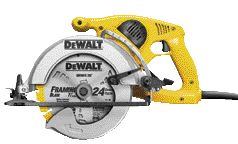
Things seem to be different today. In the last few years, on every job I’ve worked — in Maryland, New York, and Vermont — at least one other carpenter has had an inline saw. Many of them have been DeWalt 378s (see Figure 1), and recently I ran into the Bosch 1677 (Figure 2), the latest contender. I’ve grown hopeful that a revolution is in the air.
Figure 1.DeWalt’s inline offering, model 378, uses hypoid gearing instead of a traditional worm gear. Detractors claim that hypoid gears aren’t as durable, but advocates point out that they run quieter and the sealed gearbox means less maintenance.
Figure 2.Bosch has the industry’s newest inline offerings and is attempting to convert sidewinder users with its top-handle model 1678 (above left). Bosch claims that the design gives users the benefits of a wormdrive in a platform closer to what they’re accustomed to. Model 1677M (above right) has a more traditional setup and shares a housing and rear handle with the West Coast favorite, Skil’s model 77.
But my inline-centric viewpoint changed in 1980, when I moved to the East Coast and began working mostly for remodelers and as a finish carpenter. Whenever I unpacked my saw, the other carpenters raised their eyebrows, or laughed out loud, making remarks like, “Why don’t you just grab a chainsaw while you’re at it?” Rarely did I see another wormdrive on site; when I did, it was on a timber-frame or commercial site.
History 77
The division between East and West is a classic tale. You may have heard it before, but here’s a recap: The Skil 77 — the same model wormdrive that today captures nearly 90% of the wormdrive market — was invented in 1937 by Edward Sterba of the Skilsaw Company. It evolved from a sugar-cane saw that Edmund Michel invented in Louisiana in 1921. That tool used a motor from a malted-milk mixer mounted on a machete handle and a wormdrive gearbox to spin a tiny 2-inch blade. Although the tool wasn’t much good for harvesting sugar cane, it captured the attention of Joseph Sullivan, a Chicago businessman who happened to be traveling through New Orleans. Sullivan tracked down Michel and proposed a partnership to develop the saw for the construction market.
Sullivan and Michel set up shop in Chicago under the name Michel Electric Hand Saw Company (later dubbed the Skilsaw Company) and received a patent for the first wormdrive circular saw in 1924 (Figure 3). They built six, at a cost of about $1,000 total. They took three to Atlantic City, N.J., where the boardwalk was under construction, and three to Los Angeles, where a housing boom was beginning to take off. Despite myriad problems with these primitive tools, carpenters in both regions expressed enthusiasm for the wormdrives, setting the stage for distribution on both coasts. But several events led to a far greater distribution in the West. For starters, home building along the Pacific Coast spread the saw over a large area, while construction on the East Coast was mostly concentrated on commercial sites in big cities. During the depression, construction crawled, but the Army Corps of Engineers adopted the saw, taking it to Work Project Administration (WPA) sites throughout the western states, and later to hydroelectric and irrigation projects, from which the Skilsaw eventually spilled over onto construction sites. But perhaps the biggest reason the Skilsaw didn’t take off in the East was the competition from Porter-Cable.
Figure 3.The original wormdrive made by Skil evolved from a malted-milk mixer with a 2-inch blade and a machete handle. It helped build Atlantic City’s boardwalk but never caught on in the East. A housing boom and depression-era WPA projects out west led to greater acceptance there. The saw still captures almost 90% of the wormdrive market.
The Porter-Cable Machine Company was a well-established toolmaker by the time it entered the circular saw market in 1929. World War I had given the firm a boost when the demand for short-bed machine lathes and milling cutters soared. After the war Porter-Cable acquired the Syracuse Sander Company and began making floor, belt, and spindle sanders, as well as other woodworking equipment. The first Porter-Cable circular saw (Figure 4) was invented by Arthur Emmons. Since Skilsaw owned the patent on the wormdrive, Emmons developed a model dubbed the Kwiksaw, with the blade on the right and the motor sitting “sideways” — perpendicular to the blade. The saw was indeed quick. It ran full bore straight off the armature — no gears, just one hell of a big winding. Thus the “direct-drive” circular saw was born, and thereafter was marketed heavily in the well-entrenched Porter-Cable markets in the East.
Figure 4.The original sidewinder, made by Porter-Cable, spun right off the motor without a transmission because Skil already had a patent on a geared design. The saw was accepted because of PC’s established eastern market and reputation for building quality woodworking equipment.
Hypoid vs. Wormdrive
In the 1970s Makita pioneered the use of the hypoid gear train in an inline saw, and it has since been adopted in DeWalt’s inline saws. A hypoid gear is a finer-toothed gear system enclosed in a sealed case. By contrast, a wormdrive gear is a meatier, spiral gear bathed in oil that must be replenished periodically. Hypoid advocates claim that their beveled spiral gears mesh more closely than the gross coils on a worm gear, resulting in smoother power transmission and cooler, quieter operation. Critics argue that the hypoid has less shock resistance (a common example of shock is the force a saw takes when it runs into a knot at full speed) and will wear out more quickly than a worm gear.
While hypoid-drive saws run noticeably quieter than wormdrives, none of the other differences is worth getting too excited about. For starters, both designs run three to four times longer than most sidewinder saws, according to manufacturer reports. That might sway a few sidewinder users, but it’s features like weight and balance that have the most discernible influence.
What You’re Used To
“It’s all in what you’re used to,” explains Randall Coe of the SB Power Tool Company. “If you started out with a 9- or 10-pound saw, you’re never going to be comfortable with one that weighs 15 pounds.” Inline saws weigh from 13 pounds (DeWalt) to almost 17 pounds (Milwaukee). Wormdrive users love the weight, arguing that a heavier saw is easier to control (“It doesn’t bounce around”), almost exactly the same argument sidewinders use to tout their saw (“It’s easier to maneuver”).
In an effort to corral some of the sidewinder market, Skil explored the use of magnesium housings to shave weight off the 77, and the same housing has been adopted for the newest inline saws, Bosch’s 1677M and 1678. Bosch wants to take the weight reduction program even further and is exploring a new line of heavy-duty, lightweight tools to be introduced in the near future. But Randall Coe argues that the weight is in the motor and the gear train, and there’s no real-world way to lighten those without sacrificing longevity. “If you want the durability of a wormdrive, you have to contend with the weight,” he says.
Chances are good that if a wormdrive saw could be made as light as a sidewinder, it still wouldn’t win over the pack. The balance, the hand positions, the whole dynamic of using an inline saw is different. This translates into work methods. Most sidewinder users are horrified by the way I cut framing lumber by propping the boards on my ankle. They prefer to hoist the lumber onto horses at waist level — an unnecessary waste of energy, I think. But there you have it. Coe’s right. It’s all in what you’re used to.
Despite my desire for a revolution, the classic division between East and West still holds. Those inline sightings I’ve had on East Coast job sites may be an anomaly, according to market distribution reports. The majority of inline saws are still sold out west, except in the commercial trades, which don’t seem to have tool-specific boundaries. Or when I spotted those carpenters with their inline saws, I might just have been working in the company of superior beings.
was a longtime senior editor at The Journal of Light Construction and a founding editor of Tools of the Trade