It’s easy to get carried away with window placement in a house design and end up with a jumbled-looking facade. This article illustrates some simple guidelines for making windows compatible with the other elements of a house.
First, keep these two rules in mind:
• Windows are an integral part of a house design, not something you glue on to an otherwise finished design.
• Begin your window design from the inside, to suit the room and furniture arrangement. Then work on the outside. If you need to change the windows to make the elevations work, always check to be sure you haven’t altered what you were trying to achieve inside the room.
Two basic approaches. To create openings in a building, whether windows, doors, or colonnades, you can use one of two basic approaches:
• the “holes in the wall” approach
• or the “divided facade” approach
It’s best to emphasize one or the other of these approaches in a given building. If you try to use both at once, you may end up with an unpleasant visual confusion.
Holes in the Wall
To use the “holes in the wall” approach, you start with the solid-looking mass of wall and roof planes and punch holes in it. Most traditional house designs employ this method. In the more successful designs, the punching is done in an orderly fashion, rather than at random.
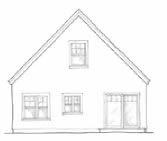
Use lineups. The design at top right has a jumble of discordant shapes placed almost randomly on the gable end. In the design at right, the edges of windows are aligned with each other and with important lines in the building; the result is a satisfying sense of order and harmony.
Use Lineups | |
| | |
Symmetry vs. asymmetry. Using the principle of symmetry is an ancient way of bringing order to any composition, but it works best on a grand scale. On smaller houses, such as the popular “center-entrance colonial,” a symmetrical window layout works only if the floor plan is simple and symmetrical. If you were to add a garage or rearrange the floor plan, you would create a powerful asymmetry.
A better approach is to use styles that are based on balanced, asymmetrical forms, such as some Victorian designs. Then you can plan freely and still end up with a good-looking building. Note that individual wings often have symmetrical windows: I call that “local symmetry” as opposed to “overall symmetry.”
Symmetry vs. Asymmetry | |
| | |
Enhancement. Windows are the eyes of the house. Just as eyes look eerily vacant if not enhanced by lids, lashes, and brows, windows need geometrical enhancements such as casings, muntins, shutters, and side lights. We often take these for granted until someone removes them to save money.
Vinyl windows are a great improvement over thin aluminum or wood windows, because even without casings, they have relatively hefty frames and sash bars. If you use casings, however, take the extra width of the vinyl window into account. You might want to keep the casings narrower than usual.
Enhancement | |
| | |
| | |
Contrast and rhythm. A facade with windows that are all the same size looks boring. Placing large and small windows along with the plain vanilla, ordinary-sized ones creates more visual interest.
To avoid oversized panes of glass, try using narrower sash, or use two narrow sash and one wide one to create a nice rhythm. If you want a local symmetry, put the big window in the middle. Don’t put symmetrical groups side by side, one after the other, or the facade will lose its vitality and movement.
Contrast and Rhythm | |
| | |
Dividing Facades
The other basic approach to creating openings is to divide the building facade into a grid of solids and voids. Each of the divisions can be further subdivided, through several generations.
Horizontal bands. Most western architecture is based on Greek and Roman examples, which almost invariably divided the facade into horizontal bands representing the foot, torso, and head of a body. But Frank Lloyd Wright created a more useful sort of horizontal band that divided the facade into two parts (the roof became the essential third part). Most of Wright’s houses are organized with a horizontal window band right under a big roof, all set on a heavy base.
Horizontal Bands | |
| | |
| | |
| | |||
| |||
The nice thing about any horizontal window band is that you can put the windows almost anywhere, and in almost any kind of group, to suit the interior room layout. Buildings with shed roofs are notoriously hard to design, which is one reason they have gone out of favor. One useful way to arm-wrestle a shed with a shallow-pitch roof is to run a horizontal band in a contrasting color under the roof, leaving a big rectangular base.
Vertical bands. As with a horizontal band, you have great flexibility in placing windows within the contained space of a vertical element. In recent years, builders have been emphasizing the vertical. Buyers like the image of such houses, because they seem to have a monumental quality.
Vertical window bands are difficult to handle, however, because they tend to break up the facade into independent, unstable-looking pieces. Gravity holds horizontal bands together, but it threatens vertical elements.
Vertical Bands | |
| | |
One thing you can do to avoid this problem is to give the vertical element its own roof, preferably a gable instead of a hip. The point of the gable “discharges” the energy of the vertical form, rather like a lightning rod.
Gordon Tullyis a principal of Tully Architectural Consulting LLC in Norwalk, Conn.