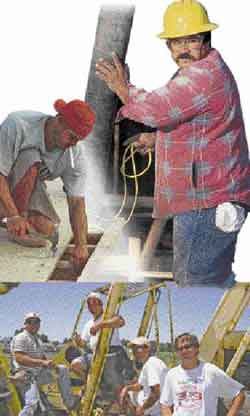
Born in Buenos Aires, Argentina, I learned to speak Spanish as a baby; I learned English later, when my family immigrated to New York City. My mother spoke both languages at home, so I grew up bilingual. Nevertheless, my first encounters with construction-site Spanish made me feel as if I had traveled to a foreign country. This was because many of the techniques used in our building industry — including wood framing, vinyl siding, and drywall — are unique to the United States. To facilitate job-site conversation, Spanish-speaking workers in the U.S. have had to develop local words and expressions that can’t be found in conventional Spanish/English dictionaries, making it tough for native Spanish-speakers to understand one another.
It can be even more difficult for an English speaker to learn job-site Spanish. Although you may have aced high school Spanish, I’m sure you never learned vocabulary like rapear (dry wrap this opening) and joistear (roll joists). But if you want to communicate effectively with this rapidly growing segment of the American work force, you’ll need to learn the basics of the Spanish language and train your ear to understand the local construction dialect.
Why bother? Consider the numbers: According to the Bureau of Labor Statistics, persons of “Hispanic origin” make up one of the fastest growing worker groups in the U.S. Their number — 13.6 million in 2000 — has increased 65 percent since 1980, a rate of growth four times that of the “non-Hispanic” work force. Spanish is the native language of nearly 18 percent of all construction workers in the U.S.; in New Mexico, Texas, and Southern California, almost half of the home-building work force speaks Spanish.
Learning the language and culture of your co-workers and employees — and perhaps your next boss — can improve your crew’s productivity and job-site safety while giving you an opportunity to build new friendships. In other words, knowing Spanish adds a practical and versatile tool to your toolbox.
Developing an Ear
You don’t have to memorize verb endings and noun genders to begin building an understanding of a new language. Just do what babies do when they learn to talk: Listen. Tuning in to a Spanish-language radio station on your way to work and discovering music that you enjoy with Latin lyrics can start developing your ear. Watching Spanish-language television can add another building block; the visual cues will help you decipher the language in context. Just by opening your ears, you’ll allow your brain to do what humans do best — decipher speech.
| Resources for Learning Job-Site Spanish |
Instead of choosing a CD course designed to teach you the language as a whole, look for a Spanish program that focuses on construction phrases and vocabulary. This will allow you to put the language to use immediately. If you want to expand your vocabulary later, you’ll have a strong foundation to build on. Also, it’s a good idea to choose a course that features a native English-speaking instructor, not a Spanish-language native. You’ll find it much easier to learn from someone with an American accent than you will trying to mimic fastidiously perfect pronunciation. As you learn Spanish, you’ll certainly want to have a Spanish/English dictionary on hand. I own several, both in reference size for my desk and in pocket size for the job site. Translation dictionaries provide equivalents for specific words, but when you learn a language, you need concepts and expressions more often than you need terms. This is where a phrase book, which provides Spanish/English translations of common sentences in specific context, comes in handy. You could use a phrase book to find expressions used in hiring, cleanup, or carpentry. Here are some resources to get you started. Easy-to-Learn Construction Spanish. (Ablemos, 2001, $14.95; 866/323-1255, www.ablemos.com) This 60-minute audio course features a clear-speaking Mexican instructor who shapes Spanish words with English-friendly tones, as well as two English-speaking instructors. Beyond simple vocabulary and phrases, the course breaks down Spanish pronunciation into vowels and consonants, then builds vocabulary by re-creating simple dialogue (it’s always easier to learn a language in a conversational context than to try to memorize isolated words). Presented in an easy-to-listen-to package — which also offers insights into Latin culture, such as the importance of lunch as the main meal of the day — this course will keep your attention. It’s the best approach I’ve found to learning Spanish, especially for supervisors. Workplace Spanish for Commercial Construction. (Workplace Spanish, 2002, $34.99; 770/993-4075, www.workplacespanish.com) I especially like the workbooks and audio courses in the Workplace Spanish series, which features a number of profession- and trade-specific programs, including one for home builders and another for commercial contractors. Both courses have substantially the same material (the home builder’s course covers the rooms in a house, while the commercial course covers heavy equipment). The 60-minute audio CD features two instructors, a native speaker and a North American with a distinctly Anglo accent, and includes 22 sections covering phrases and terms for safety, job rules, hardware, tools, measurements, building materials, appliances, paint colors, and so on. The 57-page workbook accompanying the audio course provides cultural and language tips, a guide to Spanish pronunciation, and job phrases sorted by topic. A selection of practice examples features job-specific situations, such as a tailgate safety briefing and hiring questions. Survival Spanish for Construction. (SpeakEasy Communications, 2001, $19.95; 704/662-9424, www.speakeasyspanish.com) This audio course includes an hour-long CD and a workbook and pronunciation guide. The only construction-specific sections cover the rooms in a house and a glossary of tools; the native Spanish-speaking instructor’s tone makes it difficult to stay awake while listening. Although the native pronunciation is clear, an English speaker would have difficulty imitating it. Diccionario de Arquitectura Construcción Y Obras Públicas. (By R.E. Putnam and G.E. Carlson; Paraninfo, 1996, $54.95; available through Continental Book Co., 303/289-1761, www.continentalbook.com) My favorite translation dictionary takes a little more effort to obtain because it comes from Spain. Written for Spanish architects pursuing design contracts in the U.S., it includes the full range of construction-related terminology, many construction detail illustrations, and a complete English/Spanish glossary. Means Spanish/English Construction Dictionary. (R.S. Means Company, 2000, $22.95; 800/334-3509, www.rsmeans.com) When browsing a new translation dictionary, I usually look up a few common English words that have no direct Spanish equivalent, such as driveway, shutter, and drywall. If the dictionary tackles these tough translations, I know it’s probably worth a closer look. The Means dictionary does not contain all of these common words — yet it sits on my desk as an essential reference. Why? Because it contains most of the useful terms for tools, materials, and building components. You can find the book at almost any bookstore. Constructionary: English-Spanish Construction Dictionary. (International Code Council, 2000, $19; 800/786-4452, www.iccsafe.org.) This toolbox dictionary includes a basic vocabulary of construction terms, useful phrases, measurements, time terms, and unit conversion tables for feet to meters and pounds to kilos. Construction Spanish: Spanish Terms Commonly Used on Construction Projects. (Investment Group Services Ltd., 2002, $5; 970/568-3184, www.constructionspanish.com) This small volume can fit in a shirt pocket and provides a solid set of word equivalents plus a few phrases and measurement conversions. English-Spanish Jobsite Phrasebook and English-Spanish Framing Phrasebook. (By Kent Shepard; BuilderBooks, 2003 and 2004, $22.95; 800/223-2665, www.builderbooks.com) Author Kent Shepard learned his Spanish on the job site, working as a general contractor. In an effort to communicate with Spanish-speaking framers, he began stockpiling English/Spanish phrases in a notebook, which evolved into these two books. Both contain chapters on labor relations, safety, tools, and accident and injury reporting. The job-site book covers concrete, framing, roofing, insulation, and drywall, while the framing book goes into layout, framing walls, plumb and line, joists, roof-cutting, window and door setting, punch lists, and fireplaces. Given the specialized nature of construction — especially wood-framed construction — I use both of these terrific phrase books with my Latino crews despite a lifetime of speaking Spanish. Easy Spanish for Construction. (Mitchell Brothers Press, 2003, $4.89; 800/227-9253, www.easyspanishforconstruction.com) Although the phonetic pronunciation guide contained in this pocket-sized volume is a useful feature, it crowds the text and makes the presentation difficult to follow. Spanish Phrases for Landscaping Professionals. (By Jason Holben and Dominic Arbini; Stock Pot Publishing, 2001, $22.09; available from Amazon.com) If you are a landscaping contractor, this volume’s for you. It provides job-specific phrases, with chapters on hiring, safety, equipment handling, sprinklers, sod, bedding, planning, light masonry, and cleanup. Spanish in a Pinch. (2nd Language Success, 2002, $79.95 for 18-card combo set w/sleeves and organizer; 877/265-8575, www.2ndlanguagesuccess.com) If you’ve traveled outside the English-speaking world and used a transaction guide — such as “restaurant French” or “how to order a meal in Mexico” — you’ll readily understand the concept behind “Spanish in a Pinch.” The set consists of laminated cards (which are also available individually at $4.95 each) featuring common phrases associated with specific trades. Card topics include accident reporting; safety briefing; a card for each of the construction trades, from concrete to trim; and even a card for subcontractor screening. This set would be a handy glove-box reference, although the pronunciation guide is not good. For example, to help you pronounce the simple recámara (bedroom), the tortured “ray-KAW-ma-raws” is offered instead of the simpler “reh-camera.” On the plus side, the series includes transaction guides for building inspections. I can’t even talk to my building inspector in English. |
Within a couple of months, you’ll be able to catch the drift of basic sentences and perhaps begin peppering your job-site banter with Spanish words and phrases. Of course, fluency will take a lot longer, but for most of us, that level of mastery isn’t necessary. Your objective isn’t fluency, but practical communication.
As you become familiar with the cadence of Spanish, you’ll begin to better understand the broken English of heavily accented Latinos. This means your ear is recognizing new speech patterns. Even when you don’t understand the words, you’ll have a sense of the conversation’s meaning when you hear Spanish dialogue, and you’ll start to distinguish familiar sounds and expressions and correlate them with tone and body language. By instinct, your ear will lead you to a fuzzy but slowly clarifying sense of comprehension — and your tongue will follow closely behind.
Developing Your Tongue
Just as babies learn language by listening, they also learn by babbling. This is tough for adults, who feel embarrassed by tongue-tied attempts to pronounce foreign words. But there’s no choice: You have to practice your Spanish aloud.
When I coach someone in conversational Spanish, I don’t teach them a random assortment of words. I start by teaching them the tricky aspects of Spanish pronunciation: the five vowel and consonant sounds that differentiate Latin-based languages from English.
While English vowels have multiple sounds, Spanish vowels have only one. For example, the “a” in ape sounds different from the “a” in apple; the “u” in umbrella sounds different from the “u” in duty. In Spanish, vowels sound dry by comparison. Latinos always pronounce the letter “a” as ‘ah,’ and the letter “u” as ‘oo.’ Nothing distinguishes an English accent as much as the lilting vowels, so try to learn the Latin vowels: ‘Ah, eh, ee, oh, oo.’ In Spanish, a vowel sounds the same regardless of context: taco, pato, coco. The “o” never changes.
Next, tackle the five characteristically Spanish consonants. These include “h,” the easiest to learn because it’s always silent, as in hola (hello), pronounced ‘ola.’ The Spanish “j” sounds like the English “h,” as in jalapeños. The double “ll” in martillo (hammer) sounds like a “y” in English: “mar-ti-yo.” Spanish has one letter not used in English, an “n” with a squiggle on top — the ñ. The weather phenomenon known as El Niño offers a good example of how to pronounce this letter.
The double “rr” is the only one tough to learn unless you know how to trill your tongue, but if you can’t roll your r’s, it’s okay to stick with the English pronunciation. For example, you could ask for a sierra (saw) by pronouncing the word “see-air-rah,” and I’m reasonably confident a Latino colleague won’t hand you a martillo instead.
Don’t spend too much time trying to sound like a native; you don’t have to become fluent to communicate effectively. If you come close, everyone will understand you. To help you gain proficiency, there are more than 500 different Spanish audio courses on cassette tape or CD to choose from, which allow you to practice in the privacy of your own pickup (see sidebar, “Resources for Learning Job-Site Spanish,” beginning on page2).
Lost in Translation
Once you start exploring Spanish, you’ll eventually find yourself in a sounds-alike/means-something-different situation.
For example, tell a co-worker you feel embarazado, and he or she may blush, too, given you just declared you feel pregnant. The correct word in Spanish would have been avergonzado. To avert future embarrassment, it pays to know a few of the translation pitfalls up-front.
I recently fell into an obvious lost-in-translation error despite knowing better. In Spanish, the phrase no vá doesn’t mean something new, but rather “does not go,” or “does not run” (it wasn’t a Latino who named the Chevy Nova). While pointing at boxes of Novabrik, a mortarless masonry product, I instructed my siding guys where to install it on the house. When I returned to the job later in the day, I found that they had specifically avoided these areas. When I questioned my crew leader, he asked me what I had been drinking, since I had given specific orders that the product I pointed to “does not go” (no vá) there.
Other common mistakes include asking your crew to follow dirección, which refers not to instructions or orders, but to a street address (the proper word is instrucción). You might ask a co-worker to mark a stud layout using the word marca, which actually means a brand name, such as Ford or Chevy. On the other hand, el marco would refer to the door jamb. You wouldn’t aplicar for a job, since this refers to smear or spread as in glue or paint; the correct term for soliciting employment would be solicitar.
Even more subtle, you may find yourself giving offense when you don’t mean to. Mexicans, Guatemalans, and Costa Ricans all consider themselves to be Americans, a term that people from the U.S. sometimes reserve for themselves (better to say Estadounidense, or United States-ian). You will also find that Bolivians, Nicaraguans, Argentineans, and all other Latin Americans prefer to be known by their country of origin than by the generic “Hispanic.” In fact, “Hispanic” technically refers to those born on the island of Hispaniola, which comprises Haiti and the Dominican Republic. If you need to use a generic term to refer to your Spanish-speaking colleagues, call them Latinos.
Finally, because Spanish speakers come from so many countries, you’ll find that while they all speak Spanish, they don’t all sound alike. Just as English varies from New England to New Orleans and from Ireland to Australia, Spanish varies even more. This means that expressions you learn on a job site in New York may not translate in Miami. What’s more, what you learn on the job site usually represents a mix of provincial Spanish and regional English, especially when English words do not have an easy one-word translation. For example, instead of saying El muro en seco, which takes too long, most Spanish-speaking workers will say dry-vol (drywall). But a Latino working on the East Coast, where many people still refer to drywall as Sheetrock, might say el shee-ro.
Confusing? Welcome to Spanglish, soon to become the most widely spoken language on job sites across the country. As you develop your skills, keep in mind that what you want to learn is not so much the language as the means of communicating across the language barrier. In addition to words and phrases, take full advantage of facial expressions, hand gestures, and tone of voice. A friendly smile, a laugh, and the occasional scowl translate with no dictionary required.
Fernando Pagés Ruizis a building contractor in Lincoln, Neb.