- Q. I have a hot-water system feeding high-temperature baseboard heaters and a low-temperature radiant slab. How should the system be set up to accommodate these separate zones?
A.John Siegenthaler responds: There are several ways of combining low-temperature radiant floor heating with higher-temperature distribution systems, such as fin-tube baseboard convectors. Above all, the system must be designed 1) to prevent condensation within the boiler, and 2) with a specific type of control system.
Conventional boilers must have return water temperatures high enough to prevent sustained condensation on the fire-side of the boiler, or within the flue pipe. Water vapor is a byproduct of combustion, and if allowed to condense, it can cause severe corrosion. Flue pipes are especially vulnerable, and can fail in a matter of weeks when condensation is present. This could allow toxic gases to be released into the building.
Typically, the return water temperature for a gas- or oil-fired boiler should be 140°F or higher to prevent condensation. Since radiant systems operate with a return water temperature in the range of 80° to 100°F, their return water must be mixed with hotter water before it is sent back to the boiler. There are two simple ways to do this — with a four-way valve or with injection mixing.
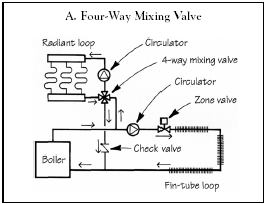
The four-way mixing valve lowers the temperature of the water supplied to the radiant floor system by mixing return water into the radiant loop, as shown in Illustration A. To avoid condensation in the boiler, the four-way mixing valve maintains a relatively high return water temperature by mixing some hot supply water into its return flow.
To control the four-way valve, you’d ideally have a motor-operator regulated by an outdoor reset control. This measures outdoor temperatures and automatically adjusts the valve to maintain a suitable water temperature in the radiant floor to match the required heating load. A less expensive (and less exact) control system for the four-way valve is to control the circulator in the floor heating loop with a room thermostat. This way, the four-way valve is set at the design-load temperature of the floor heating system and left there. When heat is needed, the circulator comes on to deliver hot water to the area. The thermostat should have a low differential (one or two degrees), to minimize swings in room temperature.
Another way to lower the water temperature of the radiant floor is through injection mixing (Illustration B). In this system, the high-temperature zones have individual circulators (C1) that are controlled by room thermostats, just as in a standard multi-zone system. Water circulates continuously (using circulator C2) through the radiant floor loop during the heating season, and a zone valve opens to allow hot water to flow into the loop when heat is needed. This zone valve can be controlled by a thermostat or for more precise control, a reset control.
The hot water from the zone valve is mixed with cool return water at the tee downstream from the valve. A balancing valve determines how much hot water flows into the radiant loop when the zone valve is open. To prevent condensation, the circulator in the main system loop (C3) must operate when the zone valve is open to shunt a significant portion of hot water back towards the boiler.
The injection mixing hardware (zone valve plus reset control) is significantly less expensive than the four-way valve system with a reset control (about $300 vs. $800). Detailed information about both approaches can be obtained from Tekmar Control, 4611 23rd St., Vernon, BC V1T 4K7, Canada; 604/545-7749.
John Siegenthaler, P.E., owns Appropriate Designs, a building systems engineering firm in Holland Patent, N.Y.
Q&A: Combining Radiant and Baseboard Heat
Combining Radiant and Baseboard Heat
3 MIN READ