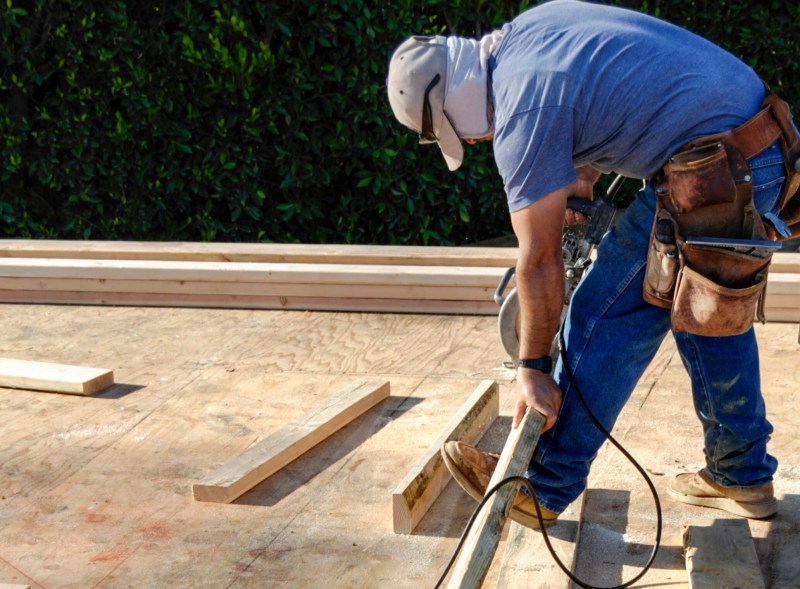
It was a crisp morning under a bright Colorado sky in late summer, 1979. I had recently graduated from high school and gotten a job on a framing crew building condos near the Beaver Creek ski resort. We were all living on the jobsite. I slept in a tool shed because I didn’t have a truck; the others—except two local boys hired as helpers—either slept in their trucks or bivouacked onsite.
These others included a grizzled old timer, the crew boss, and a couple of thirty-something career framers, one of whom I’d met in my hometown in N.M. He was the guy who’d hooked me up with this crew, which traveled all over the West, framing during summers and mostly hanging out and skiing during winter. I was the same age as the helpers but could hold my own as a full-fledged carpenter by then—though I was in no way an expert, particularly at the style of framing these guys practiced.
They measured boards with a tape and used a framing hatchet—the same ones they always kept on their belts in lieu of a hammer—to make their layout marks. None of their saws had blade guards, and they ran a pair of ancient Hitachi guns like they were automatic weapons. I was always at least two paces behind them on any given task. (I kept my guard on and used a pencil; what can I say?) And I was literally behind Diego when he sliced the end of his boot off, along with all the toes on that foot.
Diego had been cutting blocking with the board propped up on his foot. He would plunge the spinning, unguarded blade straight down for each cut, moving with minimal effort and maximum speed. Practiced as he was at this maneuver—he must have done this many thousands of times—it seemed inevitable something like this would eventually happen.
Advice from Emergency Experts
Most complete amputations don’t bleed as much as you might think, because the severed blood vessels retract into the stump. But amputations should be treated the same as for bleeding. A tight pressure dressing at the end of the stump should be adequate. Save all severed body parts in a dry plastic bag, and put them in a cooler. Give the body parts to the EMS personnel, because a lot of limbs/digits can be reattached if you hurry.
~Joshua Yamamoto, Baltimore, Md. Former EMT
Don’t apply tourniquets to prevent bleeding from an amputated area. Doctors have found that contaminants below a tourniquet will circulate back into the victim’s tissue and cause problems when released. If you do feel that a tourniquet is the only way to keep a person from bleeding to death (if, for example, you are many hours from medical help), don’t take the tourniquet off. Leave it on until you get the victim medical attention. In most cases, amputations can be treated successfully without tourniquets if you apply pressure and act quickly to retrieve the extremity, keeping it cool and dry to keep the tissue alive.
~Donald Rouse, St Louis, Mo. Former EMT
When it did, the whole front of my shirt got splattered with blood; I was so shocked I just stood there stupidly. But Andre, the crew boss, hardly missed a beat: He first grabbed Diego’s hands and pressed them against his bloody stub of a foot, then picked up the boot end, ran to his cooler, dumped out a bag of tortillas, put the boot and toes into the bag, slammed it into the cooler, grabbed a box of shop rags from his truck, and sprinted back to Diego’s side. Andre lifted Diego’s hands off the wound and replaced them with a handful of shop rags. As we learned later, Andre’s reaction was the smartest thing anyone could have done in the moment. Because Andre acted swiftly to keep the severed toes dry and cool, doctors were able to reattach them. Diego walked with a slight limp for the rest of his life, but the toes remained functional. He kept framing houses for the next thirty years without chronic foot pain.
Ten years after Diego sliced off his toes, I got a chance to imitate Andre when a co-worker sliced through the bone in his thumb while making a tricky cut on a miter saw. He didn’t slice the entire thumb off—it was still hanging by a cord of flesh. I wrapped the wound up in a dry tee shirt, put his whole hand in a plastic bag, and had him hold his bagged hand in a small cooler full of melting ice while I drove him to the emergency ward. Doctors were able to reattach the thumb, which remained a bit stiff but was otherwise intact.
We’ve all seen people play stupid games with saws. And I would guess that most of us know someone who has severed digits. Next time it happens, realize that what you do in the first thirty seconds can be the difference between damage you can fix and the loss of something you can’t replace.
Keep the conversation going—sign up to our newsletter for exclusive content and updates. Sign up for free