
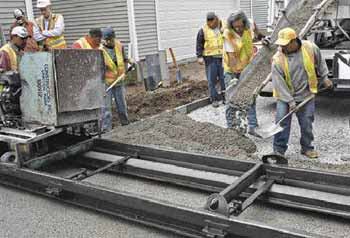
In a natural landscape, most of the rain that falls on the ground seeps through the soil and replenishes the water table. But when rain hits conventional pavement, it washes off — along with oil and other contaminants — into a nearby municipal storm sewer system or directly into the watershed. Pervious concrete pavement, however, is different: It acts like gravel and allows water to drain right through it into the ground.
Because of its environmental benefits and a regulatory climate that makes strict stormwater regulations likely in the near future, pervious concrete is generating a lot of buzz. So when the time came to pave a private roadway in a small subdivision that I’m building in Lincoln, Neb., I was eager to give it a try.
Benefits
Like regular concrete, pervious concrete consists of cement, gravel, and water. Unlike regular concrete, it contains little — or no — sand. As a result, it’s filled with voids that allow water to percolate through its surface at up to 18 gallons per minute per square foot of concrete.
When stormwater collects and passes through pervious concrete pavement, large sediments are filtered out, hydrocarbons and other pollutants are biologically degraded by bacteria colonizing the concrete, and heavy metals settle toward the bottom. As the water filters through the stone base supporting the pavement and then through the soil underneath, bacteria continue to digest pollutants; by the time the water reaches the aquifer, it’s been scrubbed clean.
In essence, pervious pavement — along with its stone base — serves as a giant sponge, absorbing rainwater and runoff and buffering flows into municipal storm sewers and nearby streams. It can reduce site drainage requirements and is recommended as an effective way to reduce runoff by the LEED (Leadership in Energy and Environmental Design) green-building rating system. In some municipalities, the use of pervious concrete can contribute to the required impervious-to-pervious surface ratios established by the Clean Water Act, in effect lowering stormwater fees and allowing for more square footage of building and parking.
Originally tested for flood-control purposes in Florida, pervious concrete has been adapted for use in cold climates, too. One advantage in those applications is that the porous structure of the concrete allows heat from the ground to rise and liquefy snow from underneath. The water drains through the pavement, leaving behind a drier surface that requires less snow and ice removal.
Working on Site
The logistics of making pervious concrete are tricky. For this highly porous concrete to provide a durable surface, the mixture must contain an exact proportion of aggregates and water plus special chemical admixtures, be properly mixed during delivery, and be expertly placed. Pervious pavement is not so much a concrete product as it is a paving system consisting of soil, subgrade, and — of course — the mix.
It’s not a job for amateurs, so to build my pervious alley I hired one of the best paving contractors in my area, Constructors Inc. For technical help I turned to the Nebraska Concrete and Aggregates Association. And the largest ready-mix supplier in Nebraska, NEBCO, offered its labs to help develop a climate-appropriate mix. NEBCO employees even poured an experimental test patch at the plant to make sure everything would go smoothly on my site.
Subgrade prep. Since water drains through pervious concrete, it must have somewhere to go. Pervious concrete can sometimes be laid on grade when placed over sandy soils, but most soils require a gravel bed of at least 6 inches thick; this bed acts as a drainage plane that holds the stormwater as it slowly percolates into the soil. In my area — where the soil is high in clay and water freezes in winter — we wanted to be sure that any moisture in the concrete would immediately drain, so we overexcavated the subgrade by 12 inches. We rolled out a layer of nonwoven geotextile against the soil to prevent the gravel bed from becoming silted with mud, then put down 10 inches of clean, lightly compacted No. 57 stone (1 1/2-inch to 3/4-inch crushed limestone).
For insurance, we also installed three rows of French drains that connected to the storm sewer system. If unusually high precipitation causes the thick gravel bed to flood, the storm sewer will serve as an emergency overflow valve.
While conventional concrete is always pitched to drain, the gravel bed under pervious concrete must remain level to maximize water retention and percolation into the soil. In our case, this requirement was an advantage, since we were having trouble establishing a water-shedding grade for our 400-foot-long alley. Using pervious concrete, we were able to pour the road low and level and still manage surface flows from adjacent driveways and lawns.
ResourcesFor more information on pervious concrete, contact the National Ready Mixed Concrete Association (888/846-7622, www.nrmca.org), which offers a number of publications and reports on pervious concrete. Also, the American Concrete Institute’s manual “Pervious Concrete” (248/848-3700, www.aci-int.org) contains technical information on all aspects of working with the material. In addition, many state concrete aggregate associations offer pervious-concrete training and certification, administered in conjunction with the NRMCA. |
A climate-suitable mix. A typical yard of pervious concrete contains coarse 3/8-inch (pea gravel) aggregate, six or seven sacks of portland cement, and water in a water-to-cement ratio of .25-to-.30 (which is about a third drier than standard concrete). Because of the low water content, pervious concrete is a difficult mix to work with: It can’t be pumped, it doesn’t pour out of the truck or spread easily, and its high porosity allows air to get in and hydration to take place quickly. To combat these characteristics, concrete designers include admixtures to slow hydration, stabilize the mix, and provide a slightly longer working time. Even so, a pour must be placed, finished, and covered within 20 minutes.
On this job, the admixtures included air entraining agents. These chemicals add microscopic air pockets to the cement paste so that moisture has a place to expand, which prevents cracking in freezing temperatures. To improve workability, water reducers and viscosity modifiers were added, too. The objective was to have a practical mix that was relatively easy to place and that would yield a pavement with a 15 percent to 20 percent void structure — somewhat resembling a rice cake.
The ready-mix company also added a small percentage of fines — in this case, fly ash (a recycled material derived from coal-burning power plants) — to increase compressive strength. We wanted to make sure that the concrete surfaces would not crumble over time; none of us wanted to come back to tear out and replace the pavement.
Proper placement and curing. Pouring pervious concrete demands a highly coordinated effort. Getting the dry, virtually zero-slump mix out of the truck and down the chute, then spreading and striking it — all within 20 minutes — requires plenty of manpower and crew members who know what they’re doing.
In this case, one worker directed the chute while forcing the stiff mix down with his hand. As the concrete spilled to the ground, the crew raked and shoveled hard to spread it like heavy, damp gravel from end to end. A mechanical vibratory screed, set 1/2 inch above the surface, came right behind, striking the concrete level.
Next, instead of floating and troweling, the pavement was simply consolidated with a steel pipe roller. With pervious concrete, the surface profile is not critical, as dimples and dips will not become birdbaths on a leaky surface. On the other hand, overworking the surface can seal it and defeat the purpose. “Strike, screed, and roll” is all that’s needed.
Immediately after compacting with the steel roller, workers fogged the concrete with a soybean-based curing compound (C2 Products, 800/575-5988, www.c2products.com), then covered the surface with polyethylene sheeting, all within 15 minutes of placement.
Because of pervious concrete’s highly porous structure and very low water content, moisture evaporates from it quickly, which can compromise the cure. Spraying water on the surface to slow hydration is not an option because it could cause the cement paste to settle along the bottom, leaving an impermeable layer below and a lean, crumbly crust above.
Costs
By the yard, pervious concrete doesn’t cost much more than conventional concrete; in fact, since there’s no finishing involved, it’s a little cheaper to install. With no floating, finishing, edging, or cutting, my paving contractor was able to install our 14-foot-wide by 400-foot-long strip in about four hours. On the other hand, we found that the extra site work involved in building the drainage bed almost doubled our overall project cost.
We also found that construction dirt presents a big challenge. To keep tracked mud from clogging the concrete, we used a lot of plastic and did a great deal of shoveling and cleaning. A pervious-
concrete surface needs regular maintenance, as well — sweeping, vacuuming, or power-washing — to remove normal dirt and debris that otherwise would accumulate in the voids.
Today, after many careful inspections and several freezing nights, the concrete in this project appears to be performing as designed. Rainwater never puddles and the roadway dries off within minutes. Moreover, a recent 2-inch snowfall simply disappeared, no plowing required.
Fernando Pagés Ruiz is a building contractor in Lincoln, Neb.


