- Q. We are working on a house with water in the basement. The homeowner got a bid from a specialty contractor for a comprehensive dewatering system that includes injecting a coating around the outside (without digging up the soil) and cutting the slab to install an interior perimeter drain connected to a sump pump. Wouldn’t it be easier and cheaper to solve the problem from the exterior?
A.Henri de Marne responds: The system the specialty contractor describes is commonly used by residential water-proofers. The injected coating, which is probably bentonite, is generally effective for only a short time, and is probably not worth the added expense. But the interior drain will remove the bulk of the water, and will last a long time, if done properly.
I have used an interior perimeter drain connected to a sump pump a number of times. It is often the best choice, depending on the house site. In general, I choose an interior drain when:
- Landscaping is extensive, long established, and valuable, and the risk from moving it is too great.
- There is not enough space to store the excavated dirt, wheel in stones and coarse backfill, or safely excavate a sufficiently wide trench.
- There is no access to the backyard or the sides of the house.
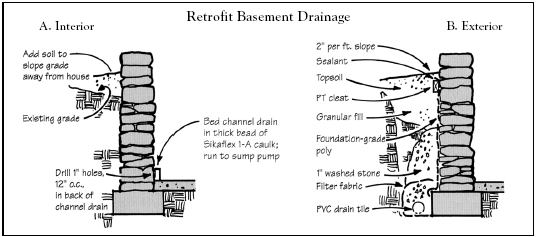
If you opt to do the work on the inside, consider using channel drain — a PVC or fiberglass enclosed gutter with holes in the top, such as Microchannel (NDS, 3001 Mission Oaks Blvd., Camarillo, CA 93011; 805/389-6700). It’s best to embed the channel in the slab, but you can install it over the slab with satisfactory results. Drill holes in the back of channel drain and embed the channel in a thick bead of caulk, as shown in Illustration A, below. Etch the slab with muriatic acid before applying the caulk. I use Sikaflex-1A sealant (Sika Chemical Corp., 201 Polito Ave., Lyndhurst, NJ 07071; 201/933-8800), which sticks well, even under the harshest conditions.
An interior perimeter drain can be fashioned from PVC channel drain (left). First, etch the slab with muriatic acid, then caulk the drain in with Sikaflex-1A. An exterior drain (right) works as well, but is difficult to retrofit if existing landscaping limits access.
As for outside options, there are essentially two approaches. The most expensive way is to install a system such as Enkadrain (Akzo Industrial Systems Co., P.O. Box 7249, Asheville, NC 28802; 704/665-5050). Or you can install foundation-grade poly and 1-inch rigid polystyrene insulation against the foundation. In both cases, you have to lay a foundation drain at the base of the footing in a gravel bed, covered by a geotextile fabric, and then backfilled with a coarse, well-draining soil to within a foot of the final grade (Illustration B, above). Finally, top this backfill with native soil as described below.
Having dealt with literally hundreds of foundation water problems in nearly 40 years in the construction business, my first recommendation is to correct any grade or “appendage” (porch, stoop, sidewalk) problems. In my experience, surface water accounts for 99% of wet basement problems.
To correct surface water problems, start by checking the ground near the foundation for low spots (including holes dug by dogs beneath the shrubbery), negative grade (sloping towards the house instead of away from it), and rotting tree stumps below grade. Inspect stoops, porches and sidewalks for cracks or settlement (including hollow spaces beneath them). And look for the absence of splash blocks or clogged and disconnected gutters and drain pipes. All grades, including the grade under open porches, stoops, and decks, should slope gradually (about 2 inches per foot) away from the foundation. Walks, driveways, concrete steps and porches, and patios should be repaired to slope away from the house at a pitch of about 1/8 inch per foot. Fill depressions in the earth with loam — not coarse material — and plant grass. Avoid flower beds, shrubs, and mulched or graveled areas within a few feet of the foundation.
The other 1% of problems are caused by underground springs, hillside drainage, ledge, or a seasonably high water table, for which the perimeter drain — inside or out — is the only solution.
Henri de Marne, a former remodeling contractor and custom builder, is now a home inspector and building consultant in Waitsfield, Vt.
Q&A: Cure for Wet Basement
Wet Basement Woes
4 MIN READ