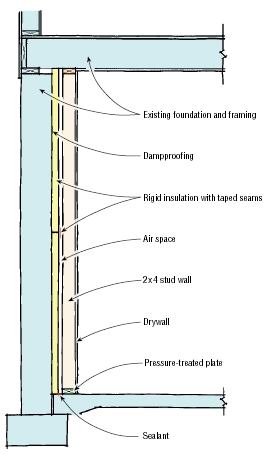
- Q. To finish an existing basement, I will be installing 2×4 walls around the perimeter. Should I install some type of waterproofing to the concrete walls? Can the 2×4 walls touch the concrete, or should I leave an air space?
A.Corresponding editor Paul Fisette responds: Before finishing the interior of a basement, you must verify that the basement doesn’t leak, and that the exterior of the foundation is protected by dampproofing, good drainage, and controlled surface runoff.
I believe that applying an additional layer of dampproofing on the interior surface of the foundation wall makes sense, if only as relatively cheap insurance. I have had good luck using Sto Watertight Coat (Sto Corp., 800/221-2397; www.stocorp.com), a two-component, trowelable, cementitious compound that has a low perm rating.
Your 2×4 walls should have pressure-treated bottom plates and should be spaced away from the foundation. Most foundation walls are not perfectly plumb and straight, so it is easier to keep your wall surface true if you space the frame away from the concrete wall. Also, building codes prevent you from placing nontreated wood in contact with the foundation.
After insulating between the studs, install your vapor barrier and finished wall surface. Since air leakage can result in condensation on the foundation wall, you should make an effort to carefully air-seal the interior finish materials.
Although this system will work, airsealing a wall can be difficult, so I prefer a different approach. After installing interior dampproofing, install rigid foam insulation directly to the inside surface of the foundation walls, using construction adhesive. Caulk and/or tape the seams of the rigid foam to make it airtight, so that warm interior air can’t reach the cold foundation. Then build an uninsulated wood-frame wall that is spaced away from the foundation. This way, it’s easier to run plumbing and wiring, and the wall should remain above dew point temperature, reducing the likelihood that condensation will form in the wall.
Q&A: Finishing Basement Walls
2 MIN READ