
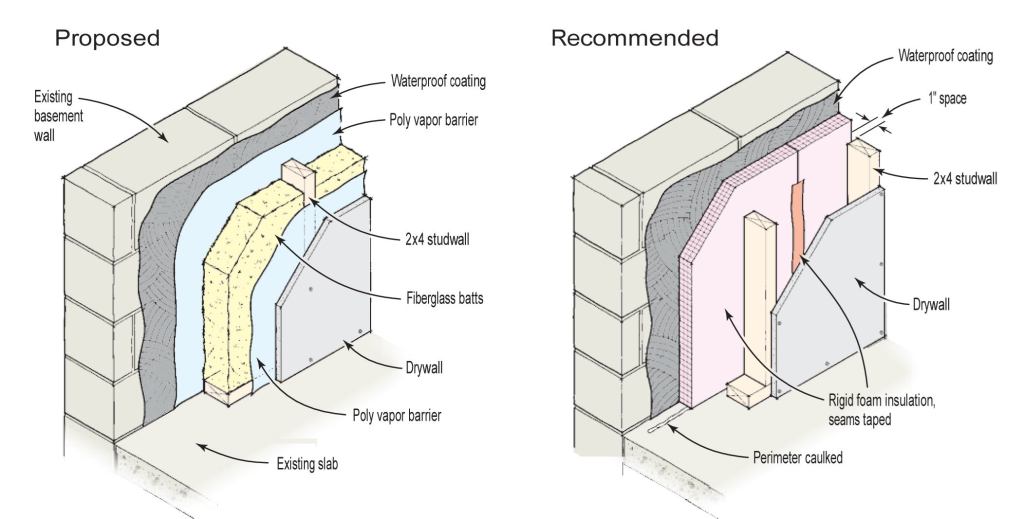
Q. I am about to start a basement remodel project in a cold climate. I plan to apply a waterproofing product to the inside of the basement wall, then stick a sheet of polyethylene directly to the basement wall over the waterproof coating. Once that is in place, I’ll frame a 2×4 wood-frame wall on the inside, insulate it with fiberglass batts, and staple a poly vapor barrier to the inside face of the studs. Does this seem like a good approach?
A. Paul Fisette, director of Building Materials and Wood Technology at the University of Massachusetts Amherst and a JLC contributing editor, responds: For the typical basement remodel, this is probably not a good plan. In fact, I think that in most cases it’s a recipe for collecting moisture, and it has the potential to create an unhealthy level of mold and mildew. The first question to ask is: What moisture are you trying to control? The answer may be slightly confusing, because your wall assembly needs to control moisture moving from the outside to the inside as well as from inside to outside.
Unless you can verify that the basement was built with good moisture protection, I would proceed with caution. Your approach places an impermeable plastic vapor barrier on both the warm and the cold side of the 2×4 wall you want to build.
Insulating the 2×4 cavities with fiberglass batts will cause the space between the wood-frame wall and the foundation wall to stay much colder than the indoor space. This means that any warm air that leaks through the 2×4 wall from the tempered basement space will cool as it reaches the cold basement wall and condense on the plastic sheet. Also, if even a small amount of water finds its way in from the outside through the foundation waterproofing coating and the poly, that moisture will be trapped inside the 2×4 wall. There is virtually no drying potential.
Instead, I would apply a coating of waterproofing to the inside surface of the basement wall, followed by a continuous layer of rigid foam insulation. Caulk the perimeter of the foam boards and tape the seams. Then build your 2×4 wall on the inside, leaving a 1-inch space between the studs and the insulation board. Don’t insulate the 2×4 wall cavities and don’t install a poly vapor retarder.
The waterproof coating will minimize moisture transfer from the outside into the basement, and any moisture that does get into the foundation wall from outside will be able to dry to the outside. If a small amount of exterior moisture does migrate through the waterproofing into the basement area, it will be able to dry to the inside living space through the open-frame construction.
And let’s not forget the water vapor contained in the indoor air. Installed carefully, this method reduces the potential for condensation because the indoor air is not exposed to cold condensing surfaces. The uninsulated stud wall allows the face of the foam insulation to remain at roughly the same temperature as the indoor air. With little or no condensation, the likelihood of mold and mildew growth is very low.


