My husband, Paul, and I began Winans Construction 25 years ago. We’ve done new construction, historic renovation, and a small amount of commercial work, but the bulk of our projects are in residential remodeling. Last year we did $2.3 million worth of business.
We’ve had employees from the very beginning, anywhere between 1 and 15 at any given time. For the past ten years we’ve averaged about 8 employees. We started providing benefits early on. In my experience, you can’t hire and retain quality employees without offering benefits. Benefits allow us to attract professionally oriented employees whose performance enhances our relationships with clients and reflects well on our business.
Over the years, we’ve done a lot of research and have gained a clear idea of the type and level of benefits offered by most remodeling contractors. This article is about some of the things we have discovered and what you might want to consider for your business. It takes time, effort, and money to set up a benefits program. A new company might not be able to afford to offer benefits, but an established firm likely can’t afford not to.
Health Care
Health care is one of the most important benefits because it’s something that everyone — including you, the business owner — needs. You may not be able to provide as much health coverage as you’d like, but anything you can do will be a help to your employees. The first thing you need to think about is how much of the employee’s premium you can afford to pay and whether you can cover dependents. You’ll also need to think about dental care, because these days it goes hand in hand with health care.
Early in our business, our employees were eligible for 100% coverage for themselves and their families after three months on the job. But we had to change that policy when the economy tanked in the early ’90s. We grandfathered the coverage for existing employees and offered different benefits to new hires. Under the new plan, we picked up the premium for the employee, but employees had to pay for their families. Some years later we changed our policy again when a valuable employee got divorced and suddenly needed health care for his son. Now our policy is to fully cover the employee after three months and dependents after three years. Even so, it’s not cheap. Right now, it costs us $2,500 per month for medical benefits for seven employees, including some dependents.
We also cover dental care premiums. Depending on the insurance company, this can be part of the medical coverage or a separate policy. Though we’ve done it both ways, we recently switched dental coverage to a separate policy because it was more flexible and less expensive than getting it with medical.
Write It Down When we first started our business, we were very casual with our employees. We took care of the legal details such as taxes and insurance, but we had no written employment policies. We found out the hard way why you should put everything in writing. We once had a good employee who thought he heard Paul say we’d give him 10% of the company’s profits at the end of the year. This was news to me when the employee’s wife thanked me for our generosity at a company event. After I talked with Paul, it was evident that there had been a huge misunderstanding. We had to tell the carpenter that he would not be getting 10% of the profits, but we did give him a substantial bonus because we felt bad about the miscommunication. He thought he should have been given the 10%, however, so he quit. We lost a good carpenter over a misunderstanding that wouldn’t have happened if we’d been writing things down. Create a manual. Where should you write your policies down? The best bet is in an employee manual. Everything and anything that has to do with employees, from hours worked to types of benefits and when they start, to job-site rules and safety policies, should be in your manual. That’s the place to go when an employee asks a policy question. If the answer isn’t there, then formulate a policy, get it out to your employees in writing, and add it to your manual. We update ours about every two years, but we often have new policies or revisions to existing ones that are distributed to everyone between revisions. For instance, the tool allowance we created last year is not in our existing manual, but all the field employees have the policy and understand it. Our next version of the manual will include the new tool allowance policy. Include a disclaimer. One very important piece of information to include in your employee manual is a disclaimer. This should make it clear that the company has the right to change its policies whenever it wants, giving you flexibility in the event of an economic downturn, for example. Be consistent in how you offer your benefits. For instance, our paid holidays policy states that an employee must work a full day before and a full day after the holiday to receive the benefit. Notice the word “full.” Our policy used to read that an employee must work the day before and the day after. The question would come up, “Can I work a half day on Friday and still get the paid holiday?” Or, even though I knew the policy, I would think, “Joe wants to take off early on Friday, and he’s really a great guy, maybe I should just pay him the holiday anyway.” Now if we receive a request for all or part of a Friday off before a holiday, I remind the employee that he won’t get paid for the Monday holiday in that case. I’m not the bad guy — I’m simply reminding him of the company policy. Writing it down makes it easy to figure out the right thing to do and creates consistency. Evaluation. We evaluate the benefits we offer on a regular basis. Is the health care coverage the best we can offer within our budget? Should we revise our vacation policy? What about a tool allowance? If you change any of your benefits, be sure it’s written down, clearly explained, and understood by your employees. |
Holidays and Vacation
Employees love paid holidays. After all, what’s better than getting paid to do nothing? This is an inexpensive but powerfully motivating benefit. Start by deciding how many holidays you can afford and then decide which ones they’ll be. If you’re just putting this in place, start with the biggies: Fourth of July, Labor Day, Thanksgiving, Christmas, and New Year’s Day. You can add more as it becomes financially possible. We’re up to nine, including a birthday holiday after a year with the company.
We’ve found that these days, employees expect to get some paid vacation. We offer 5 paid days off after one year of employment, 10 days after four years, and 15 days after ten years. Employees are not allowed to carry vacation over from one year to the next. Instead, we pay them for any vacation days that are left at the end of the year.
Retirement
In recent years, prospective employees have been asking about retirement plans during their interviews. If you’re making money and can afford to give a year-end bonus, you could leverage the value of those dollars by contributing them to a tax-deferred retirement plan, instead. It’s easy to establish that type of plan because it doesn’t require employee contributions.
We established our plan in 1987. As officers of the corporation, Paul and I decide how much to contribute when we create our annual budget. If we hit our profit targets, we make that contribution and allocate it to eligible employees on an across-the-board percentage based on wages. Contributions are deductible for the company and tax-deferred for employees. The maximum yearly contribution of an employer was recently raised by the federal government to 25% of an eligible employee’s wages. We’ve been averaging a contribution of about 10% over the past ten years.
Tool Allowance
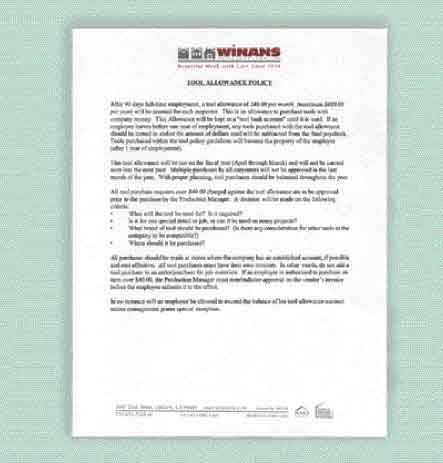
Last year we created a tool allowance for field employees. The company’s tools were aging and were not being cared for as well as one might take care of one’s own tools. We asked all our field employees for their input and came up with a new system. Our policy now is that after three months on the job, carpenters accrue $40 per month to spend on tools. They can save the allowance for large purchases or spend it in small increments along the way. Employees need the approval of the production manager for purchases over $40. This ensures that the money is spent on tools that will benefit the company and are appropriate to the skill level of the carpenter who’s buying them. For example, there’s no need for an apprentice-level carpenter to buy a $300 miter saw when what he really needs is a pry bar and a recip saw.
To avoid confusion before the new tool policy could be included in a new version of the employee manual, the company gave field employees written copies of the policy as soon as it was in force.
Vehicles and Mileage
High-volume firms sometimes provide company vehicles to select employees. We’re a smaller company and have only a single company van, but we do reimburse for certain kinds of mileage. Employees have to cover their own commutes, but we pay 32¢ per mile for trips between jobs or to pick up material.
I’ve heard of companies that give employees a fixed monthly truck allowance. In addition to mileage, we pay employees $35 per month to keep magnetic signs with the name of our business on their trucks. The trucks must be clean and in good condition, and the drivers must exercise caution and courtesy. The signs advertise our company while putting extra dollars in our employees’ pockets.
Clothing
We provide field employees with company shirts that they’re required to wear at work after 90 days of employment. Carpenters can choose between T-shirts and golf-style shirts and are given replacements yearly. We also provide hats, sweatshirts, jackets, and vests. Company clothing helps us project a professional image and helps employees by reducing what they have to spend on work clothes.
Trade Shows
Our carpenters love going to trade shows. It’s easy when the show is local, but we’ve also paid to send people to out-of-town shows such as JLC Live. They’re expected to attend seminars, visit the trade show floor, and report on what they saw when they return. Going to shows helps employees upgrade their skills and boosts their level of enthusiasm.
Add It Up
We review each employee’s compensation package with that employee annually. We have a spreadsheet that lists each benefit — from the obvious, such as wages, health care, holidays, and vacation, to the more obscure such as training, clothing, tool allowance, and truck signs. We show the cost of the benefits on an hourly and annual basis and then the total hourly and annual compensation, taking all the benefits into consideration. For instance, someone earning $21 per hour may have a total compensation package worth $26.92 per hour when all the benefits are added in.
Employees tend to focus heavily on their hourly pay. This spreadsheet is used to show them the value of the additional benefits they receive.
Financial Implications
In order to offer benefits to employees, you need to be in good enough financial shape. Assuming it was profitable, create a budget based on your performance last year. Then factor in the cost of the benefits you want to offer. You’ll want to earn at least as much as you did last year, in compensation and net profit, so take a look at the impact the added benefits will have on your bottom line. You may need to increase your sales volume or raise your gross profit percentage in order to make up the difference. By the way, formulating an annual budget and measuring your performance against it as the year goes on will give you a good handle on your finances and the health of your company.
Resources
You may be wondering how we know what other remodeling companies are offering, or where to get information about setting up health care and retirement plans. We belong to a number of professional organizations, including a local contractors’ group called the Splinter Group. In 1988, we devised a survey on benefits and asked other members to fill it out. The results gave all of us a picture of what similar companies were offering. Since then, we’ve conducted at least two more surveys and have been asked by others in the group to participate in more surveys than I can count. The surveys are a great reality check on whether our pay and benefits are in line with those of our counterparts.
Trade Organizations
My number one recommendation is to get involved with a local chapter of a trade organization such as NARI or NAHB. Membership has allowed us to network and socialize with other contractors, and that has helped us become better employers and business people. Also, consider joining a peer review group such as Remodelers Advantage Roundtables (www.remodelersadvantage.com) or Business Networks (www.businessnetworks.com). This is a fabulous way to meet contractors from other parts of the country and see how they do business.
Our relationships with other remodelers have been a great source of information. We’ve been able to find out such things as who colleagues are using for health care coverage or how they started their 401K programs. In all our years as members of these groups, we’ve never encountered anyone who wasn’t willing to help or to provide information. Of course, we’ve always been willing to reciprocate by sharing our information. Our participation in trade organizations has helped us find business and software consultants, accountants, lawyers, office help, bookkeepers, and innumerable trade contractors. We’ve also gotten benefit program referrals from our accountant, lawyer, and insurance broker.
In a Nutshell
Benefits are not difficult to put into place. Do a budget first and keep on top of costs. Be on the lookout for what you can add and what you might need to change or revise. Write everything down, review all new policies with your staff as they are added, and have an escape clause. Remind each employee annually of what he or she is receiving. Remember, the more you give, the more you get.
Nina Winans, CR, is co-owner with her husband, Paul, of Winans Construction, Inc., in Oakland, Calif.