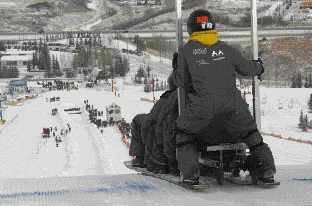
What’s cold, weighs 300 pounds, has 10 legs (possibly broken), and reaches top speeds of 50 to 70 kilometers per hour before grinding to a halt, overturning, or colliding with an obstacle? If you guessed “A concrete toboggan,” you’re right. If you said, “There is no such thing as a concrete toboggan,” you are mistaken. In fact, dozens of concrete toboggans and more than a hundred intrepid tobogganauts compete each year in Canada’s annual Great Northern Concrete Toboggan Race, a unique test of the athletes’ imagination, technical skill, and raw courage.
Inspired by the concrete-canoe races sponsored by the American Society of Civil Engineers, the concrete-toboggan race attracts a very special breed of north-country engineering students. The basic principle is simple: Whoever slides fastest, wins. There are a few rules, however. The sleds must have a concrete sliding surface, weigh no more than 300 pounds, carry a crew of five, be equipped with a steel roll cage, and have — or attempt to have — brakes. No horn is required, but it might be a good option for when the brakes are less than fully function-
al: In 2003, says the Web site of the Carleton University toboggan team, “Our brake failed both times and we almost took out the cooking tent and everyone else by narrowly missing the propane tank.”
Carleton’s sled teams have a colorful history: Their first entry in 1995 finished a disappointing 32nd out of 33 entrants, but Carleton took second and sixth place with its two 1996 teams, Crash and Burn. Carleton’s current team, the Stonecutters, buoyed by a strong technical presentation, took top honors overall at this year’s event, held at Canada’s Olympic Park in Calgary, Alberta. The Waterloo University Pirates had the fastest piece of concrete among official entries, clocking in at 74 kph (approximately 45 mph), but the noncompeting Mixed Nuts from host University of Calgary topped that, hitting 78 kph in a demo performance. McMaster University’s team, the Rigid Members, ranked first for spirit despite relatively slow times on the hill.
But what does all this have to do with concrete, a material not usually prized for its velocity? Maria Guglielmino, who captained McGill’s 2004 team, says it’s a challenge to adapt concrete to this unconventional use. “We need a mix that is strong and lightweight, and also we want something that is smooth enough to slide on the snow,” she told JLC. “What we’ve done for the last few years is put a carbon fiber grid in it, because it’s good in bending moment resistance. And it’s also good with impact loads, which is basically what you’re going to be hitting going down that slope.”