
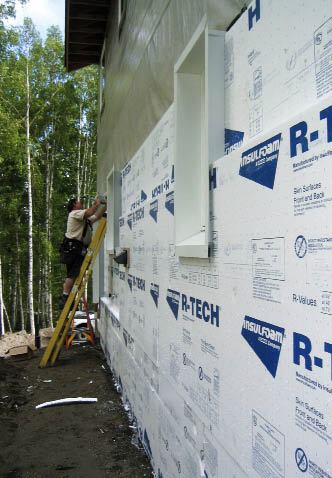
As a custom home builder in Alaska, I’ve seen how poorly
conventional wall assemblies perform in extremely cold weather.
In Fairbanks, Alaska, where I work, a “typical”
wood-frame wall might consist of 2x6 framing with R-19 batt
insulation, OSB sheathing, and housewrap on the outside, and a
6-mil poly vapor retarder on the inside.
There are two problems with this construction. The first is
that the wall framing members act as heat conductors between
the warm interior and the cold outside. There’s nothing
to stop the transfer of heat. But the bigger issue is air
leakage. It’s nearly impossible to do a perfect job
sealing all the penetrations in the vapor retarder, and just as
hard to make the housewrap airtight. On cold winter days, warm,
moist indoor air is driven into the wall cavities, where it
hits the inside of the cold sheathing, condenses, and freezes.
When the weather warms up, the moisture is trapped between the
vapor retarder and the relatively impermeable sheathing, where
it degrades the insulation and causes mold and even rot.
CCHRC Research
Moisture infiltration into wall cavities is a concern
anywhere, but especially in climates like Alaska’s, where
extreme winter temperatures and a short drying season
exacerbate the problem. To address the shortcomings of standard
frame construction, my company has adopted an insulation and
air-sealing method developed by builders and researchers
working with the Cold Climate Housing Research Center (CCHRC;
cchrc.org) here in Fairbanks. Nicknamed the REMOTE Wall System
(for Residential Exterior Membrane Outside Insulation
Technique), it involves installing a barrier membrane on top of
the structural sheathing, followed by several inches of rigid
foam insulation (see illustration). The
membrane provides an air seal, while the thick insulation keeps
the sheathing and framing above the dewpoint temperature and so
prevents condensation from occurring in the wall.

The rigid foam can be supplemented by installing a lesser
amount of fiberglass batt insulation in the frame wall. The
goal is to increase the wall’s total R-value from the
inside, but without allowing the sheathing to cool to the
dewpoint. It’s a balancing act: You have to put enough
insulation on the outside to keep the sheathing membrane warm,
but not too much on the inside else you’ll isolate the
sheathing and framing members from indoor heat. This is
critical, because besides providing an air barrier, the
membrane — either by itself or in combination with the
sheathing and exterior insulation — acts as a vapor
retarder. So there’s no doubt that in a REMOTE wall,
interior moisture vapor will be stopped at the sheathing
plane.
Concerns With Exterior
Membranes
Mindful of the dangers of a “wrong-side vapor
barrier,” the CCHRC has been monitoring REMOTE wall
projects around Alaska, in both dry northern areas and the
humid coastal region. Using HOBO data loggers (available from
onsetcomp.com) that
record temperature and humidity over time, the research has
confirmed a rule of thumb long used by builders wishing to
place vapor retarders inside of walls: It’s generally
safe to put approximately one-third of the total R-value to the
inside of the vapor barrier. This holds true even for an
extremely cold climate like that of Fairbanks, which has 14,000
heating degree days. (Keep in mind this is just a rule of
thumb; the ratio may change somewhat depending on project
specifics.)
Data loggers on some REMOTE projects have indicated short
periods when humidity levels in certain wall cavities rose. The
good news is that the cavities also dry out again as soon as
conditions are right, because there’s no poly vapor
retarder on the inside face of the studs. So if condensation
does occur in the wall — say, in extreme cold weather
— it can dry to the interior.
I’ve used the REMOTE method on 14 homes to date, with
excellent results. I learned years ago that to create a
durable, energy-efficient home in a cold climate, you have to
meet four goals: adequate insulation, airtightness, moisture
control, and good indoor air quality. The REMOTE wall method
allows me to meet all of these.
Insulation
I generally use R-Tech IV EPS (expanded polystyrene) on the
exterior. It’s made by Insulfoam (800/248-5995,
insulfoam.com) and has
an R-value of 4.8 per inch at 40°F. (The R-value
actually increases as temperatures drop.) I typically install 6
inches — two layers of 3-inch. R-Tech has a polyethylene
facing that helps it shed water, though the edges are unfaced.
This has led to some concern that moisture might get into the
foam board at joints and be unable to get out. But CCHRC tests
in the rainy southeast of Alaska have shown that R-Tech
performs well in REMOTE walls and that moisture entrapment is
not a problem.
Some builders have used XPS (extruded polystyrene) foam, which
has a slightly higher R-value and has also performed well on
monitored projects.
Note that in cold Fairbanks, I can carry the EPS below grade
with no fear of insect damage. Although some foams contain a
borate additive intended to repel insects, the treatment may
leach out over time in wet soils. In situations where insect
damage poses a threat, holding the exposed foam above grade and
using a termite shield is a safer option.
On the inside, I supplement the exterior foam with fiberglass
batts.
Airtightness and Blower-Door
Test
Covering the house with rigid foam board creates a potentially
tight structure, but it’s the barrier membrane applied to
the sheathing that does most of the work (see Figure
1).
Figure 1. In a REMOTE wall, the sheathing is covered
with a barrier membrane — either peel-and-stick (top
left), 6-mil polyethylene sheeting (top right), or, in wet
climates or beneath EIFS cladding, a wrinkled drainage material
such as StuccoWrap (bottom). Installed before the roof is
framed, the barrier membrane extends over the top plates and is
later sealed to the poly air barrier on the ceiling of the
house’s top floor.
The earliest REMOTE walls used peel-and-stick membranes; this
produced an incredibly airtight, waterproof shell but it was
expensive. So most builders switched to less expensive
materials — 6-mil poly or, in very wet zones,
vapor-permeable drainage wraps such as Tyvek StuccoWrap or
DrainWrap. Poly works fine in Fairbanks, which is fairly dry;
in rainy southern Alaska, the Tyvek products are the usual
substitute for peel-and-stick. The reason is that rainwater
might travel through a nail hole and get trapped behind poly,
whereas using a housewrap will allow for evaporation to the
outside. (StuccoWrap or something similar is also used on
REMOTE houses that receive an EIFS cladding, per the EIFS
manufacturer’s specifications.)
On the inside, the 6-mil poly continues across the ceiling
below the attic. To avoid stack-effect exfiltration, we refuse
to install recessed light fixtures in the ceiling poly and even
avoid putting sealed electrical boxes there, pushing customers
to put upper-floor lighting fixtures in the walls instead. On
most of our jobs the plumbing stack is the only thing that
penetrates the lid. Access to the attic is through a gable
wall, preferably above an attached garage.
Performance test. Installing the barrier membrane and
exterior foam doesn’t in itself guarantee that the
structure is airtight. The only way to do that is to do a
blower-door test. This is a critically important step in
achieving a tight shell, and you have to do it when you can
still access the leaks. If you hold off doing the blower-door
test until the insulation and drywall are installed,
it’ll be too late.
We wait until the electrical, plumbing, and mechanical subs
have done their rough-ins, then hang the drywall over the
ceiling air barrier. The blower door depressurizes the interior
and shows us where the leaks are. There’s no insulation
in the stud bays at this point, so it’s easy to seal wall
leaks from the inside, using spray foam and acoustical sealant.
The attic has not yet been insulated, so we can plug those
leaks working from above. When the house is finished, an
independent energy rater performs a second blower-door test as
part of an energy audit.
Our goal is an airtightness of 0.6 air changes per hour at a
pressure of 50 pascals (ACH50) — the same standard
required for a Passive House. We’ve achieved this with
the 6-mil poly barrier and have gotten down to 0.3 ACH50 with a
peel-and-stick membrane. The best we’ve done with
StuccoWrap is 0.8 ACH50.

Moisture and Air Quality
In buildings this tight, relying on passive ventilation by
natural infiltration or even exhaust-only fans (which require
makeup air) would be a mistake. The home would have poor air
quality and moisture and condensation problems. So I put a
heat-recovery ventilator (HRV) in every house I build. The HRV
provides a measured supply of fresh air and recovers much of
the heat that would be lost with a simple fan system. HRVs also
address the issue of indoor humidity by replacing stale humid
air with drier outside air.
Installing the Membrane
Most of the houses I build have wood or vinyl siding; on those
jobs we typically install a 6-mil poly barrier membrane,
lapping the seams shingle style and sealing the laps with a
non-hardening acoustical sealant.
Poly is slippery to walk on and will tear if you drag trusses
across it, so when we get to the top of the wall we switch to a
strip of 9-inch peel-and-stick flashing. The flashing adheres
to the top plate and laps an equal distance onto the poly and
the inside face of the plate (Figure 2).
Figure 2. The author’s crew applies a
9-inch-wide peel-and-stick flashing to the top plates, adhering
it to the inside edge of the plates (top) and lapping it onto
the 6-mil poly membrane on the sheathing (bottom).
Pencil marks will not show on this material, so we use a white
marker to lay out truss locations. Once the trusses are set, we
install the ceiling membrane, lapping its edges onto the
peel-and-stick flashing and sealing the lap with acoustical
sealant.
Installing Windows
Windows can be installed either at the face of the sheathing
— in a recess — or out at the face of the wall.
From a performance standpoint, a recess is better, because the
window is somewhat protected from wind-washing and the interior
glass is more easily warmed by the heat in the room. By
contrast, windows installed at the face of the wall are in an
interior recess, separating them from the warm air inside
(especially if a curtain is drawn) and exposing the outer layer
of glass to cold wind. I’ve observed that in extremely
cold weather — when it’s 25°F below
zero, for example — frost tends to form inside windows
installed at the face of the wall, whereas frost rarely occurs
on inset windows.
Recessed installation. I’ve installed windows
both ways, but because of the frost problem I now do only
recessed installations. A recessed installation is more
complicated because the sides of the recess must be covered
with exterior jamb extensions. On vinyl-sided homes, we make
the extensions from 20-gauge metal coil stock (Figure
3). The bottom is sloped to shed water, and there are
flanges on both edges — an inner flange that gets
fastened to the sheathing and an outer flange that laps over
the 1x4 strapping that we install on top of the EPS around the
window.
Figure 3. When installing recessed windows, the author
uses sill and jamb extensions bent from coated sheet metal. The
flanges at the outer edges (left) are carefully placed to allow
for the thickness of the foam, 3/4-inch strapping, and the
vinyl siding, which will tuck underneath. Note the lines of
black acoustical caulk used to seal the jamb extensions to the
poly membrane and the poly seams (right).
We’ve also made extensions from wood and cellular PVC.
These solid extension jambs are glued and screwed at the
corners and fastened to the wall over a thick bead of sealant.
We either toe-screw them to the framing or fasten them from the
inside with metal clips.
Window bucks. Because it’s less expensive, many
of my past customers chose to have doors and windows installed
at the outside face of the wall. We did this by extending the
rough openings with bucks ripped from 2-by lumber. The buck
fits inside the opening and extends from the inside face of the
frame to the outside face of the furring that goes over the
foam.
The window is installed in the buck and the fins lapped with
peel-and-stick flashings that extend back to the wall membrane
(Figure 4). Though this method is less
expensive than fabricating jamb extensions, it requires more
care with the flashing. From the standpoint of moisture
intrusion, I felt comfortable doing it around Fairbanks because
we don’t get a lot of rain, but in a wetter climate I
would recommend recessing the windows. As I mentioned above, I
no longer use this technique because of the icing problem my
customers experienced. But for builders in a warmer climate, it
could still be a reasonable approach.


Figure 4. On past jobs, the author installed windows
at the face of the wall by setting them in solid lumber bucks
protected with peel-and-stick flashing (top). The bucks are
attached to the inside of the rough opening and taped or
flashed to the wall membrane (bottom left). Bucks are sized so
that when foam insulation and furring are installed, the siding
will be in the proper plane (bottom right).
Installing the Exterior
Insulation
The EPS insulation can be lightly attached with framing staples
or nails because the furring strips, which get screwed through
into the studs, will securely hold it in place. We stagger
seams and lap corners in successive layers so that air
doesn’t have a direct path through to the wall. The
boards are butted to the sides of window bucks and jamb
extensions, and gaps between sheets and around windows and
doors are filled with minimally expanding spray foam.
Some areas have to be insulated and sealed before the framing
is complete. For example, where the roof of an unheated attic
butts to a sidewall, we’ll insulate that wall before
framing the roof (Figure 5).
Figure 5. To ensure the continuity of the barrier
membrane and exterior insulation, the wall to the right of this
garage roof was covered with poly and foam before the roof was
framed (top). Moving truss blocks in line with the outer edge
of the exterior EPS will allow the cellulose in the attic to
completely cover the full thickness of the exterior walls
(bottom).
We insulate attic gables at least as high as the top of the
attic insulation. The area above does not have to be insulated,
but it needs to be built out to the plane of the foam below,
which we often do with scrap pieces of insulation.
If the inspector and engineer will allow it, we push the truss
blocks along the eaves out to the face of the foam so that the
blown-in attic insulation will cover the entire top of the
wall, including the EPS. Otherwise, we carry the insulation
boards up to the top of the attic insulation by fitting them
around the rafter tails.
Furring
We provide nailing for siding by installing 1x4 furring or
strips of 3/4-inch plywood over the foam, fastening through to
the studs with long screws (Figure 6). We
space the screws about 12 inches on-center and make sure we
penetrate at least 1 1/2 inches into the framing. These long
fasteners have to be mail-ordered; we use Wind-Lock W-SIP
screws (800/872-5625,
wind-lock.com) and
FastenMaster HeadLok and OlyLog screws (800/518-3569,
fastenmaster.com).
Figure 6. The EPS insulation is first tacked
in place, then secured with long screws fastened through
furring strips into the framing (top left). Wide furring
members are needed at corners (top right) and around openings
(bottom) to provide backing for trim.
Screws are very heat-conductive and can cause condensation
where they miss the studs. We always check from the inside for
missed fasteners, reinstall them, and use spray foam to seal
the holes.
Cost and Payback
Though the REMOTE method is more expensive than conventional
construction — EPS costs more than fiberglass and
there’s extra labor involved — the added costs are
offset by reduced energy use and a longer building life cycle.
The CCHRC has estimated a three- to five-year payback period
from energy savings, and there’s no question that a
building free of moisture problems will have a considerably
longer life. But what’s equally important is that good
insulation, tight construction, and proper heat-recovery
ventilation add up to a comfortable, healthy house to live
in.
Thorsten Chlupp owns REINA, LLC, in Fairbanks, Alaska.
Special thanks to Ilya Benesch of the CCHRC for providing
technical advice.

