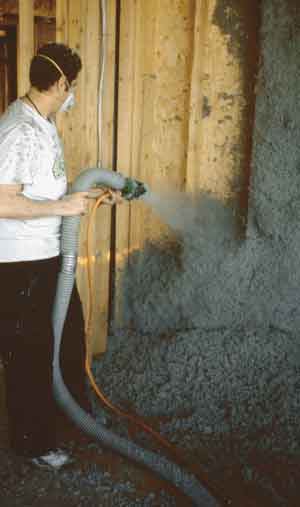
Damp-spray cellulose stops air infiltration, offers excellent sound insulation,and costs only slightly more than fiberglass batts
by Michael Uniacke
In the hierarchy of the building trades, insulation contractors are often considered about half a step above the porta-john guy. That’s because insulation is one of the most taken-for-granted systems in a house. It’s installed in exterior walls one day and covered up with sheetrock the next, and few municipalities have substantive insulation inspections. The result is little accountability or quality control on the majority of jobs I inspect. In spite of all that, insulation can and should be done right. My company, Advanced Insulation in Prescott, Ariz., works with several types of insulation, but our workhorse product for wall applications is damp-spray cellulose (formerly known as wet-spray cellulose). That preference is based on years of experience in our marketplace, which is at 5,000 feet elevation and has a climate similar to that of Denver. We’ve found that walls insulated with spray cellulose are more thermally efficient than those with fiberglass batts. In our 5,000 heating-degree-day climate, we are seeing 1,600-square-foot homes that don’t require conventional forced-air heating systems. In some cases, the actual heating load is so small that it can be handled by a heater-rated gas log fireplace. Equally important, our customers tell us that spray cellulose provides a much more comfortable house. Spray cellulose does cost a little more than batts — in our market, it’s about $.60 per square foot of wall area, compared to $.42 for fiberglass, or an additional $250 or so for a typical 2,000-square-foot house — but the gain in energy efficiency and overall comfort makes the investment well worth it.
Cellulose Basics
Cellulose fiber is produced from paper, which in turn is derived from wood. However the insulation is installed — blown into the attic or damp-sprayed into wall cavities — the material is the same. It comes packed in bags that weigh from 25 to 35 pounds apiece (see Figure 1). By weight, about 82% to 85% of the material is cellulose fiber — most of which is reprocessed from old newspaper — with the remainder consisting of chemical fire retardant. The fire retardants are added in the form of a dry powder. The borate chemicals used — often in combination with ammonium sulfate — also add mold, insect, and rodent resistance. We often use an all-borate insulation called Incide (Hamilton Manufacturing, 901 Russet St., Twin Falls, ID 83301; 208/733-9689; ) that is designed to prevent infestation by termites and other insects throughout the life of the structure.
Figure 1. The same cellulose material is used for both wall-spray and loose-fill applications. A typical whole-house wall-spray application requires 60-120 bags. |
Although pure cellulose is flammable, the added fire retardants make cellulose insulation a safe material. The cellulose manufacturing industry adheres to strict standards set by the ASTM and Consumer Products Safety Commission, and at least three of the ten material attributes considered by the ASTM (thermal resistance, surface burning characteristics, adhesive and cohesive strength, smoldering combustion, fungi resistance, corrosiveness, moisture vapor absorption, odor, and flame resistance permanency) relate directly to fire safety. Test data consistently show that the fire resistance of cellulose is as good as or better than that of most insulating materials. According to Canada’s National Research Council, for example, cellulose-insulated walls are from 22% to 55% more fire resistant than uninsulated walls. Walls insulated with fiberglass were found to be slightly less fire resistant than uninsulated walls. My own experience has led me to the conclusion that cellulose insulation simply does not burn, partly because of the added fire retardants but also because cellulose contains few voids, excluding the air necessary for combustion. Not long ago a plumber working in a house that we had recently insulated got careless with a torch and set fire to a stud. The stud and adjacent insulation smoldered all night and filled the crawlspace with smoke, but the fire never spread. I’ve also inspected hundreds of attics insulated by others in which cellulose was carelessly blown against B-vent chimneys, on top of metal fireplaces, and against recessed cans and other hot points, and although I’ve occasionally seen slight charring, I’ve never seen evidence of fire. (I’ve also seen charring of the kraft facing of improperly placed fiberglass batts.) It goes without saying that such practices should be avoided, but it’s reassuring to know that even under such worst-case conditions, the material won’t burn.
Why Damp Spray?
In a blown cellulose installation, the material is simply blown into place in a loose, unconsolidated state. This is commonly done in attics, where the cellulose is supported by the ceiling beneath. Loose-fill cellulose can also be blown into enclosed walls in remodeling applications — an application known as dense-pack cellulose — although it can be tricky to do that without leaving hidden voids. Damp spray, on the other hand, is self-sticking, so it can be placed in open wall cavities that are backed by sheathing or spray mesh.
Blown and damp-spray cellulose use the same basic equipment — typically, a truck-mounted insulation-blowing machine that delivers the material through a 21/2-inch hose — but with one important difference: The nozzle of a damp-spray hose contains a separate water nozzle that mixes the cellulose with a fine water spray as it emerges (Figure 2). The water, which is delivered at 200-300 psi, comes from a truck-mounted tank through a hose like that used on pressure washers. The 200-gallon tanks on our trucks contain enough water to complete a typical house.
Figure 2. A high-pressure water nozzle moistens both the surface to be sprayed and the insulation as it is blown from the hose. The water flow is adjustable by the operator, who must supply enough moisture to get the insulation to adhere properly but not so much that excess moisture leads to nail pops and other problems. Freshly applied spray cellulose should contain between 30% and 40% moisture by weight. |
Fiber and water. When the spray nozzle is properly adjusted, it delivers a fine spray that simultaneously moistens the studs and sheathing as well as the insulation itself. The moistened fibers then adhere strongly to both the substrate and one another. This bond gets even stronger as it dries, which makes correctly installed spray cellulose very resistant to settling. At the recommended density of 3 pounds per cubic foot, it’s reliably self-supporting. (For comparison, loose-fill attic insulation is typically installed at about 1.6 pounds per cubic foot.) Some cellulose manufacturers regularly test their products in a machine that vibrates an 8-foot-tall wall cavity for 24 hours to simulate 20 years of normal vibration. For a product to meet the standard, no more than a quarter-inch gap can appear at the top of the cavity. Some damp-spray cellulose used in commercial construction — for coating gym ceilings, for example, where the insulation will be left exposed — contains adhesives that provide an even stronger bond. A similar technique is used for blowing insulation against the masonry walls of unvented crawlspaces. But this is overkill in residential wall cavities and complicates cleanup, so we don’t use added adhesives there.
Figure 3. A 24-foot box truck holds up to 200 bags of insulation, as well as the blower, water supply, and other equipment. We try to get as close to the job as possible, but our equipment is powerful enough to push material up to 250 feet if necessary. |