
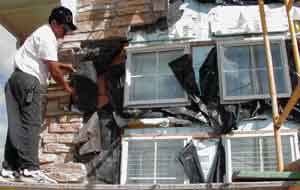
As a contractor specializing in remediation and repairs, I’ve been concentrating for years on fixing failed applications of EIFS and traditional stucco. I’ve learned from experience that most stucco failures result from improper flashing and drainage details behind the stucco. Typically, houses that end up with rotten sheathing and framing under the stucco don’t have properly installed building papers and flashings. In recent years, I’ve been finding more and more cases of leaking and rot behind another material that is very similar to stucco: cementitious manufactured-stone veneer, or “cast stone,” as it is sometimes called. The problems we are finding with cast stone are just like the problems we’ve seen with incorrectly applied stucco. But the weather detailing flaws we identify in artificial-stone jobs often cause even greater problems than the errors made with stucco. With cast-stone veneer, leaks and rot often show up sooner, progress more quickly, and cause more severe damage inside the wall.
After investigating and repairing at least a hundred examples, I’ve concluded that the problems with cast stone go back to a misunderstanding of the material. Installers as well as building inspectors have gotten used to thinking of cast stone as a masonry material, and they expect walls to get the kind of weather detailing behind the stone that is traditional with brick: a single layer of paper, lapped a couple of inches at the horizontal joints. But, unlike brick, cast stone is not installed with an air space between the cladding and the framed wall. Cast-stone veneers are cementitiously adhered to a stuccolike base coat that is applied directly to the wall. Like stucco, cast stone gets saturated with water in a rainstorm and holds that water right up against the framed wall. The papers and flashings under the veneer have to fend off that moisture load without the benefit of any drainage or drying space. One layer of paper isn’t going to do the job — two layers, as specified under stucco, are necessary.
Painstaking Details Required
If anything, cast stone should in fact be backed up by even tougher details than stucco. That’s because it has some characteristics that may help create a more stressful moisture load for walls during wet weather.
For one thing, manufactured stone is a cement-based product that absorbs and holds water like stucco, but cast stone is thicker than stucco and can thus store more moisture. Also, most of the cast-stone brands now have “ledgestone” versions of the product, which have a long, horizontal shape; the long, flat, shelflike ledges are often sloped toward the framing when installed, which provides a place for rain water to puddle up and soak into the wall.
The greater thickness of cast stone also complicates the task of fabricating and installing practical flashing components. The kickout or diverter flashing required where a roofline butts into a wall is a good example. On job after job, my company gets paid good money to go in after the fact, tear cast-stone veneer off a wall, and retrofit a larger kickout flashing to the wall because the original roofer’s kickout flashing was too small to push water out beyond the plane of the cladding. If the diverter flashing is too small, it may as well not be there: All the water flowing and blowing against that spot will just get dumped into the wall system below.
Of course, all the other typical vulnerable spots in a stucco application are just as problematic, if not more so, in a cast-stone application. Window pan flashings, for instance, are a good idea in a manufactured-stone job. However, we are more likely to see a reverse-lap flashing error, with building paper run to the window edge in such a way that the window flange directs water beneath the paper instead of on top of it. And, as with stucco, brick, or any other cladding, a cast-stone veneer should be equipped with weeps of some kind at any bottom termination, whether at the foundation sill or above a window or abutting roof. Otherwise, water will pool longest at the lowest points, and those areas may stay continuously wet.
We also see problems when cast stone is paired with another material on the same wall. It’s very common, for instance, for a single house to have stucco or EIFS as well as cast stone; if the joint where the two meet is detailed wrong, water can get to the wood-framed wall and cause trouble.
Investigating Problems
When my company is called to look at a building, the owners or the builder often have no conception of the severity of the problem they may be facing. Poly vapor barriers under the home’s drywall often conceal wall framing that is sopping wet; on the exterior, the cementitious stone or stucco does not decay, so it never betrays the secret underneath. Homeowners may complain of just a few small leaks, or be worried about a moldy smell.
From experience, we know where trouble is likely to be found, and how bad it can be. By spraying a wall with water while we create negative pressure inside the house, we can find out how water is getting in, and by removing a few small sections of the cladding, we can get an idea of the extent of the resultant damage.
Repairing the Failures
On many occasions, our company has found a shocking amount of water damage and rot under the cast-stone cladding of homes less than two years old, or in some cases less than one year old. The amount of water that can be taken in and held by cultured stone is significant — enough to support robust growth of wood-destroying funguses. If rot organisms have water and they have wood, they will thrive until the wood is gone. Often, what we find under cast stone looks more like the ashes of a fire than like lumber (see “Under a Fine Surface, a Disturbing Discovery,” page 4).
If it’s caught soon enough, the damage can be repaired. But this is far more costly than doing the job right the first time. Although I make my living from this kind of work, I wish that every builder and contractor who installs this material, as well as the building officials who inspect the jobs, could see some of the failures I have seen and learn how to avoid them. Too often, I’ve seen problems like these ruin a family’s finances when they lead to the uninsured loss of much of a home’s value.
Details That Work
Code provisions for cast stone can be confusing and murky. The product isn’t mentioned in the body of the building code, and the evaluation reports and manufacturer instructions required for code acceptance can be contradictory or incomplete. But the basic methods required to succeed with the material are not that complicated. In essence, cast stone has to be treated as if it were stucco.
Before you apply lath to the wall, you need to be sure you have a weather-resistant paper barrier on that wall — and it needs to include two layers of paper, not just one. Wherever there are penetrations, or intersections between assemblies such as walls and roofs, or joints between cast stone and other materials like brick or stucco, there must be properly lapped flashings that keep kicking water away from the building. And at the bottom of the wall, there has to be a way for water to drain out. If all those precautions are observed, there is no reason cast stone should cause moisture problems.
When you’re choosing your building paper, be careful. Type D paper gets a “minute rating,” based on the time the paper can be placed in direct contact with water before it soaks through. You can get 15-minute, 30-minute, or 60-minute rated paper, and the more severe the climate, the higher the rating you should choose. In dry and mild parts of Southern California or Arizona, for instance, two layers of 15-minute paper ought to be fine. In the valley-floor areas near Salt Lake City, we use two layers of 30-minute paper. But if we work up near the ski areas, where there is lots of wind and rain, we use 60-minute paper. Sixty-minute paper is very rugged stuff — it is more than twice as thick as 30-minute paper. In Houston, we use either 60-minute paper or sometimes a layer or two of asphalt felt paper applied over the top of a housewrap such as Tyvek.
But no paper is intended to be absolutely waterproof for an indefinite period. That’s why the flashings and weeps are so important. If you don’t have them, water can pool at low points and stand against the wall for hours, days, or weeks. And if that happens, no paper, be it housewrap, asphalt felt, or Type D kraft, is going to save your wall from rot. So if you’re applying cast stone, be smart: Use the papers, install the flashings, and provide the weeps. It will cost a little more, but it is a lot cheaper than hiring me and my crew to come back and fix the wall when the studs are decaying underneath the cast stone.
Under a Fine Surface, a Disturbing Discovery and a Costly Repair
The owners of this one-year-old custom home . reported moldy smells behind the drywall; a mushroom growing from the cast-stone veneer face was the only visible sign of trouble on the exterior . The gutter butting into the top of the wall seemed a likely source of moisture, while the bottom of the wall provided no way for moisture to escape .
Opening the wall revealed severely rotted OSB sheathing and damage to the framing. While the row of soldier bricks at fascia height provided some protection , the water coming off the roof saturated the cast stone and soaked through the housewrap beneath, turning the sheathing at the base of the wall to compost in less than two years .
To repair the damage, the author’s crew replaced the rotted wood members , but was able to leave the original drywall in place because it had been protected by the interior vapor barrier . Parts of the band joist were left in place but soaked with a copper-based wood preservative .
Destructive Investigation: Tracing a Leak to Its Source
On this job, the original installer of the cast-stone veneer wall had tried unsuccessfully to stop leaks by spraying a clear sealer onto the stone and by removing the lowest courses to apply a membrane flashing where the wall meets the foundation. To assess the problem, the Ram Builders team first seals large openings inside the home and sets up a blower door . With the blower door running to depressurize the house, the crew turns on a water-spray apparatus , thus simulating the effect of a 15-mph wind-driven rain. Within a short time, water finds its way into the house . After verifying that the cladding leaks, the team digs under the surface to find out why. Tearing off small areas of EIFS on the upper wall reveals that there is no building paper or window flashing installed where the EIFS meet the cast stone , or between upper and lower windows in the EIFS wall . Tearing off cast stone near a window , the team learns that water has wet the OSB sheathing. The author measures high moisture content even at the bottom of the wall, where no direct stream was applied . The retrofit flashing repair has proven ineffective because flaws higher in the wall dump water behind it. owns and operates Ram Builders, based in Lindon, Utah, which specializes in remediation and repair work in Utah, Texas, Colorado, and California.


