Q. What are the risks of installing cedar siding directly over foil-faced rigid foam insulation? Should tar paper or housewrap be used as well?
A. Joe Lstiburek responds: Wood siding, including cedar siding, should be installed over an air space, regardless of the type of sheathing used. With foam sheathing, an air space is essential, both to reduce the siding’s water uptake and to provide a receptor space for the moisture in the siding. If the cedar siding is installed directly on foil-faced foam sheathing, it will be prone to cupping, splitting, and premature paint peeling.
Since sidings are not watertight, no matter what we do, moisture will get into any wood siding. Rain water penetrates the siding at joints, nail holes, penetrations, and overlaps, and runs down the back surface of the siding. Additionally, capillary action can pull water upward at siding overlaps.
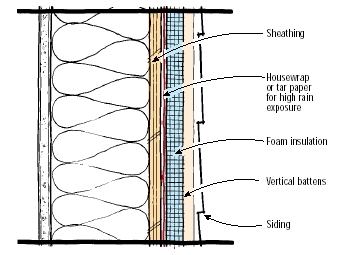
When the sun beats down on wet siding, it drives the moisture inward. If the sheathing is plywood or boards, the moisture is redistributed into the sheathing, relieving the moisture stress on wood siding that happens when the front is really dry and the back is really wet. This redistribution of the moisture can’t happen with wood sidings over foam sheathing, so we need an air space. Even a shallow air space — 1/4 to 3/8 inch — will do. To provide an air space, most installers find it easiest to install the siding on vertical battens.
Housewrap or asphalt felt is useful to control rainwater that penetrates the siding. In locations with high exposure to wind-driven rain, it may be necessary to install tar paper or housewrap behind foam sheathing to help control any rainwater that penetrates the siding.
To sum up, If you want to install tar paper or a housewrap with foam sheathing, install it under the foam sheathing — but keep the air space between the siding and foam.